

74
Topological defects
3.5 Gravitational fields of local cosmic strings
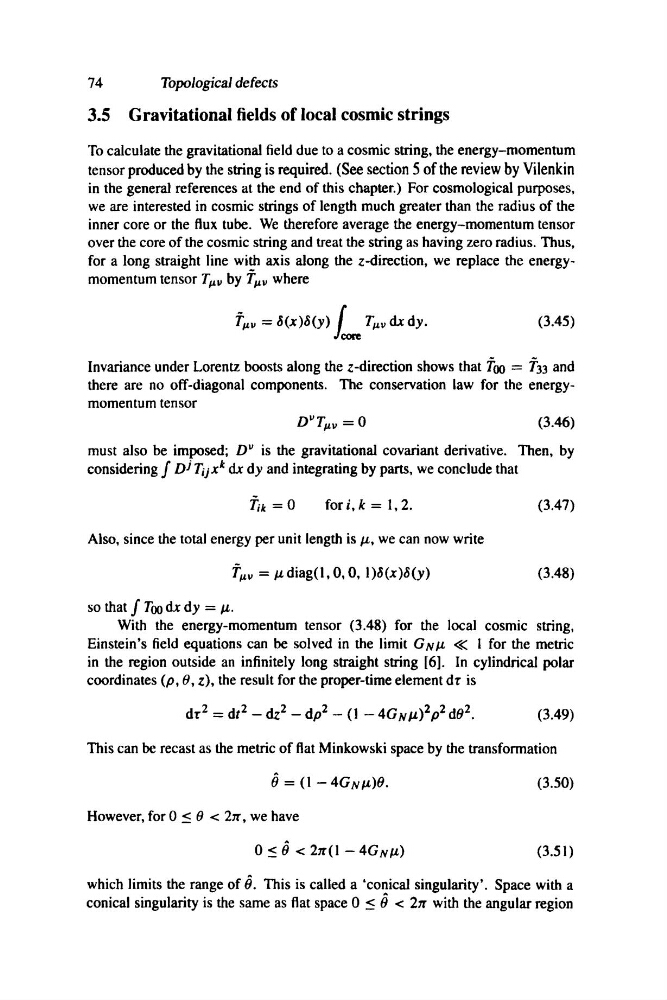
To calculate the gravitational field due to a cosmic string, the energy-momentum
tensor produced by the string is required. (See section 5 of the review by Vilenkin
in the general references at the end of this chapter.) For cosmological purposes,
we are interested in cosmic strings of length much greater than the radius of the
inner core or the flux tube. We therefore average the energy-momentum tensor
over the core of the cosmic string and treat the string as having zero radius. Thus,
for a long straight line with axis along the z-direction, we replace the energymomentum tensor T",IJ by T"'IJ where
T"'IJ = c5(x)8(y) fcore T",IJ dx dy.
(3.45)
Invariance under Lorentz boosts along the z-direction shows that Too = T33 and
there are no off-diagonal components. The conservation law for the energymomentum tensor
DIJT",IJ = 0
(3.46)
must also be imposed; D IJ is the gravitational covariant derivative. Then, by
considering f Dj T;j xk dx d y and integrating by parts, we conclude that
tk =0 fori,k = 1,2.
(3.47)
Also, since the total energy per unit length is JL, we can now write
T"'IJ = JLdiag(l,O,O,I)cHx)8(y)
(3.48)
so that f Too dx dy = JL.
With the energy-momentum tensor (3.48) for the local cosmic string,
Einstein's field equations can be solved in the limit GNJL « I for the metric
in the region outside an infinitely long straight string [6]. In cylindrical polar
coordinates (p, (J, z), the result for the proper-time element d'l' is
dT2 = dt 2 - dz2 - dp2 - (I - 4GNJL)2p2 d(J2.
(3.49)
This can be recast as the metric of flat Minkowski space by the transformation
e = (I - 4GNJL)(}.
(3.50)
However, for 0 ~ (} < 211', we have
o ~ e < 211'(1 - 4GNJL)
(3.51 )
which limits the range of e. This is called a 'conical singularity'. Space with a
conical singUlarity is the same as flat space 0 ~ {) < 211' with the angular region
Topological defects
3.5 Gravitational fields of local cosmic strings
To calculate the gravitational field due to a cosmic string, the energy-momentum
tensor produced by the string is required. (See section 5 of the review by Vilenkin
in the general references at the end of this chapter.) For cosmological purposes,
we are interested in cosmic strings of length much greater than the radius of the
inner core or the flux tube. We therefore average the energy-momentum tensor
over the core of the cosmic string and treat the string as having zero radius. Thus,
for a long straight line with axis along the z-direction, we replace the energymomentum tensor T",IJ by T"'IJ where
T"'IJ = c5(x)8(y) fcore T",IJ dx dy.
(3.45)
Invariance under Lorentz boosts along the z-direction shows that Too = T33 and
there are no off-diagonal components. The conservation law for the energymomentum tensor
DIJT",IJ = 0
(3.46)
must also be imposed; D IJ is the gravitational covariant derivative. Then, by
considering f Dj T;j xk dx d y and integrating by parts, we conclude that
tk =0 fori,k = 1,2.
(3.47)
Also, since the total energy per unit length is JL, we can now write
T"'IJ = JLdiag(l,O,O,I)cHx)8(y)
(3.48)
so that f Too dx dy = JL.
With the energy-momentum tensor (3.48) for the local cosmic string,
Einstein's field equations can be solved in the limit GNJL « I for the metric
in the region outside an infinitely long straight string [6]. In cylindrical polar
coordinates (p, (J, z), the result for the proper-time element d'l' is
dT2 = dt 2 - dz2 - dp2 - (I - 4GNJL)2p2 d(J2.
(3.49)
This can be recast as the metric of flat Minkowski space by the transformation
e = (I - 4GNJL)(}.
(3.50)
However, for 0 ~ (} < 211', we have
o ~ e < 211'(1 - 4GNJL)
(3.51 )
which limits the range of e. This is called a 'conical singularity'. Space with a
conical singUlarity is the same as flat space 0 ~ {) < 211' with the angular region