

70
Topological defects
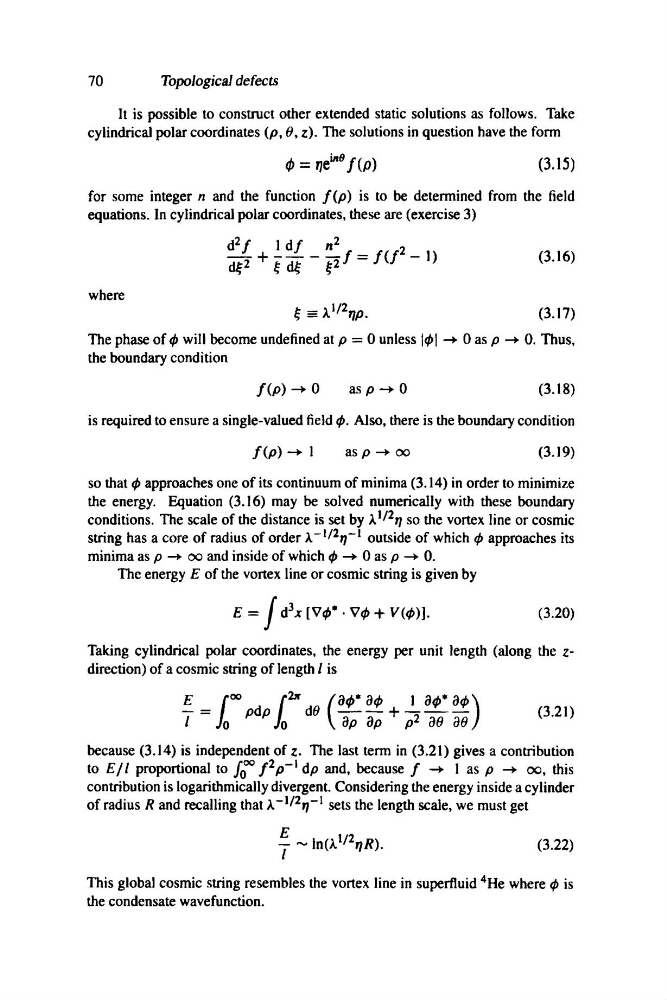
It is possible to construct other extended static solutions as follows. Take
cylindrical polar coordinates (p, 0, z). The solutions in question have the form
f/) = 1je Ut8 f(p)
(3.15)
for some integer n and the function I (P) is to be determined from the field
equations. In cylindrical polar coordinates. these are (exercise 3)
d 2 I I dl n 2
(3.16)
~2 + ~ d~ - ~2 I = 1(/ 2 - 1)
where
~ == l,1/2'1P.
(3.17)
The phase of t/J will become undefined at p = 0 unless It/JI ~ 0 as p ~ O. Thus,
the boundary condition
I(p) ~ 0
asp~ 0
(3.18)
is required to ensure a single-valued field t/J. Also, there is the boundary condition
I(p) ~ 1
asp ~ 00
(3.19)
so that t/J approaches one of its continuum of minima (3.14) in order to minimize
the energy. Equation (3.16) may be solved numerically with these boundary
conditions. The scale of the distance is set by l, 1/2'1 so the vortex line or cosmic
string has a core of radius of order l. -1/2'1- 1 outside of which t/J approaches its
minima as p ~ 00 and inside of which t/J ~ 0 as p ~ O.
The energy E of the vortex line or cosmic string is given by
E = f d 3 x [Vt/J* . Vt/J + V(t/J)].
(3.20)
Taking cylindrical polar coordinates, the energy per unit length (along the zdirection) of a cosmic string of length I is
E
LOO LlK (at/J* at/J 1 at/J* at/J)
- =
pdp
dO - - + - - -
(3.21)
I
0
0
ap ap p2 ao ao
because (3.14) is independent of z. The last term in (3.21) gives a contribution
to Ell proportional to 10 00 12p-1 dp and, because I ~ I as p ~ 00, this
contribution is logarithmically divergent. Considering the energy inside a cylinder
of radius R and recalling that l, -1/2'1- 1 sets the length scale, we must get
E ...., In(l.1/2'1R).
(3.22)
I
This global cosmic string resembles the vortex line in superftuid 4He where t/J is
the condensate wavefunction.
Topological defects
It is possible to construct other extended static solutions as follows. Take
cylindrical polar coordinates (p, 0, z). The solutions in question have the form
f/) = 1je Ut8 f(p)
(3.15)
for some integer n and the function I (P) is to be determined from the field
equations. In cylindrical polar coordinates. these are (exercise 3)
d 2 I I dl n 2
(3.16)
~2 + ~ d~ - ~2 I = 1(/ 2 - 1)
where
~ == l,1/2'1P.
(3.17)
The phase of t/J will become undefined at p = 0 unless It/JI ~ 0 as p ~ O. Thus,
the boundary condition
I(p) ~ 0
asp~ 0
(3.18)
is required to ensure a single-valued field t/J. Also, there is the boundary condition
I(p) ~ 1
asp ~ 00
(3.19)
so that t/J approaches one of its continuum of minima (3.14) in order to minimize
the energy. Equation (3.16) may be solved numerically with these boundary
conditions. The scale of the distance is set by l, 1/2'1 so the vortex line or cosmic
string has a core of radius of order l. -1/2'1- 1 outside of which t/J approaches its
minima as p ~ 00 and inside of which t/J ~ 0 as p ~ O.
The energy E of the vortex line or cosmic string is given by
E = f d 3 x [Vt/J* . Vt/J + V(t/J)].
(3.20)
Taking cylindrical polar coordinates, the energy per unit length (along the zdirection) of a cosmic string of length I is
E
LOO LlK (at/J* at/J 1 at/J* at/J)
- =
pdp
dO - - + - - -
(3.21)
I
0
0
ap ap p2 ao ao
because (3.14) is independent of z. The last term in (3.21) gives a contribution
to Ell proportional to 10 00 12p-1 dp and, because I ~ I as p ~ 00, this
contribution is logarithmically divergent. Considering the energy inside a cylinder
of radius R and recalling that l, -1/2'1- 1 sets the length scale, we must get
E ...., In(l.1/2'1R).
(3.22)
I
This global cosmic string resembles the vortex line in superftuid 4He where t/J is
the condensate wavefunction.