

Domain walls
67
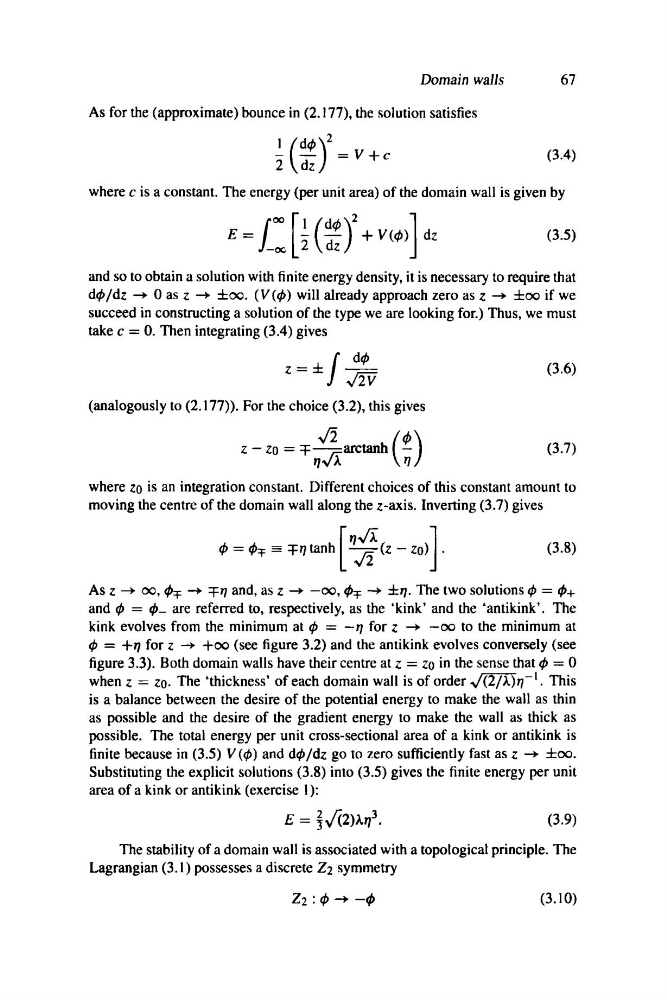
As for the (approximate) bounce in (2.177), the solution satisfies
~ (dq,)2 = V +c
(3.4)
2 dz
where c is a constant. The energy (per unit area) of the domain wall is given by
(3.5)
E= L:[H:Y +V(~)] d,
and so to obtain a solution with finite energy density, it is necessary to require that
dq,/dz ..... 0 as z ..... ±oo. (V(q,) will already approach zero as z ..... ±oo if we
succeed in constructing a solution of the type we are looking for.) Thus, we must
take c = O. Then integrating (3.4) gives
z=±f~
(3.6)
..tIV
(analogously to (2.177». For the choice (3.2), this gives
z - zo = =f ,J2 aretanh (tl)
(3.7)
"..fi.
"
where zo is an integration constant. Different choices of this constant amount to
moving the centre of the domain wall along the z-axis. Inverting (3.7) gives
rfJ = th == :fTl tanh [ "..fi. ..ti (z - zo) ] .
(3.8)
As z ..... 00, ~ ..... :PI and, as z ..... -00, ~ ..... ±". The two solutions q, = q,+
and q, = q,_ are referred to, respectively, as the 'kink' and the 'antikink'. The
kink evolves from the minimum at q, = -Tt for z ..... -00 to the minimum at
q, = +" for z ..... +00 (see figure 3.2) and the antikink evolves conversely (see
figure 3.3). Both domain walls have their centre at Z = zo in the sense that rfJ = 0
when z = zoo The 'thickness' of each domain wall is of order J(2/"A),,-I. This
is a balance between the desire of the potential energy to make the wall as thin
as possible and the desire of the gradient energy to make the wall as thick as
possible. The total energy per unit cross-sectional area of a kink or antikink is
finite because in (3.5) V(rfJ) and dq,/dz go to zero sufficiently fast as z ..... ±oo.
Substituting the explicit solutions (3.8) into (3.5) gives the finite energy per unit
area of a kink or anti kink (exercise I):
E = j 02)"A,,3 .
(3.9)
The stability of a domain wall is associated with a topological principle. The
Lagrangian (3.1) possesses a discrete Z2 symmetry
Z2 : q, ..... -q,
(3.10)
67
As for the (approximate) bounce in (2.177), the solution satisfies
~ (dq,)2 = V +c
(3.4)
2 dz
where c is a constant. The energy (per unit area) of the domain wall is given by
(3.5)
E= L:[H:Y +V(~)] d,
and so to obtain a solution with finite energy density, it is necessary to require that
dq,/dz ..... 0 as z ..... ±oo. (V(q,) will already approach zero as z ..... ±oo if we
succeed in constructing a solution of the type we are looking for.) Thus, we must
take c = O. Then integrating (3.4) gives
z=±f~
(3.6)
..tIV
(analogously to (2.177». For the choice (3.2), this gives
z - zo = =f ,J2 aretanh (tl)
(3.7)
"..fi.
"
where zo is an integration constant. Different choices of this constant amount to
moving the centre of the domain wall along the z-axis. Inverting (3.7) gives
rfJ = th == :fTl tanh [ "..fi. ..ti (z - zo) ] .
(3.8)
As z ..... 00, ~ ..... :PI and, as z ..... -00, ~ ..... ±". The two solutions q, = q,+
and q, = q,_ are referred to, respectively, as the 'kink' and the 'antikink'. The
kink evolves from the minimum at q, = -Tt for z ..... -00 to the minimum at
q, = +" for z ..... +00 (see figure 3.2) and the antikink evolves conversely (see
figure 3.3). Both domain walls have their centre at Z = zo in the sense that rfJ = 0
when z = zoo The 'thickness' of each domain wall is of order J(2/"A),,-I. This
is a balance between the desire of the potential energy to make the wall as thin
as possible and the desire of the gradient energy to make the wall as thick as
possible. The total energy per unit cross-sectional area of a kink or antikink is
finite because in (3.5) V(rfJ) and dq,/dz go to zero sufficiently fast as z ..... ±oo.
Substituting the explicit solutions (3.8) into (3.5) gives the finite energy per unit
area of a kink or anti kink (exercise I):
E = j 02)"A,,3 .
(3.9)
The stability of a domain wall is associated with a topological principle. The
Lagrangian (3.1) possesses a discrete Z2 symmetry
Z2 : q, ..... -q,
(3.10)