

62
Phase transitions in the early universe
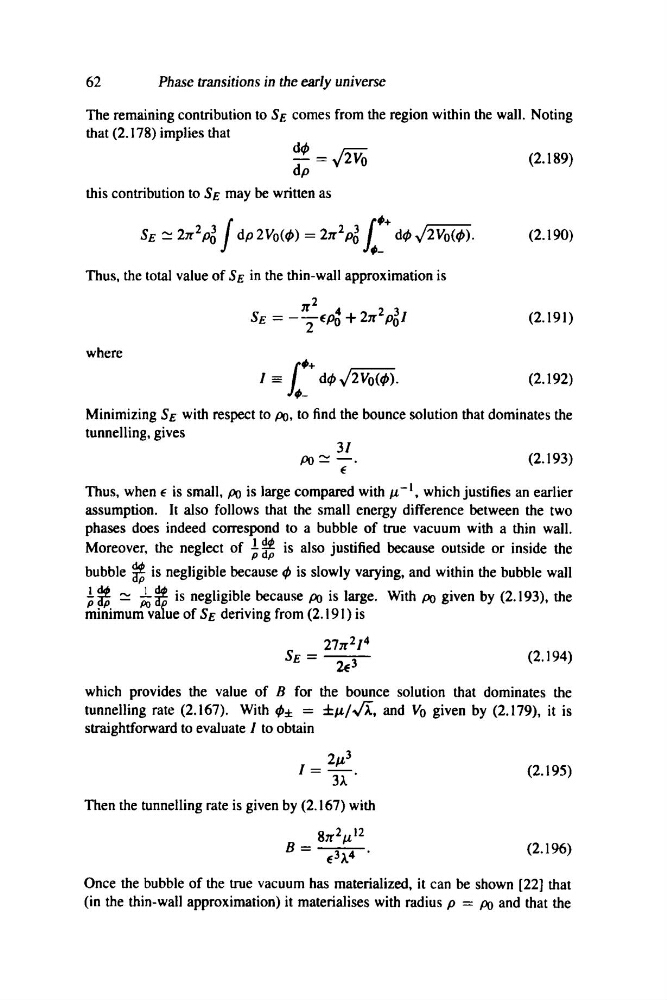
The remaining contribution to SE comes from the region within the wall. Noting
that (2.178) implies that
dcp
- dp =./2VO
(2.189)
this contribution to SE may be written as
SE ~ 21r2~ / dp 2Vo(cp) = 21r2~ L:+ dCPJ2Vo(t!». (2.190)
Thus, the total value of SE in the thin-wall approximation is
1r'2
SE = -T~~ + 21r'2p5 1
(2.191)
where
·+
1 ==
dCPJ2VO(CP).
(2.192)
1 .Minimizing SE with respect to Po, to find the bounce solution that dominates the
tunnelling, gives
31
Po ~ - .
(2.193)
~
Thus, when ~ is small, Po is large compared with J.L -I, which justifies an earlier
assumption. It also follows that the small energy difference between the two
phases does indeed correspond to a bubble of true vacuum with a thin wall.
Moreover, the neglect of ~ ~ is also justified because outside or inside the
bubble ~ is negligible because cP is slowly varying, and within the bubble wall
~ ~ ~ ~ ~ is negligible because Po is large. With Po given by (2.193), the
minimum value of SE deriving from (2.191) is
2711'2/4
SE = lE3
(2.194)
which provides the value of B for the bounce solution that dominates the
tunnelling rate (2.167). With CP± = ±p,/.Jr, and Vo given by (2.179), it is
straightforward to evaluate 1 to obtain
2p,3
1 = - .
(2.195)
3A.
Then the tunnelling rate is given by (2.167) with
81r'2 P, 12
B = 3 4 .
(2.196)
~ l;
Once the bubble of the true vacuum has materialized, it can be shown [22] that
(in the thin-wall approximation) it materialises with radius p = Po and that the
Phase transitions in the early universe
The remaining contribution to SE comes from the region within the wall. Noting
that (2.178) implies that
dcp
- dp =./2VO
(2.189)
this contribution to SE may be written as
SE ~ 21r2~ / dp 2Vo(cp) = 21r2~ L:+ dCPJ2Vo(t!». (2.190)
Thus, the total value of SE in the thin-wall approximation is
1r'2
SE = -T~~ + 21r'2p5 1
(2.191)
where
·+
1 ==
dCPJ2VO(CP).
(2.192)
1 .Minimizing SE with respect to Po, to find the bounce solution that dominates the
tunnelling, gives
31
Po ~ - .
(2.193)
~
Thus, when ~ is small, Po is large compared with J.L -I, which justifies an earlier
assumption. It also follows that the small energy difference between the two
phases does indeed correspond to a bubble of true vacuum with a thin wall.
Moreover, the neglect of ~ ~ is also justified because outside or inside the
bubble ~ is negligible because cP is slowly varying, and within the bubble wall
~ ~ ~ ~ ~ is negligible because Po is large. With Po given by (2.193), the
minimum value of SE deriving from (2.191) is
2711'2/4
SE = lE3
(2.194)
which provides the value of B for the bounce solution that dominates the
tunnelling rate (2.167). With CP± = ±p,/.Jr, and Vo given by (2.179), it is
straightforward to evaluate 1 to obtain
2p,3
1 = - .
(2.195)
3A.
Then the tunnelling rate is given by (2.167) with
81r'2 P, 12
B = 3 4 .
(2.196)
~ l;
Once the bubble of the true vacuum has materialized, it can be shown [22] that
(in the thin-wall approximation) it materialises with radius p = Po and that the