

Phase transitions in supergraviry theories
57
we have
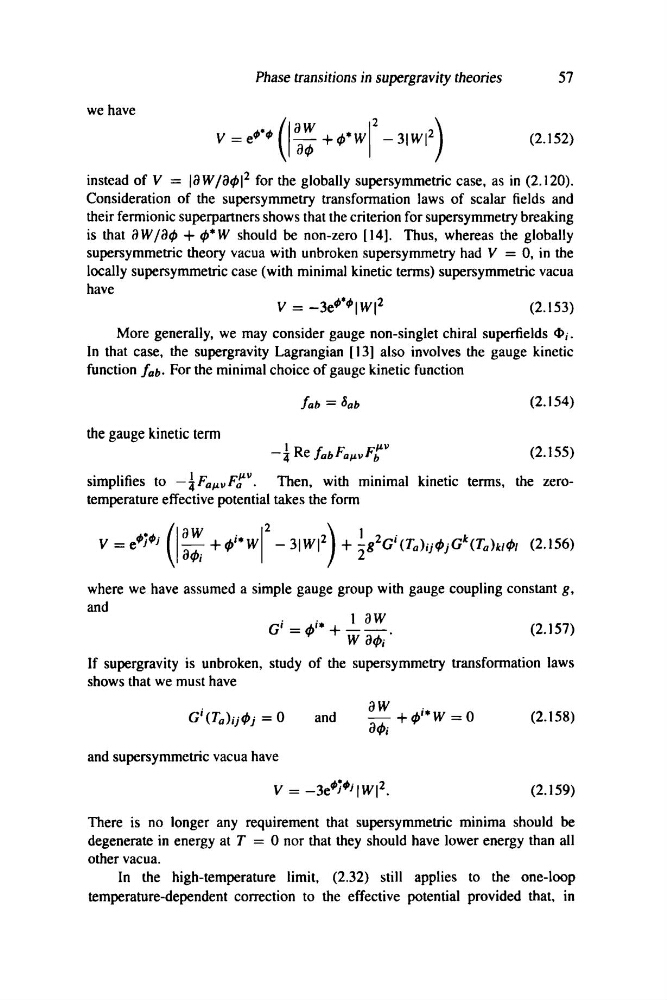
v=e~·~(I~;
2
+q,*wI -3IW I2 )
(2.152)
instead of V = law/aq,1 2 for the globally supersymmetric case, as in (2.120).
Consideration of the supersymmetry transformation laws of scalar fields and
their fermionic superpartners shows that the criterion for supersymmetry breaking
is that aw /aq, + q,*W should be non-zero [14]. Thus, whereas the globally
supersymmetric theory vacua with unbroken supersymmetry had V = 0, in the
locally supersymmetric case (with minimal kinetic terms) supersymmetric vacua
have
V = -3e~·~IWI2
(2.153)
More generally, we may consider gauge non-singlet chiral superfields 4>;.
In that case, the supergravity Lagrangian [13] also involves the gauge kinetic
function fab. For the minimal choice of gauge kinetic function
fab = 8ab
(2.154)
the gauge kinetic term
-1 Re fabFaJl.vF/:v
(2.155)
simplifies to - 1 FaJl.v Ft" . Then. with minimal kinetic terms, the zerotemperature effective potential takes the form
V = e~j~J (I :: 2
+q,i*wI - 31W12) + ~g2Gi(Ta)ijq,jGk(Ta)klq,1 (2.156)
where we have assumed a simple gauge group with gauge coupling constant g.
and
1 aw
G i = q,i* + W aq,i .
(2.157)
If supergravity is unbroken, study of the supersymmetry transformation laws
shows that we must have
aw
Gi(Ta);jq,j = 0
and
aq,i + q,;*W = 0
(2.158)
and supersymmetric vacua have
V = _3e lfl jlflj IWI2.
(2.159)
There is no longer any requirement that supersymmetric minima should be
degenerate in energy at T = 0 nor that they should have lower energy than all
other vacua.
In the high-temperature limit, (2.32) stilI applies to the one-loop
temperature-dependent correction to the effective potential provided that. in
57
we have
v=e~·~(I~;
2
+q,*wI -3IW I2 )
(2.152)
instead of V = law/aq,1 2 for the globally supersymmetric case, as in (2.120).
Consideration of the supersymmetry transformation laws of scalar fields and
their fermionic superpartners shows that the criterion for supersymmetry breaking
is that aw /aq, + q,*W should be non-zero [14]. Thus, whereas the globally
supersymmetric theory vacua with unbroken supersymmetry had V = 0, in the
locally supersymmetric case (with minimal kinetic terms) supersymmetric vacua
have
V = -3e~·~IWI2
(2.153)
More generally, we may consider gauge non-singlet chiral superfields 4>;.
In that case, the supergravity Lagrangian [13] also involves the gauge kinetic
function fab. For the minimal choice of gauge kinetic function
fab = 8ab
(2.154)
the gauge kinetic term
-1 Re fabFaJl.vF/:v
(2.155)
simplifies to - 1 FaJl.v Ft" . Then. with minimal kinetic terms, the zerotemperature effective potential takes the form
V = e~j~J (I :: 2
+q,i*wI - 31W12) + ~g2Gi(Ta)ijq,jGk(Ta)klq,1 (2.156)
where we have assumed a simple gauge group with gauge coupling constant g.
and
1 aw
G i = q,i* + W aq,i .
(2.157)
If supergravity is unbroken, study of the supersymmetry transformation laws
shows that we must have
aw
Gi(Ta);jq,j = 0
and
aq,i + q,;*W = 0
(2.158)
and supersymmetric vacua have
V = _3e lfl jlflj IWI2.
(2.159)
There is no longer any requirement that supersymmetric minima should be
degenerate in energy at T = 0 nor that they should have lower energy than all
other vacua.
In the high-temperature limit, (2.32) stilI applies to the one-loop
temperature-dependent correction to the effective potential provided that. in