

54
Phase transitions in the early universe
massless states. (The SU(S) coupling becomes strong at a higher temperature
than the SU(4) and SU(3) couplings.) Then one of the other two phases may
become the absolute minimum and, eventually, tunnelling may occur to one of
the other phases. In general, running coupling constants ga(J,L) and ga(M) at
energy scales #J- and M are related by
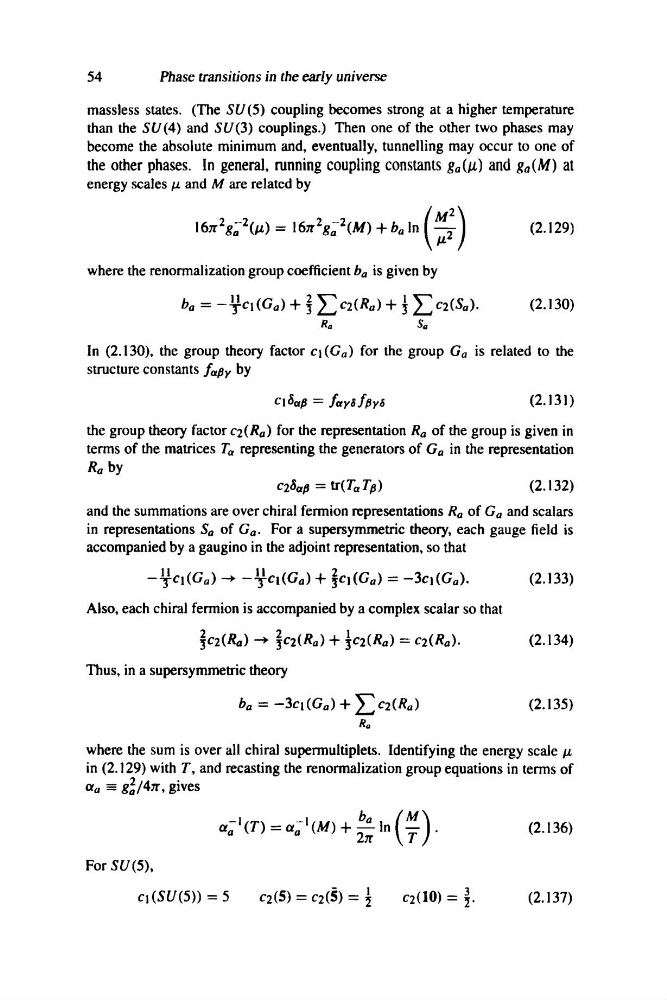
1611"2g;2(#J-) = I 611" 2g;2 (M) +ba In (::)
(2.129)
where the renormalization group coefficient ba is given by
ba = -¥ct(Go ) + j LC2(Ro ) + t L C2(So).
(2.130)
Ra
Sa
In (2.130), the group theory factor CI(Ga ) for the group Ga is related to the
structure constants fafJy by
cl8afJ = fay&f/Jy&
(2.131)
the group theory factor c2(Ra ) for the representation Ra of the group is given in
terms of the matrices Ta representing the generators of Ga in the representation
Ra by
C28afJ = tr(TaT/J)
(2.132)
and the summations are over chiral fermion representations Ra of G a and scalars
in representations Sa of Go. For a supersyrnmetric theory, each gauge field is
accompanied by a gaugino in the adjoint representation, so that
-¥ct(Ga) -+ -¥Cl(Ga) + ict(Ga) = -3q(Ga).
(2.133)
Also, each chiral fermion is accompanied by a complex scalar so that
jC2(Ra ) -+ jC2(Ra) + lC2(Ra ) = c2(Ra ).
(2.134)
Thus, in a supersymmetric theory
ba = -3CI(Ga) + L C2(Ra)
(2.135)
Ra
where the sum is over all chiral supermultiplets. Identifying the energy scale #Jin (2.129) with T, and recasting the renormalization group equations in terms of
- 2/4
.
aa = ga 11" , gives
-I
-I
ha (M)
aa (T) = aa (M) + - In - .
(2.136)
211"
T
For SUeS),
-
1
Cl (SU(s» = 5 C2(S) = C2(S) = ~ c2(IO) = ~.
(2.137)
Phase transitions in the early universe
massless states. (The SU(S) coupling becomes strong at a higher temperature
than the SU(4) and SU(3) couplings.) Then one of the other two phases may
become the absolute minimum and, eventually, tunnelling may occur to one of
the other phases. In general, running coupling constants ga(J,L) and ga(M) at
energy scales #J- and M are related by
1611"2g;2(#J-) = I 611" 2g;2 (M) +ba In (::)
(2.129)
where the renormalization group coefficient ba is given by
ba = -¥ct(Go ) + j LC2(Ro ) + t L C2(So).
(2.130)
Ra
Sa
In (2.130), the group theory factor CI(Ga ) for the group Ga is related to the
structure constants fafJy by
cl8afJ = fay&f/Jy&
(2.131)
the group theory factor c2(Ra ) for the representation Ra of the group is given in
terms of the matrices Ta representing the generators of Ga in the representation
Ra by
C28afJ = tr(TaT/J)
(2.132)
and the summations are over chiral fermion representations Ra of G a and scalars
in representations Sa of Go. For a supersyrnmetric theory, each gauge field is
accompanied by a gaugino in the adjoint representation, so that
-¥ct(Ga) -+ -¥Cl(Ga) + ict(Ga) = -3q(Ga).
(2.133)
Also, each chiral fermion is accompanied by a complex scalar so that
jC2(Ra ) -+ jC2(Ra) + lC2(Ra ) = c2(Ra ).
(2.134)
Thus, in a supersymmetric theory
ba = -3CI(Ga) + L C2(Ra)
(2.135)
Ra
where the sum is over all chiral supermultiplets. Identifying the energy scale #Jin (2.129) with T, and recasting the renormalization group equations in terms of
- 2/4
.
aa = ga 11" , gives
-I
-I
ha (M)
aa (T) = aa (M) + - In - .
(2.136)
211"
T
For SUeS),
-
1
Cl (SU(s» = 5 C2(S) = C2(S) = ~ c2(IO) = ~.
(2.137)