

S2
Phase transitions in the early universe
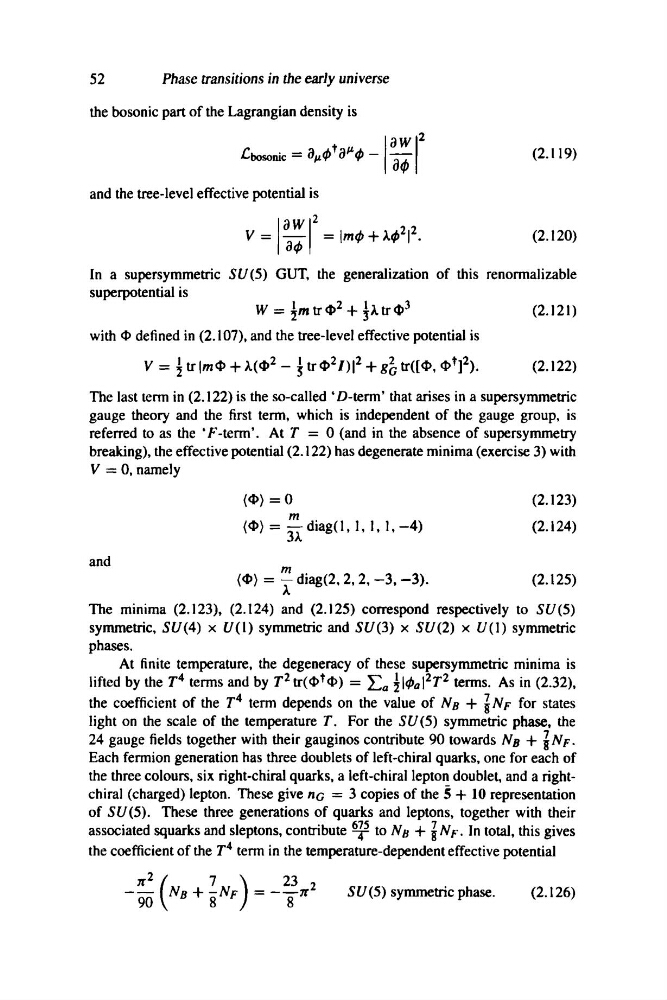
the bosonic part of the Lagrangian density is
=
l ai aw/ 2
.cbosonic
al'tPtal'tP -
(2.119)
and the tree-level effective potential is
- _l ""ii4> aw
v
l
2
= ImtP + )..tP 2 12.
(2.120)
In a supersymmetric SU(S) GUT, the generalization of this renormalizable
superpotential is
w = !m tr Cl>2 + l).. tr Cl>3
(2.121)
with Cl> defined in (2.107), and the tree-level effective potential is
V = !tr lmCl>+)..(CI>2 - !trCl>21)12+g~tr([CI>, Cl>t]2).
(2.122)
The last term in (2.122) is the so-called • D-term' that arises in a supersymmetric
gauge theory and the first term, which is independent of the gauge group, is
referred to as the • F -term'. At T = 0 (and in the absence of supersymmetry
breaking), the effective potential (2.122) has degenerate minima (exercise 3) with
V = 0, namely
(Cl» = 0
(2.123)
m .
(Cl» =
4
3).. dlag(l. I, I, I, - )
(2.124)
and
(Cl» = ~ diag(2, 2, 2, -3, -3).
(2.12S)
The minima (2.123), (2.124) and (2.12S) correspond respectively to SU(5)
symmetric, SU(4) x U(l) symmetric and SU(3) x SU(2) x U(I) symmetric
phases.
At finite temperature, the degeneracy of these supersymmetric minima is
lifted by the T4 terms and by T2tr(CI>tCl» = La !ltPal2T2 terms. As in (2.32),
the coefficient of the T4 term depends on the value of NB + iN F for states
light on the scale of the temperature T. For the SU(S) symmetric phase, the
24 gauge fields together with their gauginos contribute 90 towards NB + iN F.
Each fermion generation has three doublets of left-chiral quarks, one for each of
the three colours, six right-chiral quarks, a left-chirallepton doublet, and a rightchiral (charged) lepton. These give nG = 3 copies of the 5 + 10 representation
of SU(S). These three generations of quarks and leptons, together with their
associated squarks and sleptons, contribute ~ to NB + iN F. In total, this gives
the coefficient of the T4 term in the temperature-dependent effective potential
]1"2 (
7 )
23 2
- 90 NB + gNF = -8]1"
SU(5) symmetric phase.
(2.126)
Phase transitions in the early universe
the bosonic part of the Lagrangian density is
=
l ai aw/ 2
.cbosonic
al'tPtal'tP -
(2.119)
and the tree-level effective potential is
- _l ""ii4> aw
v
l
2
= ImtP + )..tP 2 12.
(2.120)
In a supersymmetric SU(S) GUT, the generalization of this renormalizable
superpotential is
w = !m tr Cl>2 + l).. tr Cl>3
(2.121)
with Cl> defined in (2.107), and the tree-level effective potential is
V = !tr lmCl>+)..(CI>2 - !trCl>21)12+g~tr([CI>, Cl>t]2).
(2.122)
The last term in (2.122) is the so-called • D-term' that arises in a supersymmetric
gauge theory and the first term, which is independent of the gauge group, is
referred to as the • F -term'. At T = 0 (and in the absence of supersymmetry
breaking), the effective potential (2.122) has degenerate minima (exercise 3) with
V = 0, namely
(Cl» = 0
(2.123)
m .
(Cl» =
4
3).. dlag(l. I, I, I, - )
(2.124)
and
(Cl» = ~ diag(2, 2, 2, -3, -3).
(2.12S)
The minima (2.123), (2.124) and (2.12S) correspond respectively to SU(5)
symmetric, SU(4) x U(l) symmetric and SU(3) x SU(2) x U(I) symmetric
phases.
At finite temperature, the degeneracy of these supersymmetric minima is
lifted by the T4 terms and by T2tr(CI>tCl» = La !ltPal2T2 terms. As in (2.32),
the coefficient of the T4 term depends on the value of NB + iN F for states
light on the scale of the temperature T. For the SU(S) symmetric phase, the
24 gauge fields together with their gauginos contribute 90 towards NB + iN F.
Each fermion generation has three doublets of left-chiral quarks, one for each of
the three colours, six right-chiral quarks, a left-chirallepton doublet, and a rightchiral (charged) lepton. These give nG = 3 copies of the 5 + 10 representation
of SU(S). These three generations of quarks and leptons, together with their
associated squarks and sleptons, contribute ~ to NB + iN F. In total, this gives
the coefficient of the T4 term in the temperature-dependent effective potential
]1"2 (
7 )
23 2
- 90 NB + gNF = -8]1"
SU(5) symmetric phase.
(2.126)