

Partition functions
3 I
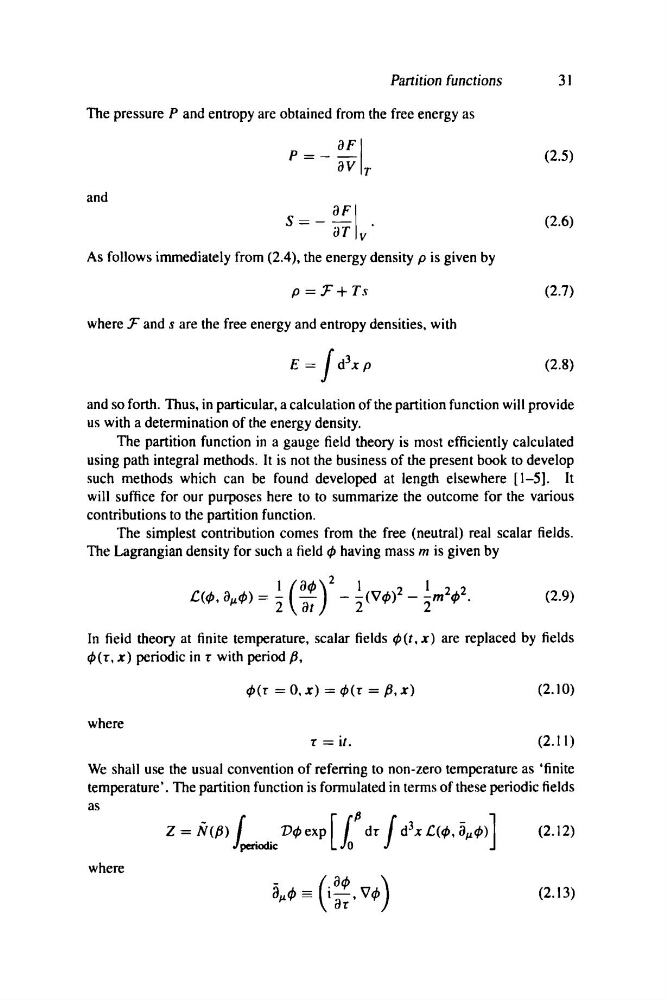
The pressure P and entropy are obtained from the free energy as
p
aFI
= - av
(2.5)
T
and
s = _ aFI .
(2.6)
aT v
As follows immediately from (2.4), the energy density p is given by
p =:F+ Ts
(2.7)
where :F and s are the free energy and entropy densities, with
E = d 3 xp
(2.8)
and so forth. Thus, in particular, a calculation of the partition function will provide
us with a determination of the energy density.
The partition function in a gauge field theory is most efficiently calculated
using path integral methods. It is not the business of the present book to develop
such methods which can be found developed at length elsewhere [1-5]. It
will suffice for our purposes here to to summarize the outcome for the various
contributions to the partition function.
The simplest contribution comes from the free (neutral) real scalar fields.
The Lagrangian density for such a field 41 having mass m is given by
2
I aq,
a
(
)
I
£(41 41)
2
I 2
41
2
= - -
- -(Vq,) - -m
.
(2.9)
'p.
2 at
2
2
In field theory at finite temperature, scalar fields 41 (t, x) are replaced by fields
q,(r:. x) periodic in r: with period p,
q,(r: = D. x) = q,(r: = P. x)
(2.10)
where
r: = it.
(2.11)
We shall use the usual convention of referring to non-zero temperature as 'finite
temperature'. The partition function is formulated in terms of these periodic fields
as
Z = N(P) !periodic Vq,exp [foil dr: ! d 3 x £(41, Bp.q,)]
(2.12)
where
-
(. aq,
)
ap.q,= lar:'Vq,
(2.13)
!
3 I
The pressure P and entropy are obtained from the free energy as
p
aFI
= - av
(2.5)
T
and
s = _ aFI .
(2.6)
aT v
As follows immediately from (2.4), the energy density p is given by
p =:F+ Ts
(2.7)
where :F and s are the free energy and entropy densities, with
E = d 3 xp
(2.8)
and so forth. Thus, in particular, a calculation of the partition function will provide
us with a determination of the energy density.
The partition function in a gauge field theory is most efficiently calculated
using path integral methods. It is not the business of the present book to develop
such methods which can be found developed at length elsewhere [1-5]. It
will suffice for our purposes here to to summarize the outcome for the various
contributions to the partition function.
The simplest contribution comes from the free (neutral) real scalar fields.
The Lagrangian density for such a field 41 having mass m is given by
2
I aq,
a
(
)
I
£(41 41)
2
I 2
41
2
= - -
- -(Vq,) - -m
.
(2.9)
'p.
2 at
2
2
In field theory at finite temperature, scalar fields 41 (t, x) are replaced by fields
q,(r:. x) periodic in r: with period p,
q,(r: = D. x) = q,(r: = P. x)
(2.10)
where
r: = it.
(2.11)
We shall use the usual convention of referring to non-zero temperature as 'finite
temperature'. The partition function is formulated in terms of these periodic fields
as
Z = N(P) !periodic Vq,exp [foil dr: ! d 3 x £(41, Bp.q,)]
(2.12)
where
-
(. aq,
)
ap.q,= lar:'Vq,
(2.13)
!