

Black holes in string theory
299
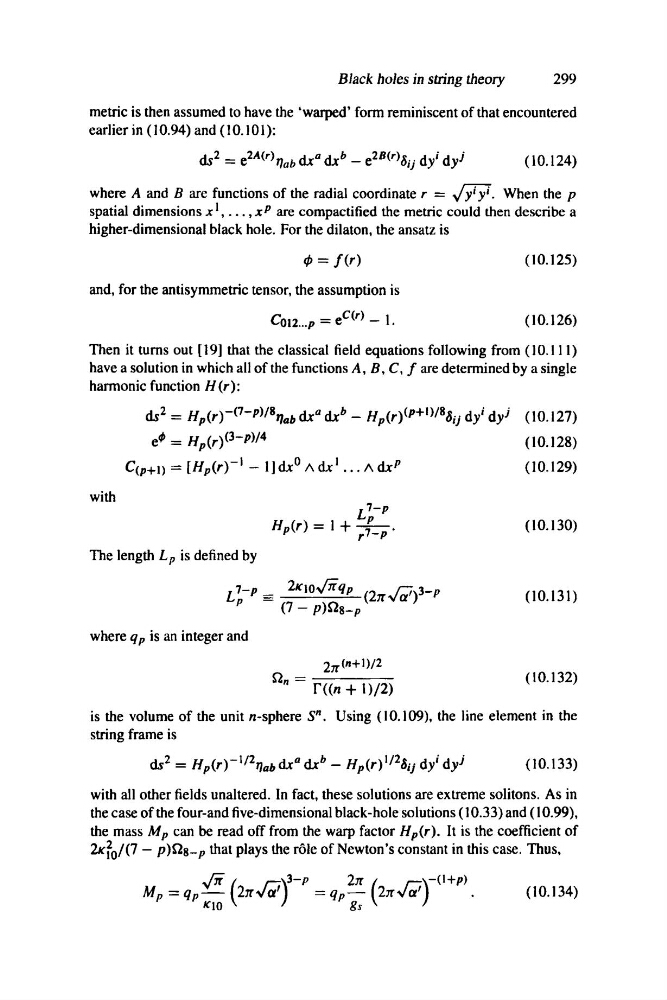
metric is then assumed to have the 'warped' form reminiscent of that encountered
earlier in (l 0.94) and (l 0.1 0 I ):
ds 2 = e 2A (r)"ab dx a dx b _ e2B(r)~ij dyi dyj
(10.124)
where A and B are functions of the radial coordinate r = J yi yi. When the p
spatial dimensions x I, ... ,xP are compactified the metric could then describe a
higher-dimensional black hole. For the dilaton, the ansatz is
t/J = f(r)
(10.125)
and, for the anti symmetric tensor, the assumption is
COI2 ... p = eC(r) - I.
(10.126)
Then it turns out [19] that the classical field equations following from (10.111)
have a solution in which all of the functions A, B, c. f are determined by a single
harmonic function H(r):
ds 2 = H p (r)-(7-P)/8"ab dx a dx b - H p (r)(P+1)/88;j dyi dyj (10.127)
e. = H p (r)(3- p )/4
(10.128)
C(p+1) = [Hp(r)-I - l]dx° "dx l ... " dx P
(10.129)
with
7-p
Lp
Hp(r) = 1+ r 7 -p'
(10.130)
The length Lp is defined by
L~-P == 2KIO../iiqp (21r#)3-p
(10.131)
(7 - p)n8-p
where q p is an integer and
21r(1I+1)/2
( 10.132)
nil = -n-(n-+-I}-/2)
is the volume of the unit n-sphere S". Using (10.109), the line element in the
string frame is
ds 2 = Hp(r)-1/2TJabdxQ dx b - Hp(r)I/28;j dyi dyj
(10.133)
with all other fields unaltered. In fact, these solutions are extreme solitons. As in
the case of the four-and five-dimensional black-hole solutions (10.33) and (10.99),
the mass Mp can be read off from the warp factor Hp(r). It is the coefficient of
2K~o/(7 - p)ns-p that plays the role of Newton's constant in this case. Thus,
J1i (
)3- P
21r (
)-(I+P)
Mp = qp- 21rN = qp- 21rN
.
(lO.134)
KIO
gs
299
metric is then assumed to have the 'warped' form reminiscent of that encountered
earlier in (l 0.94) and (l 0.1 0 I ):
ds 2 = e 2A (r)"ab dx a dx b _ e2B(r)~ij dyi dyj
(10.124)
where A and B are functions of the radial coordinate r = J yi yi. When the p
spatial dimensions x I, ... ,xP are compactified the metric could then describe a
higher-dimensional black hole. For the dilaton, the ansatz is
t/J = f(r)
(10.125)
and, for the anti symmetric tensor, the assumption is
COI2 ... p = eC(r) - I.
(10.126)
Then it turns out [19] that the classical field equations following from (10.111)
have a solution in which all of the functions A, B, c. f are determined by a single
harmonic function H(r):
ds 2 = H p (r)-(7-P)/8"ab dx a dx b - H p (r)(P+1)/88;j dyi dyj (10.127)
e. = H p (r)(3- p )/4
(10.128)
C(p+1) = [Hp(r)-I - l]dx° "dx l ... " dx P
(10.129)
with
7-p
Lp
Hp(r) = 1+ r 7 -p'
(10.130)
The length Lp is defined by
L~-P == 2KIO../iiqp (21r#)3-p
(10.131)
(7 - p)n8-p
where q p is an integer and
21r(1I+1)/2
( 10.132)
nil = -n-(n-+-I}-/2)
is the volume of the unit n-sphere S". Using (10.109), the line element in the
string frame is
ds 2 = Hp(r)-1/2TJabdxQ dx b - Hp(r)I/28;j dyi dyj
(10.133)
with all other fields unaltered. In fact, these solutions are extreme solitons. As in
the case of the four-and five-dimensional black-hole solutions (10.33) and (10.99),
the mass Mp can be read off from the warp factor Hp(r). It is the coefficient of
2K~o/(7 - p)ns-p that plays the role of Newton's constant in this case. Thus,
J1i (
)3- P
21r (
)-(I+P)
Mp = qp- 21rN = qp- 21rN
.
(lO.134)
KIO
gs