

288
Black holes in string theory
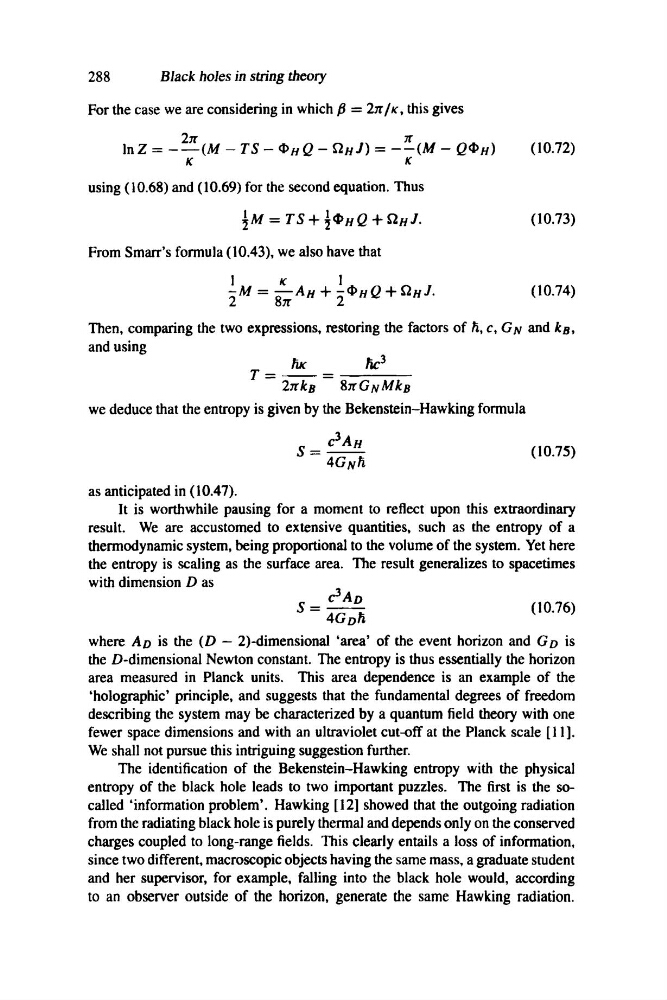
For the case we are considering in which {J = 211' I/(, this gives
211'
11'
InZ = --(M - TS - <'PHQ - OHJ) = --(M - Q<'PH)
(10.72)
K
K
using (10.68) and (10.69) for the second equation. Thus
!M = TS+ !
From Smarr's formula (10.43), we also have that
I
K
I
'2M = 811' AH + '2<1»HQ + OHJ.
(10.74)
Then, comparing the two expressions, restoring the factors of Ii, e, GN and k8,
and using
1ix
lie3
T = - - = - - -
211'k8
811'GNMkB
we deduce that the entropy is given by the Bekenstein-Hawking formula
c 3 AH
S = - -
(10.75)
4GNIi
as anticipated in (10.47).
It is worthwhile pausing for a moment to reflect upon this extraordinary
result. We are accustomed to extensive quantities, such as the entropy of a
thermodynamic system, being proportional to the volume of the system. Yet here
the entropy is scaling as the surface area. The result generalizes to spacetimes
with dimension D as
clAD
(10.76)
S = 4GDIi
where AD is the (D - 2)-dimensional 'area' of the event horizon and GD is
the D-dimensional Newton constant. The entropy is thus essentially the horizon
area measured in Planck units. This area dependence is an example of the
'holographic' principle, and suggests that the fundamental degrees of freedom
describing the system may be characterized by a quantum field theory with one
fewer space dimensions and with an ultraviolet cut-off at the Planck scale [11].
We shall not pursue this intriguing suggestion further.
The identification of the Bekenstein-Hawking entropy with the physical
entropy of the black hole leads to two important puzzles. The first is the socalled 'information problem'. Hawking [12] showed that the outgoing radiation
from the radiating black hole is purely thermal and depends only on the conserved
charges coupled to long-range fields. This clearly entails a loss of information,
since two different. macroscopic objects having the same mass, a graduate student
and her supervisor, for example, falling into the black hole would, according
to an observer outside of the horizon, generate the same Hawking radiation.
Black holes in string theory
For the case we are considering in which {J = 211' I/(, this gives
211'
11'
InZ = --(M - TS - <'PHQ - OHJ) = --(M - Q<'PH)
(10.72)
K
K
using (10.68) and (10.69) for the second equation. Thus
!M = TS+ !
From Smarr's formula (10.43), we also have that
I
K
I
'2M = 811' AH + '2<1»HQ + OHJ.
(10.74)
Then, comparing the two expressions, restoring the factors of Ii, e, GN and k8,
and using
1ix
lie3
T = - - = - - -
211'k8
811'GNMkB
we deduce that the entropy is given by the Bekenstein-Hawking formula
c 3 AH
S = - -
(10.75)
4GNIi
as anticipated in (10.47).
It is worthwhile pausing for a moment to reflect upon this extraordinary
result. We are accustomed to extensive quantities, such as the entropy of a
thermodynamic system, being proportional to the volume of the system. Yet here
the entropy is scaling as the surface area. The result generalizes to spacetimes
with dimension D as
clAD
(10.76)
S = 4GDIi
where AD is the (D - 2)-dimensional 'area' of the event horizon and GD is
the D-dimensional Newton constant. The entropy is thus essentially the horizon
area measured in Planck units. This area dependence is an example of the
'holographic' principle, and suggests that the fundamental degrees of freedom
describing the system may be characterized by a quantum field theory with one
fewer space dimensions and with an ultraviolet cut-off at the Planck scale [11].
We shall not pursue this intriguing suggestion further.
The identification of the Bekenstein-Hawking entropy with the physical
entropy of the black hole leads to two important puzzles. The first is the socalled 'information problem'. Hawking [12] showed that the outgoing radiation
from the radiating black hole is purely thermal and depends only on the conserved
charges coupled to long-range fields. This clearly entails a loss of information,
since two different. macroscopic objects having the same mass, a graduate student
and her supervisor, for example, falling into the black hole would, according
to an observer outside of the horizon, generate the same Hawking radiation.