

286
Black holes in string theory
4M arg(y + in is an angular coordinate with period fJ == 8:11' M. The functional
integral defining the generating function should. therefore. be over matter fields
and metrics with this periodicity in 1'. But this is just the
=
partition
=
function Z for
a canonical ensemble of the fields at temperature T {j-I
(811' M)-I. The
surface gravity K for the Schwarzchild black hole is K = (4M)-I, so that the
temperature is T = K/21I' in accordance with (10.46). (For the generalization
of this result to the Reissner-Nordstrom black hole, see exercise 7.) With this
established. it is clear that the black hole must have the entropy given by (10.47).
Nevertheless, it is an interesting excercise to verify this directly by evaluating the
action.
In order to obtain a finite result, it is necessary not only to compute the
(Euclidean) action by integrating over the previous imaginary time coordinate l'
but also over a finite region of space. In general. for a finite region M of 0dimensional spacetime, the Einstein-Hilbert action must be supplemented by a
contribution evaluated on the boundary aM which allows variations of the metric
that vanish on aM but which might have non-vanishing derivatives normal to it.
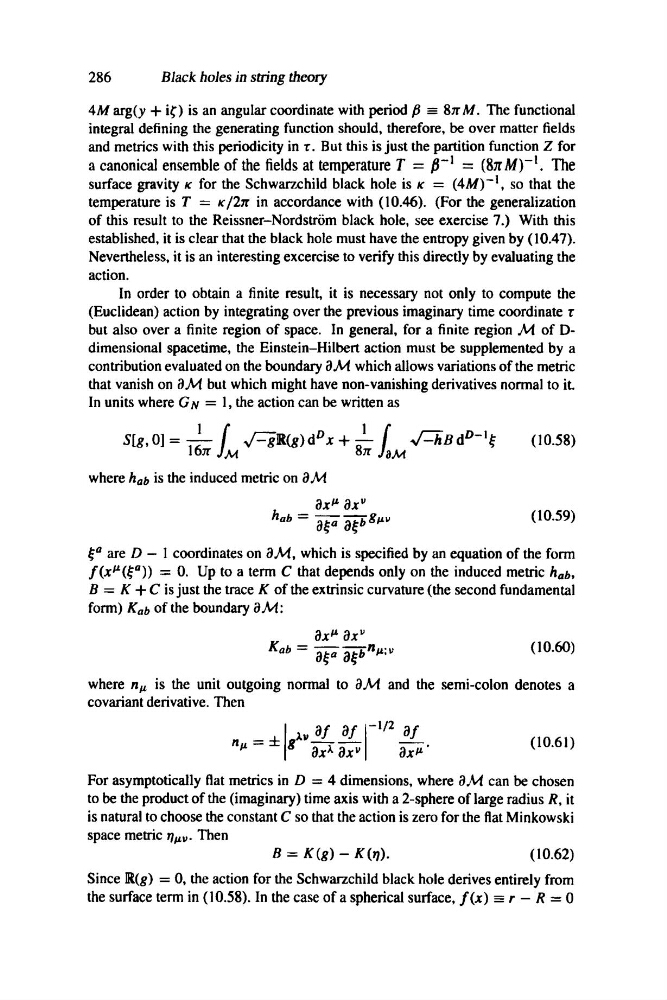
In units where G N = I, the action can be written as
S[g, 0] = I~:II' fM .J=gR(g)dDx + 8~ laM HBdD-l~ (10.58)
where hab is the induced metric on aM
ax" axil
h b - - - g
a - a~a a~b "I}
(10.59)
~a are D - 1 coordinates on aM, which is specified by an equation of the fonn
I(x,,(~a» = O. Up to a term C that depends only on the induced metric hab,
B = K + C is just the trace K of the extrinsic curvature (the second fundamental
form) Kab of the boundary aM:
ax" axil
Kab = a~a a~b"";1I
(10.60)
where "" is the unit outgoing normal to aM and the semi-colon denotes a
covariantderivative. Then
"" = ± II'" a l ). . al 11 2
/ al
(10.61)
ax axl}
ax'"
For asymptotically flat metrics in D = 4 dimensions, where aM can be chosen
to be the product of the (imaginary) time axis with a 2-sphere of large radius R, it
is natural to choose the constant C so that the action is zero for the flat Minkowski
space metric ",,1}' Then
B = K(g) - K(,,).
(10.62)
Since Ji(g) = 0, the action for the Schwarzchild black hole derives entirely from
the surface tenn in (10.58). In the case of a spherical surface, I (x) == r - R = 0
Black holes in string theory
4M arg(y + in is an angular coordinate with period fJ == 8:11' M. The functional
integral defining the generating function should. therefore. be over matter fields
and metrics with this periodicity in 1'. But this is just the
=
partition
=
function Z for
a canonical ensemble of the fields at temperature T {j-I
(811' M)-I. The
surface gravity K for the Schwarzchild black hole is K = (4M)-I, so that the
temperature is T = K/21I' in accordance with (10.46). (For the generalization
of this result to the Reissner-Nordstrom black hole, see exercise 7.) With this
established. it is clear that the black hole must have the entropy given by (10.47).
Nevertheless, it is an interesting excercise to verify this directly by evaluating the
action.
In order to obtain a finite result, it is necessary not only to compute the
(Euclidean) action by integrating over the previous imaginary time coordinate l'
but also over a finite region of space. In general. for a finite region M of 0dimensional spacetime, the Einstein-Hilbert action must be supplemented by a
contribution evaluated on the boundary aM which allows variations of the metric
that vanish on aM but which might have non-vanishing derivatives normal to it.
In units where G N = I, the action can be written as
S[g, 0] = I~:II' fM .J=gR(g)dDx + 8~ laM HBdD-l~ (10.58)
where hab is the induced metric on aM
ax" axil
h b - - - g
a - a~a a~b "I}
(10.59)
~a are D - 1 coordinates on aM, which is specified by an equation of the fonn
I(x,,(~a» = O. Up to a term C that depends only on the induced metric hab,
B = K + C is just the trace K of the extrinsic curvature (the second fundamental
form) Kab of the boundary aM:
ax" axil
Kab = a~a a~b"";1I
(10.60)
where "" is the unit outgoing normal to aM and the semi-colon denotes a
covariantderivative. Then
"" = ± II'" a l ). . al 11 2
/ al
(10.61)
ax axl}
ax'"
For asymptotically flat metrics in D = 4 dimensions, where aM can be chosen
to be the product of the (imaginary) time axis with a 2-sphere of large radius R, it
is natural to choose the constant C so that the action is zero for the flat Minkowski
space metric ",,1}' Then
B = K(g) - K(,,).
(10.62)
Since Ji(g) = 0, the action for the Schwarzchild black hole derives entirely from
the surface tenn in (10.58). In the case of a spherical surface, I (x) == r - R = 0