

268
Superstring cosmology
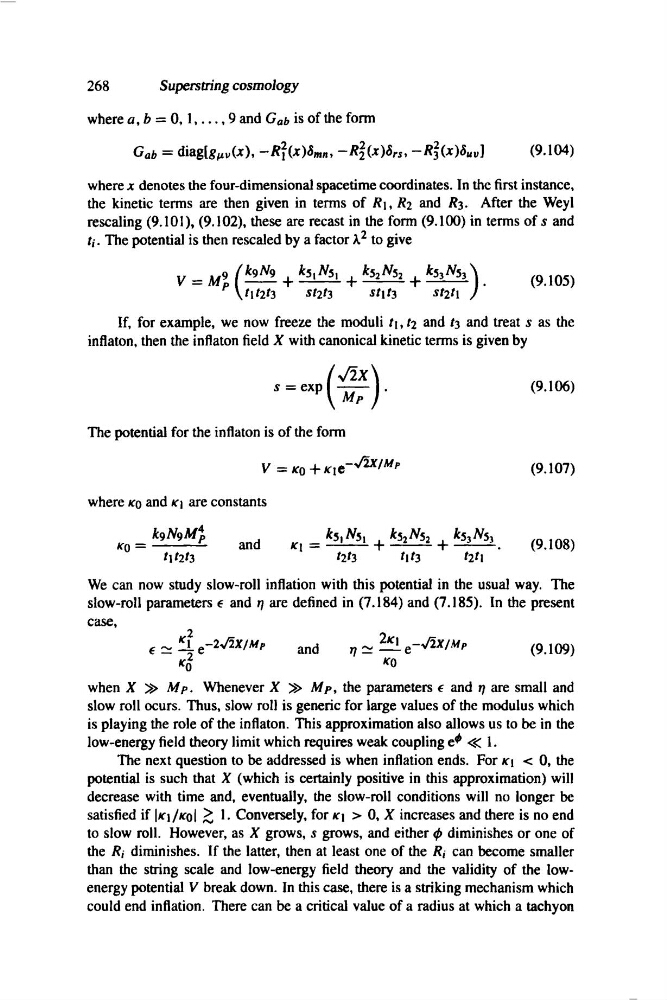
where a, b = 0, 1, .•. ,9 and Gab is of the fonn
Gab = diag[gl'lI(X), -R?(x)8mll , -R~(x)8r.s, -Rj(x)811I1 ]
(9.104)
where x denotes the four-dimensional spacetime coordinates. In the first instance.
the kinetic terms are then given in terms of RI, R2 and R3. After the Weyl
rescaling (9.101), (9.102), these are recast in the form (9.100) in terms of sand
Ij. The potential is then re scaled by a factor A 2 to give
M 9 (k9N9
ks\Ns\
kS2 N S2
kS3NS3)
V =
- - + - - + - - + - - .
(9.105)
P tl t213
st2t3
Stl t3
st2tl
If, for example, we now freeze the moduli tl, 12 and 13 and treat s as the
inflaton, then the inflaton field X with canonical kinetic terms is given by
(9.106)
s =ex p ( ~:).
The potential for the inflaton is of the fonn
V = KO + Kle-..r2X/Mp
(9.107)
where KO and KI are constants
k9N9M~
ks\Ns\
kS2 NS2
kS3Ns3
and
K I = - - + - - + - - .
(9.108)
KO = tlt213
1213
I1 t3
t2tl
We can now study slow-roll inflation with this potential in the usual way. The
slow-roll parameters € and" are defined in (7.184) and (7.185). In the present
case,
K2
'"
ZKI
'"
€ ~ -1. e-2..,2X/Mp
and
" ~ _ e-..,2X/Mp
(9.109)
KJ
KO
when X » Mp. Whenever X » Mp, the parameters € and " are small and
slow roll ocurs. Thus. slow roll is generic for large values of the modulus which
is playing the role of the inflaton. This approximation also allows us to be in the
low-energy field theory limit which requires weak coupling e. « 1.
The next question to be addressed is when inflation ends. For KI < 0, the
potential is such that X (which is certainly positive in this approximation) will
decrease with time and. eventually, the slow-roll conditions will no longer be
satisfied if IKI/KOI ~ 1. Conversely, for KI > 0, X increases and there is no end
to slow roll. However, as X grows, s grows, and either tP diminishes or one of
the Ri diminishes. If the latter, then at least one of the Ri can become smaller
than the string scale and low-energy field theory and the validity of the lowenergy potential V break down. In this case, there is a striking mechanism which
could end inflation. There can be a critical value of a radius at which a tachyon
Superstring cosmology
where a, b = 0, 1, .•. ,9 and Gab is of the fonn
Gab = diag[gl'lI(X), -R?(x)8mll , -R~(x)8r.s, -Rj(x)811I1 ]
(9.104)
where x denotes the four-dimensional spacetime coordinates. In the first instance.
the kinetic terms are then given in terms of RI, R2 and R3. After the Weyl
rescaling (9.101), (9.102), these are recast in the form (9.100) in terms of sand
Ij. The potential is then re scaled by a factor A 2 to give
M 9 (k9N9
ks\Ns\
kS2 N S2
kS3NS3)
V =
- - + - - + - - + - - .
(9.105)
P tl t213
st2t3
Stl t3
st2tl
If, for example, we now freeze the moduli tl, 12 and 13 and treat s as the
inflaton, then the inflaton field X with canonical kinetic terms is given by
(9.106)
s =ex p ( ~:).
The potential for the inflaton is of the fonn
V = KO + Kle-..r2X/Mp
(9.107)
where KO and KI are constants
k9N9M~
ks\Ns\
kS2 NS2
kS3Ns3
and
K I = - - + - - + - - .
(9.108)
KO = tlt213
1213
I1 t3
t2tl
We can now study slow-roll inflation with this potential in the usual way. The
slow-roll parameters € and" are defined in (7.184) and (7.185). In the present
case,
K2
'"
ZKI
'"
€ ~ -1. e-2..,2X/Mp
and
" ~ _ e-..,2X/Mp
(9.109)
KJ
KO
when X » Mp. Whenever X » Mp, the parameters € and " are small and
slow roll ocurs. Thus. slow roll is generic for large values of the modulus which
is playing the role of the inflaton. This approximation also allows us to be in the
low-energy field theory limit which requires weak coupling e. « 1.
The next question to be addressed is when inflation ends. For KI < 0, the
potential is such that X (which is certainly positive in this approximation) will
decrease with time and. eventually, the slow-roll conditions will no longer be
satisfied if IKI/KOI ~ 1. Conversely, for KI > 0, X increases and there is no end
to slow roll. However, as X grows, s grows, and either tP diminishes or one of
the Ri diminishes. If the latter, then at least one of the Ri can become smaller
than the string scale and low-energy field theory and the validity of the lowenergy potential V break down. In this case, there is a striking mechanism which
could end inflation. There can be a critical value of a radius at which a tachyon