

Ten-dimensional string cosmology
263
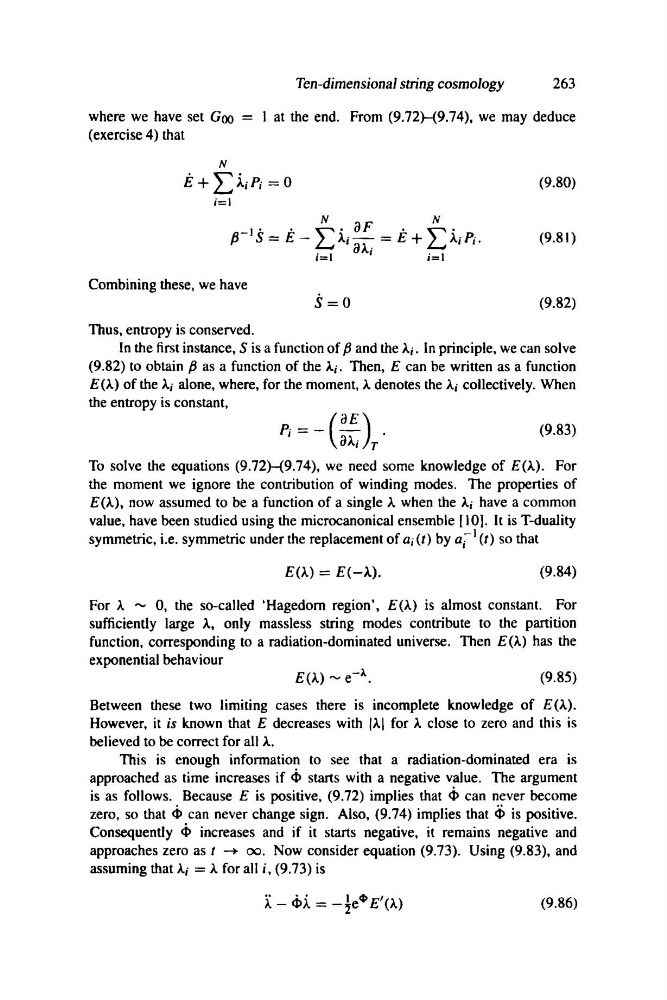
where we have set Goo = I at the end. From (9.72)-(9.74), we may deduce
(exercise 4) that
N
E+ Li;p; = 0
(9.80)
;=1
N
N
1 •
=
•
{r S E
aF . '" .
-
" ' .
LJAi- = E + LJAiP;.
(9.81 )
i=1
aAI
i=1
Combining these. we have
5=0
(9.82)
Thus, entropy is conserved.
In the first instance, S is a function of f3 and the Ai. In principle. we can solve
(9.82) to obtain f3 as a function of the Ai. Then, E can be written as a function
E(A) of the Ai alone. where, for the moment, A denotes the Ai collectively. When
the entropy is constant.
(9.83)
Pi = - (:~t.
To solve the equations (9.72)-(9.74), we need some knowledge of E(A). For
the moment we ignore the contribution of winding modes. The properties of
E(A), now assumed to be a function of a single A when the Ai have a common
value, have been studied using the microcanonical ensemble [10). It is T-duality
symmetric, i.e. symmetric under the replacement of aj (t) by a; 1 (t) so that
E()") = E( -l.).
(9.84)
For).. ,... 0, the so-called 'Hagedom region', E()") is almost constant. For
sufficiently large A, only massless string modes contribute to the partition
function, corresponding to a radiation-dominated universe. Then E()") has the
exponential behaviour
E()") ,... e- A •
(9.85)
Between these two limiting cases there is incomplete knowledge of E(l.).
However, it is known that E decreases with /)..\ for).. close to zero and this is
believed to be correct for alll..
This is enough information to see that a radiation-dominated era is
approached as time increases if 4> starts with a negative value. The argument
is as follows. Because E is positive, (9.72) implies that 4> can never become
zero, so that ci> can never change sign. Also, (9.74) implies that (i, is positive.
Consequently 4> increases and if it starts negative, it remains negative and
approaches zero as t -+ 00. Now consider equation (9.73). Using (9.83), and
assuming that)..i =).. for all i. (9.73) is
x - 4>i = _!e4» E'()..)
(9.86)
263
where we have set Goo = I at the end. From (9.72)-(9.74), we may deduce
(exercise 4) that
N
E+ Li;p; = 0
(9.80)
;=1
N
N
1 •
=
•
{r S E
aF . '" .
-
" ' .
LJAi- = E + LJAiP;.
(9.81 )
i=1
aAI
i=1
Combining these. we have
5=0
(9.82)
Thus, entropy is conserved.
In the first instance, S is a function of f3 and the Ai. In principle. we can solve
(9.82) to obtain f3 as a function of the Ai. Then, E can be written as a function
E(A) of the Ai alone. where, for the moment, A denotes the Ai collectively. When
the entropy is constant.
(9.83)
Pi = - (:~t.
To solve the equations (9.72)-(9.74), we need some knowledge of E(A). For
the moment we ignore the contribution of winding modes. The properties of
E(A), now assumed to be a function of a single A when the Ai have a common
value, have been studied using the microcanonical ensemble [10). It is T-duality
symmetric, i.e. symmetric under the replacement of aj (t) by a; 1 (t) so that
E()") = E( -l.).
(9.84)
For).. ,... 0, the so-called 'Hagedom region', E()") is almost constant. For
sufficiently large A, only massless string modes contribute to the partition
function, corresponding to a radiation-dominated universe. Then E()") has the
exponential behaviour
E()") ,... e- A •
(9.85)
Between these two limiting cases there is incomplete knowledge of E(l.).
However, it is known that E decreases with /)..\ for).. close to zero and this is
believed to be correct for alll..
This is enough information to see that a radiation-dominated era is
approached as time increases if 4> starts with a negative value. The argument
is as follows. Because E is positive, (9.72) implies that 4> can never become
zero, so that ci> can never change sign. Also, (9.74) implies that (i, is positive.
Consequently 4> increases and if it starts negative, it remains negative and
approaches zero as t -+ 00. Now consider equation (9.73). Using (9.83), and
assuming that)..i =).. for all i. (9.73) is
x - 4>i = _!e4» E'()..)
(9.86)