

Dilaton or moduli as possible intfatons
259
is positive and has the smaller value. Then, the parameter J.. in (9.45) is given by
J.. = 2.!1 a•
(9.57)
A more careful treatment [5) with the correct non-minimal kinetic terms for Re S
makes very little difference to (9.54), with 41 replaced by Re S.
This discussion is valid provided that Re S is able to attain the asymptotic
form of solution before passing through the minimum. Sufficient conditions [5)
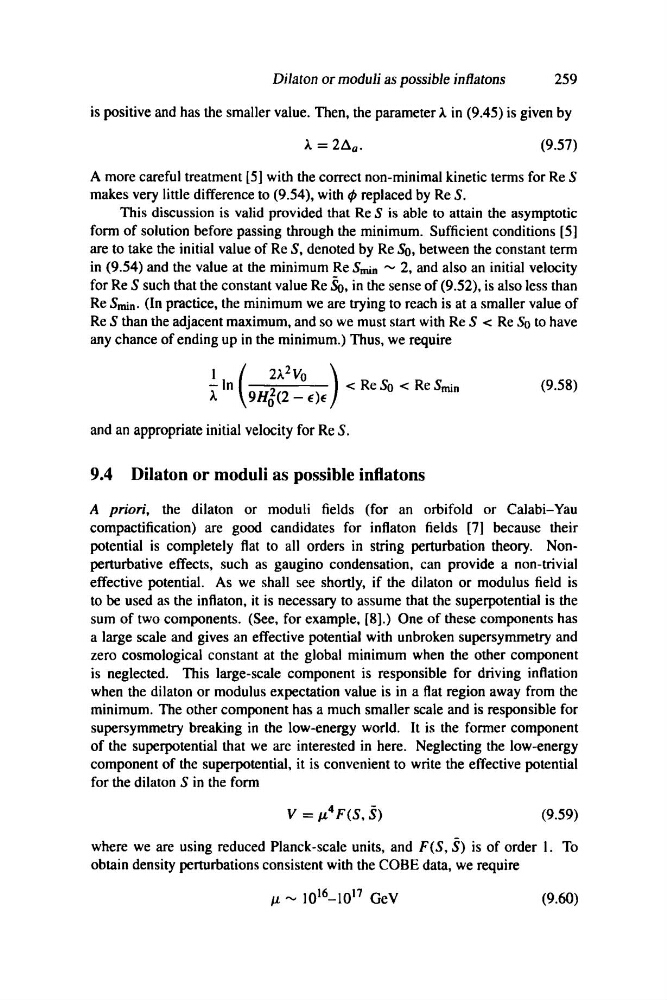
are to take the initial value of Re S, denoted by Re So. between the constant term
in (9.54) and the value at the minimum Re Smin '" 2. and also an initial velocity
for Re S such that the constant value Re So, in the sense of (9.52), is also less than
Re Smin. (In practice, the minimum we are trying to reach is at a smaller value of
Re S than the adjacent maximum, and so we must start with Re S < Re So to have
any chance of ending up in the minimum.) Thus, we require
~ In ( 2J.. 2V o )
(9.58)
J..
9HJ(2 _ E)E < Re So < Re Smio
and an appropriate initial velocity for Re S.
9.4 Dilaton or moduli as possible inflatons
A priori, the dilaton or moduli fields (for an orbifold or Calabi-Yau
compactification) are good candidates for inflaton fields [7) because their
potential is completely flat to all orders in string perturbation theory. Nonperturbative effects, such as gaugino condensation. can provide a non-trivial
effective potential. As we shall see shortly. if the dilaton or modulus field is
to be used as the inflaton, it is necessary to assume that the superpotential is the
sum of two components. (See. for example. [8).) One of these components has
a large scale and gives an effective potential with unbroken supersymmetry and
zero cosmological constant at the global minimum when the other component
is neglected. This large-scale component is responsible for driving inflation
when the dilaton or modulus expectation value is in a flat region away from the
minimum. The other component has a much smaller scale and is responsible for
supersymmetry breaking in the low-energy world. It is the former component
of the superpotential that we are interested in here. Neglecting the low-energy
component of the superpotential. it is convenient to write the effective potential
for the dilaton S in the form
V = /L
4 F(S.
-
S)
(9.59)
where we are using reduced Planck-scale units, and F(S, oS) is of order l. To
obtain density perturbations consistent with the COBE data. we require
/L '" 10 16 _10 17 GeV
(9.60)
259
is positive and has the smaller value. Then, the parameter J.. in (9.45) is given by
J.. = 2.!1 a•
(9.57)
A more careful treatment [5) with the correct non-minimal kinetic terms for Re S
makes very little difference to (9.54), with 41 replaced by Re S.
This discussion is valid provided that Re S is able to attain the asymptotic
form of solution before passing through the minimum. Sufficient conditions [5)
are to take the initial value of Re S, denoted by Re So. between the constant term
in (9.54) and the value at the minimum Re Smin '" 2. and also an initial velocity
for Re S such that the constant value Re So, in the sense of (9.52), is also less than
Re Smin. (In practice, the minimum we are trying to reach is at a smaller value of
Re S than the adjacent maximum, and so we must start with Re S < Re So to have
any chance of ending up in the minimum.) Thus, we require
~ In ( 2J.. 2V o )
(9.58)
J..
9HJ(2 _ E)E < Re So < Re Smio
and an appropriate initial velocity for Re S.
9.4 Dilaton or moduli as possible inflatons
A priori, the dilaton or moduli fields (for an orbifold or Calabi-Yau
compactification) are good candidates for inflaton fields [7) because their
potential is completely flat to all orders in string perturbation theory. Nonperturbative effects, such as gaugino condensation. can provide a non-trivial
effective potential. As we shall see shortly. if the dilaton or modulus field is
to be used as the inflaton, it is necessary to assume that the superpotential is the
sum of two components. (See. for example. [8).) One of these components has
a large scale and gives an effective potential with unbroken supersymmetry and
zero cosmological constant at the global minimum when the other component
is neglected. This large-scale component is responsible for driving inflation
when the dilaton or modulus expectation value is in a flat region away from the
minimum. The other component has a much smaller scale and is responsible for
supersymmetry breaking in the low-energy world. It is the former component
of the superpotential that we are interested in here. Neglecting the low-energy
component of the superpotential. it is convenient to write the effective potential
for the dilaton S in the form
V = /L
4 F(S.
-
S)
(9.59)
where we are using reduced Planck-scale units, and F(S, oS) is of order l. To
obtain density perturbations consistent with the COBE data. we require
/L '" 10 16 _10 17 GeV
(9.60)