

240
Inflation in supergravity
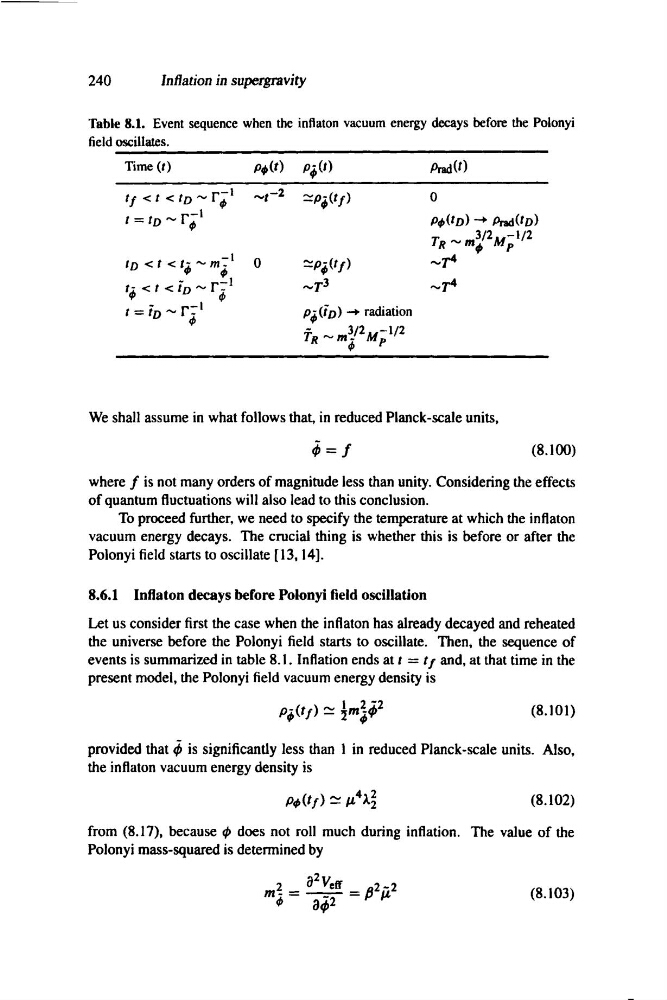
Table 8.1. Event sequence when the inflaton vacuum energy decays before the Polonyi
field oscillates.
Time (t)
p.
Prad(t)
r- I _t-2
'1 ~p~(I/)
0
r- I
1= tD -
tP
P.(tD) ~ Pnd(tD)
T
3/2 M -l/2
R-m.
p
-I
ID < t < I~"'" m~
0
~p.(lf)
-r4
- r- 1
_T3
t~ < 1< tD - ~
-r4
I =;D -ri 1
p. (; D) ~ radiation
t
3/2 M -I/2
R -m~
p
We shall assume in what follows that, in reduced Planck-scale units,
(p=!
(8.100)
where! is not many orders of magnitude less than unity. Considering the effects
of quantum fluctuations will also lead to this conclusion.
To proceed further, we need to specify the temperature at which the inflaton
vacuum energy decays. The crucial thing is whether this is before or after the
Polonyi field starts to oscillate [13, 14).
8.6.1 Inflaton decays before Polonyi field oscillation
Let us consider first the case when the inflaton has already decayed and reheated
the universe before the Polonyi field starts to oscillate. Then, the sequence of
events is summarized in table 8.1. Inflation ends at t = t f and, at that time in the
present model, the Polonyi field vacuum energy density is
P~(tf) ~ !ml~2
(8.101)
provided that (p is significantly less than I in reduced Planck-scale units. Also,
the inflaton vacuum energy density is
p.(t f) ~ ,.,h.~
(8.102)
from (8.17), because ~ does not roU much during inflation. The value of the
Polonyi mass-squared is detennined by
2
a2Veff
fJ2-2
m- = - - = IL
(8.103)
tP
arp2
Inflation in supergravity
Table 8.1. Event sequence when the inflaton vacuum energy decays before the Polonyi
field oscillates.
Time (t)
p.
Prad(t)
r- I _t-2
'1 ~p~(I/)
0
r- I
1= tD -
tP
P.(tD) ~ Pnd(tD)
T
3/2 M -l/2
R-m.
p
-I
ID < t < I~"'" m~
0
~p.(lf)
-r4
- r- 1
_T3
t~ < 1< tD - ~
-r4
I =;D -ri 1
p. (; D) ~ radiation
t
3/2 M -I/2
R -m~
p
We shall assume in what follows that, in reduced Planck-scale units,
(p=!
(8.100)
where! is not many orders of magnitude less than unity. Considering the effects
of quantum fluctuations will also lead to this conclusion.
To proceed further, we need to specify the temperature at which the inflaton
vacuum energy decays. The crucial thing is whether this is before or after the
Polonyi field starts to oscillate [13, 14).
8.6.1 Inflaton decays before Polonyi field oscillation
Let us consider first the case when the inflaton has already decayed and reheated
the universe before the Polonyi field starts to oscillate. Then, the sequence of
events is summarized in table 8.1. Inflation ends at t = t f and, at that time in the
present model, the Polonyi field vacuum energy density is
P~(tf) ~ !ml~2
(8.101)
provided that (p is significantly less than I in reduced Planck-scale units. Also,
the inflaton vacuum energy density is
p.(t f) ~ ,.,h.~
(8.102)
from (8.17), because ~ does not roU much during inflation. The value of the
Polonyi mass-squared is detennined by
2
a2Veff
fJ2-2
m- = - - = IL
(8.103)
tP
arp2