

New inflation
205
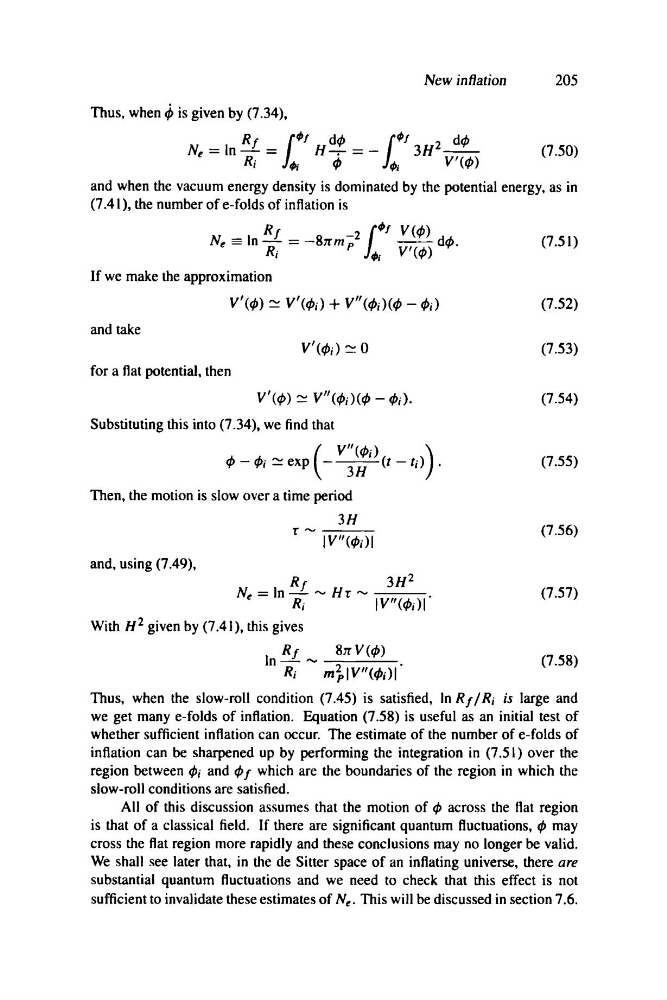
Thus, when 4> is given by (7.34),
Ne = In RI = 1·' Hd~ = -1·' 3H2~ (7.50)
Ri
.,
tP
.,
Y'(tP)
and when the vacuum energy density is dominated by the potential energy, as in
(7.41), the number of e-folds of inflation is
-21·'
== RI
Y(tP)
Ne In- = -81rm p
-,-dtP.
(7.51)
Ri
., Y (t!»
If we make the approximation
V'(tP) ~ Y'(tPi) + Y"(tPi)(tP - tPi)
(7.52)
and take
Y'(tPi) ~ 0
(7.53)
for a flat potential. then
Y'(t!» ~ Y"(t!>i)(tP - tPi).
(7.54)
Substituting this into (7.34), we find that
Y"(tPi)
)
t!>-tPi~exp ( -~(I-ti) .
(7.55)
Then. the motion is slow over a time period
3H
f " " - -
(7.56)
IV 11 (tPi) I
and, using (7.49).
R
3H 2
Ne = In -1. "" H f "" - -
(7.57)
Ri
1V"(tP;) I
With H2 given by (7.4), this gives
In RI "" 81rY(tP) .
(7.58)
Ri
m~IV"(tPi)1
Thus. when the slow-roll condition (7.45) is satisfied. In RI/Ri is large and
we get many e-folds of inflation. Equation (7.58) is useful as an initial test of
whether sufficient inflation can occur. The estimate of the number of e-folds of
inflation can be sharpened up by performing the integration in (7.51) over the
region between tPi and tP I which are the boundaries of the region in which the
slow-roll conditions are satisfied.
All of this discussion assumes that the motion of tP across the flat region
is that of a classical field. If there are significant quantum fluctuations. tP may
cross the flat region more rapidly and these conclusions may no longer be valid.
We shall see later that. in the de Sitter space of an inflating universe. there are
substantial quantum fluctuations and we need to check that this effect is not
sufficient to invalidate these estimates of Ne. This will be discussed in section 7.6.
205
Thus, when 4> is given by (7.34),
Ne = In RI = 1·' Hd~ = -1·' 3H2~ (7.50)
Ri
.,
tP
.,
Y'(tP)
and when the vacuum energy density is dominated by the potential energy, as in
(7.41), the number of e-folds of inflation is
-21·'
== RI
Y(tP)
Ne In- = -81rm p
-,-dtP.
(7.51)
Ri
., Y (t!»
If we make the approximation
V'(tP) ~ Y'(tPi) + Y"(tPi)(tP - tPi)
(7.52)
and take
Y'(tPi) ~ 0
(7.53)
for a flat potential. then
Y'(t!» ~ Y"(t!>i)(tP - tPi).
(7.54)
Substituting this into (7.34), we find that
Y"(tPi)
)
t!>-tPi~exp ( -~(I-ti) .
(7.55)
Then. the motion is slow over a time period
3H
f " " - -
(7.56)
IV 11 (tPi) I
and, using (7.49).
R
3H 2
Ne = In -1. "" H f "" - -
(7.57)
Ri
1V"(tP;) I
With H2 given by (7.4), this gives
In RI "" 81rY(tP) .
(7.58)
Ri
m~IV"(tPi)1
Thus. when the slow-roll condition (7.45) is satisfied. In RI/Ri is large and
we get many e-folds of inflation. Equation (7.58) is useful as an initial test of
whether sufficient inflation can occur. The estimate of the number of e-folds of
inflation can be sharpened up by performing the integration in (7.51) over the
region between tPi and tP I which are the boundaries of the region in which the
slow-roll conditions are satisfied.
All of this discussion assumes that the motion of tP across the flat region
is that of a classical field. If there are significant quantum fluctuations. tP may
cross the flat region more rapidly and these conclusions may no longer be valid.
We shall see later that. in the de Sitter space of an inflating universe. there are
substantial quantum fluctuations and we need to check that this effect is not
sufficient to invalidate these estimates of Ne. This will be discussed in section 7.6.