

202
Inflationary cosmology
V(q,>
\
q,j
q,f
q,
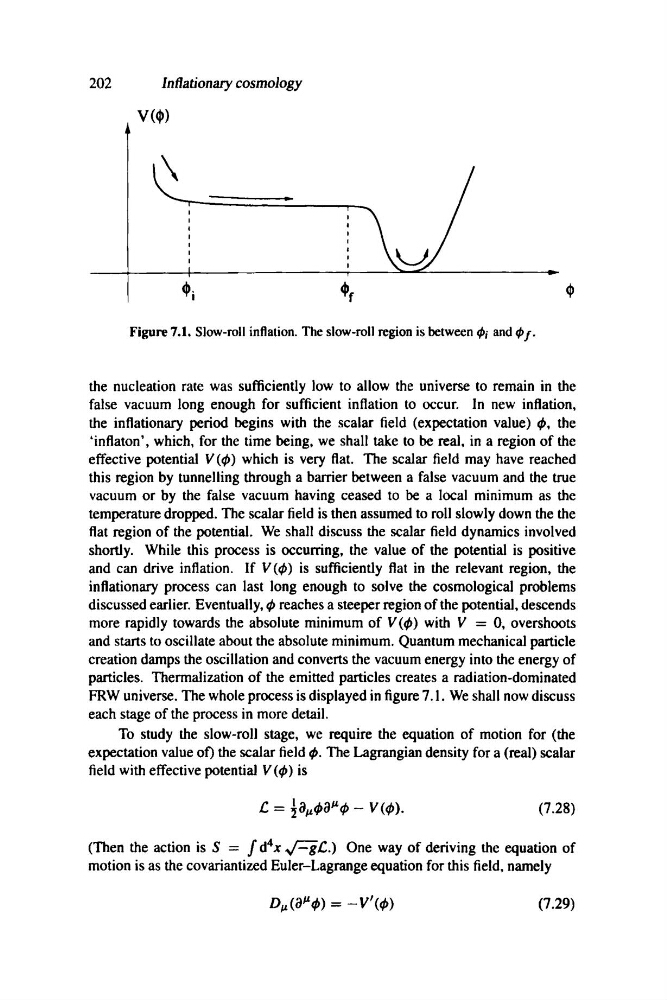
Figure 7.1. Slow-roll inflation. The slow-roll region is between ~i and ~f.
the nucleation rate was sufficiently low to allow the universe to remain in the
false vacuum long enough for sufficient inflation to occur. In new inflation.
the inflationary period begins with the scalar field (expectation value) t/J. the
'inflaton', which. for the time being, we shaH take to be real, in a region of the
effective potential V(t/J) which is very flat. The scalar field may have reached
this region by tunnelling through a barrier between a false vacuum and the true
vacuum or by the false vacuum having ceased to be a local minimum as the
temperature dropped. The scalar field is then assumed to roll slowly down the the
flat region of the potential. We shaH discuss the scalar field dynamics involved
shortly. While this process is occurring, the value of the potential is positive
and can drive inflation. If V(t/J) is sufficiently flat in the relevant region, the
inflationary process can last long enough to solve the cosmological problems
discussed earlier. Eventually, t/J reaches a steeper region of the potential. descends
more rapidly towards the absolute minimum of V(t/J) with V = 0, overshoots
and starts to oscillate about the absolute minimum. Quantum mechanical particle
creation damps the oscillation and converts the vacuum energy into the energy of
particles. Thermalization of the emitted particles creates a radiation-dominated
FRW universe. The whole process is displayed in figure 7.1. We shall now discuss
each stage of the process in more detail.
To study the slow-roU stage, we require the equation of motion for (the
expectation value of) the scalar field t/J. The Lagrangian density for a (real) scalar
field with effective potential V (t/J) is
C, = !a"t/Ja"t/J - V(t/J).
(7.28)
(Then the action is S = f d 4 x RC.) One way of deriving the equation of
motion is as the covariantized Euler-Lagrange equation for this field, namely
D,,(a"'t/J) = -V'(t/J)
(7.29)
Inflationary cosmology
V(q,>
\
q,j
q,f
q,
Figure 7.1. Slow-roll inflation. The slow-roll region is between ~i and ~f.
the nucleation rate was sufficiently low to allow the universe to remain in the
false vacuum long enough for sufficient inflation to occur. In new inflation.
the inflationary period begins with the scalar field (expectation value) t/J. the
'inflaton', which. for the time being, we shaH take to be real, in a region of the
effective potential V(t/J) which is very flat. The scalar field may have reached
this region by tunnelling through a barrier between a false vacuum and the true
vacuum or by the false vacuum having ceased to be a local minimum as the
temperature dropped. The scalar field is then assumed to roll slowly down the the
flat region of the potential. We shaH discuss the scalar field dynamics involved
shortly. While this process is occurring, the value of the potential is positive
and can drive inflation. If V(t/J) is sufficiently flat in the relevant region, the
inflationary process can last long enough to solve the cosmological problems
discussed earlier. Eventually, t/J reaches a steeper region of the potential. descends
more rapidly towards the absolute minimum of V(t/J) with V = 0, overshoots
and starts to oscillate about the absolute minimum. Quantum mechanical particle
creation damps the oscillation and converts the vacuum energy into the energy of
particles. Thermalization of the emitted particles creates a radiation-dominated
FRW universe. The whole process is displayed in figure 7.1. We shall now discuss
each stage of the process in more detail.
To study the slow-roU stage, we require the equation of motion for (the
expectation value of) the scalar field t/J. The Lagrangian density for a (real) scalar
field with effective potential V (t/J) is
C, = !a"t/Ja"t/J - V(t/J).
(7.28)
(Then the action is S = f d 4 x RC.) One way of deriving the equation of
motion is as the covariantized Euler-Lagrange equation for this field, namely
D,,(a"'t/J) = -V'(t/J)
(7.29)