

Detection of dark matter
191
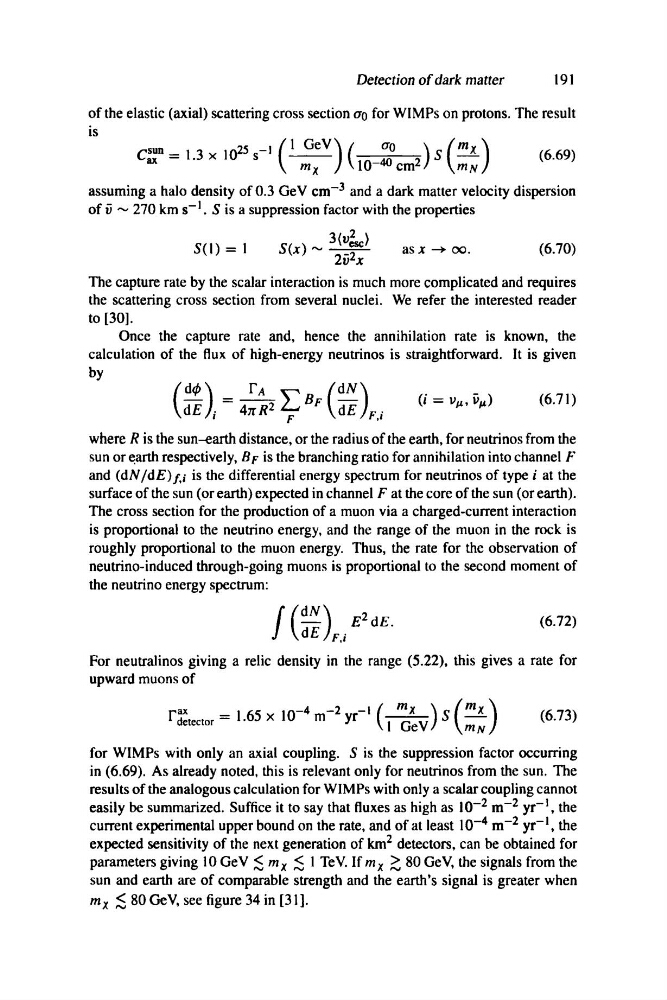
of the elastic (axial) scattering cross section 0'0 for WIMPs on protons. The result
is
-I (1 Gev) (
) S (mx )
0'0
(6.69)
C:;n = 1.3 x 1025 s --;;;;- 10-40 cm2
mN
assuming a halo density of 0.3 GeV cm- 3 and a dark matter velocity dispersion
of jj '" 270 km s-I. S is a suppression factor with the properties
S( ) ,.." 3(v!c)
S(I) = 1
asx .... 00.
(6.70)
x
2jj2x
The capture rate by the scalar interaction is much more complicated and requires
the scattering cross section from several nuclei. We refer the interested reader
to [30).
Once the capture rate and, hence the annihilation rate is known, the
calculation of the flux of high-energy neutrinos is straightforward. It is given
by
( dt/»
r A
(dN)
(i = vI" v",)
(6.71)
dE ; = 41rR2 ~ BF dE F,;
where R is the sun-earth distance, or the radius of the earth, for neutrinos from the
sun or ~arth respectively, B F is the branching ratio for annihilation into channel F
and (dN /dE) /.1 is the differential energy spectrum for neutrinos of type; at the
surface of the sun (or earth) expected in channel F at the core of the sun (or earth).
The cross section for the production of a muon via a charged-current interaction
is proportional to the neutrino energy, and the range of the mu on in the rock is
roughly proportional to the muon energy. Thus, the rate for the observation of
neutrino-induced through-going muons is proportional to the second moment of
the neutrino energy spectrum:
(6.72)
f (::t,; E 2 dE.
For neutralinos giving a relic density in the range (5.22), this gives a rate for
upward muons of
r~ctor = 1.65 x 10- 4 m- 2 yr-I (-.!!!.L.) S (mx) (6.73)
1 GeV
mN
for WIMPs with only an axial coupling. S is the suppression factor occurring
in (6.69). As already noted, this is relevant only for neutrinos from the sun. The
results of the analogous calculation for WIMPs with only a scalar coupling cannot
easily be summarized. Suffice it to say that fluxes as high as 10- 2 m- 2 yr-I, the
current experimental upper bound on the rate, and of at least 10- 4 m- 2 yr- I , the
expected sensitivity of the next generation of km 2 detectors, can be obtained for
parameters giving 10 Ge V ~ m x ~ 1 Te V. If m x ~ 80 Ge V, the signals from the
sun and earth are of comparable strength and the earth's signal is greater when
m x ~ 80 Ge V, see figure 34 in [31).
191
of the elastic (axial) scattering cross section 0'0 for WIMPs on protons. The result
is
-I (1 Gev) (
) S (mx )
0'0
(6.69)
C:;n = 1.3 x 1025 s --;;;;- 10-40 cm2
mN
assuming a halo density of 0.3 GeV cm- 3 and a dark matter velocity dispersion
of jj '" 270 km s-I. S is a suppression factor with the properties
S( ) ,.." 3(v!c)
S(I) = 1
asx .... 00.
(6.70)
x
2jj2x
The capture rate by the scalar interaction is much more complicated and requires
the scattering cross section from several nuclei. We refer the interested reader
to [30).
Once the capture rate and, hence the annihilation rate is known, the
calculation of the flux of high-energy neutrinos is straightforward. It is given
by
( dt/»
r A
(dN)
(i = vI" v",)
(6.71)
dE ; = 41rR2 ~ BF dE F,;
where R is the sun-earth distance, or the radius of the earth, for neutrinos from the
sun or ~arth respectively, B F is the branching ratio for annihilation into channel F
and (dN /dE) /.1 is the differential energy spectrum for neutrinos of type; at the
surface of the sun (or earth) expected in channel F at the core of the sun (or earth).
The cross section for the production of a muon via a charged-current interaction
is proportional to the neutrino energy, and the range of the mu on in the rock is
roughly proportional to the muon energy. Thus, the rate for the observation of
neutrino-induced through-going muons is proportional to the second moment of
the neutrino energy spectrum:
(6.72)
f (::t,; E 2 dE.
For neutralinos giving a relic density in the range (5.22), this gives a rate for
upward muons of
r~ctor = 1.65 x 10- 4 m- 2 yr-I (-.!!!.L.) S (mx) (6.73)
1 GeV
mN
for WIMPs with only an axial coupling. S is the suppression factor occurring
in (6.69). As already noted, this is relevant only for neutrinos from the sun. The
results of the analogous calculation for WIMPs with only a scalar coupling cannot
easily be summarized. Suffice it to say that fluxes as high as 10- 2 m- 2 yr-I, the
current experimental upper bound on the rate, and of at least 10- 4 m- 2 yr- I , the
expected sensitivity of the next generation of km 2 detectors, can be obtained for
parameters giving 10 Ge V ~ m x ~ 1 Te V. If m x ~ 80 Ge V, the signals from the
sun and earth are of comparable strength and the earth's signal is greater when
m x ~ 80 Ge V, see figure 34 in [31).