

6
The standard model of cosmology
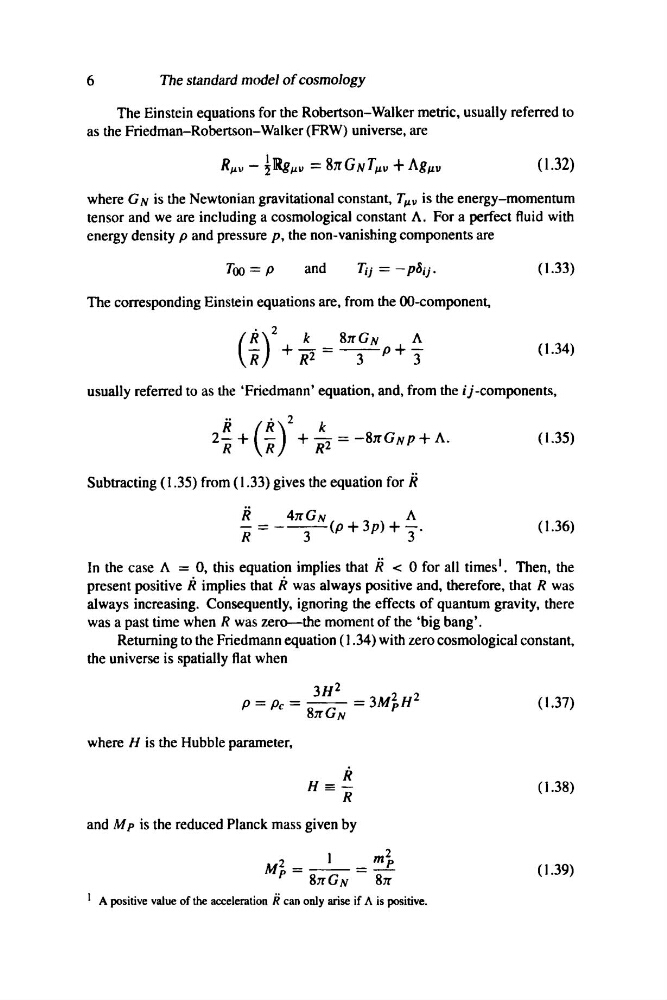
The Einstein equations for the Robertson-Walker metric, usually referred to
as the Friedman-Robertson-Walker (FRW) universe, are
RJ-L\I - !1RgJ-L1I = 87rGN TJ-LII + Ag/LII
( 1.32)
where G N is the Newtonian gravitational constant, TJ-LIJ is the energy-momentum
tensor and we are including a cosmological constant A. For a perfect fluid with
energy density P and pressure p, the non-vanishing components are
Too = p
and
T;j = - pfJij •
( \.33)
The corresponding Einstein equations are, from the OO-component,
( !!.)
. 2
R
+.!.... = 8rrGN p + A
( 1.34)
R2
3
3
usually referred to as the 'Friedmann' equation, and, from the ij-components,
R
2/i + (R)2 /i + R2 k = -8rrG N P + A.
(1.35)
Subtracting (1.35) from (1.33) gives the equation for R
R
4rrGN
A
- = ---(p+3p)+(1.36)
R
3
3'
In the case A = 0, this equation implies that R < 0 for all times I. Then, the
present positive R implies that R was always positive and, therefore, that R was
always increasing. Consequently, ignoring the effects of quantum gravity, there
was a past time when R was zero-the moment of the 'big bang'.
Returning to the Friedmann equation (1.34) with zero cosmological constant,
the universe is spatially flat when
2
3H =
( 1.37)
P = Pc
3M~H2
= 8rrGN
where H is the Hubble parameter,
H=!!..
( 1.38)
R
and Mp is the reduced Planck mass given by
2
I
m~
M - - - -
( 1.39)
p - 8rrGN - 8rr
A positive value of the acceleration R can only arise if A is positive.
The standard model of cosmology
The Einstein equations for the Robertson-Walker metric, usually referred to
as the Friedman-Robertson-Walker (FRW) universe, are
RJ-L\I - !1RgJ-L1I = 87rGN TJ-LII + Ag/LII
( 1.32)
where G N is the Newtonian gravitational constant, TJ-LIJ is the energy-momentum
tensor and we are including a cosmological constant A. For a perfect fluid with
energy density P and pressure p, the non-vanishing components are
Too = p
and
T;j = - pfJij •
( \.33)
The corresponding Einstein equations are, from the OO-component,
( !!.)
. 2
R
+.!.... = 8rrGN p + A
( 1.34)
R2
3
3
usually referred to as the 'Friedmann' equation, and, from the ij-components,
R
2/i + (R)2 /i + R2 k = -8rrG N P + A.
(1.35)
Subtracting (1.35) from (1.33) gives the equation for R
R
4rrGN
A
- = ---(p+3p)+(1.36)
R
3
3'
In the case A = 0, this equation implies that R < 0 for all times I. Then, the
present positive R implies that R was always positive and, therefore, that R was
always increasing. Consequently, ignoring the effects of quantum gravity, there
was a past time when R was zero-the moment of the 'big bang'.
Returning to the Friedmann equation (1.34) with zero cosmological constant,
the universe is spatially flat when
2
3H =
( 1.37)
P = Pc
3M~H2
= 8rrGN
where H is the Hubble parameter,
H=!!..
( 1.38)
R
and Mp is the reduced Planck mass given by
2
I
m~
M - - - -
( 1.39)
p - 8rrGN - 8rr
A positive value of the acceleration R can only arise if A is positive.