

Axions
167
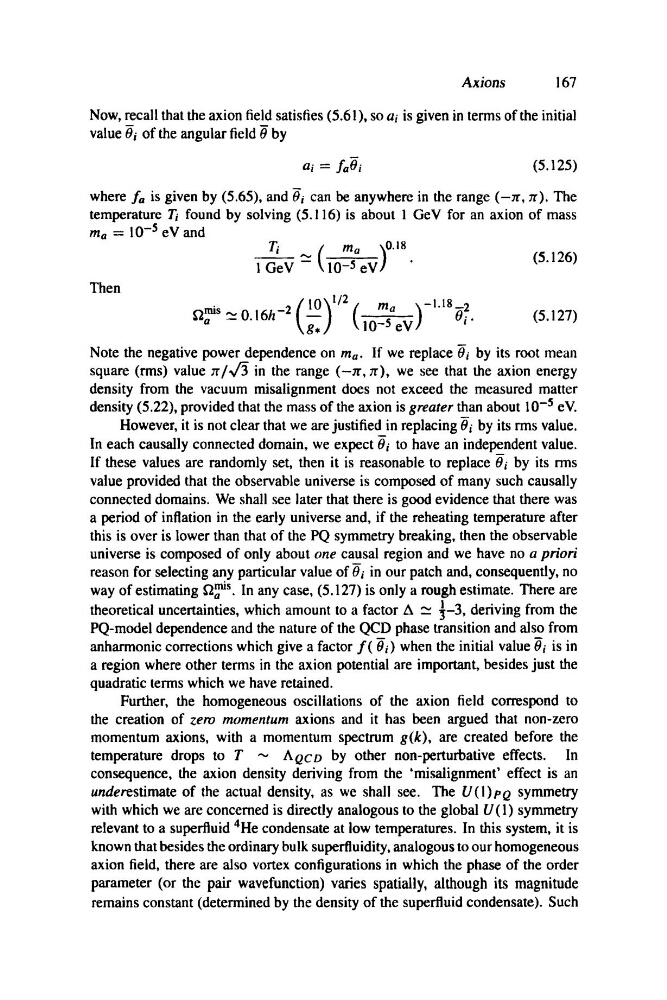
Now, recall that the axion field satisfies (5.61), so aj is given in terms of the initial
value 0; of the angular field 0 by
a; = laO;
(S.125)
where la is given by (S.6S), and 0; can be anywhere in the range (-H, H). The
temperature T; found by solving (5.116) is about 1 GeV for an axion of mass
ma = 10- 5 eV and
T;
(ma )0.18
(S.126)
1 GeV ~ 10-5 eV
.
Then
O:"S~O.16h-2(1O)1/2( ma )-1.18_~
(S.127)
g.
10-5 eV
(),.
Note the negative power dependence on ma. If we replace 0; by its root mean
square (rms) value H/.f3 in the range (-H, H), we see that the axion energy
density from the vacuum misalignment does not exceed the measured matter
density (S.22), provided that the mass of the axion is greater than about 10- 5 eV.
However. it is not clear that we are justified in replacing OJ by its rms value.
In each causally connected domain, we expect 0; to have an independent value.
If these values are randomly set, then it is reasonable to replace 0; by its rms
value provided that the observable universe is composed of many such causally
connected domains. We shall see later that there is good evidence that there was
a period of inflation in the early universe and. if the reheating temperature after
this is over is lower than that of the PQ symmetry breaking. then the observable
universe is composed of only about one causal region and we have no a priori
reason for selecting any particular value of 0; in our patch and. consequently. no
way of estimating O::US. In any case. (S.127) is only a rough estimate. There are
theoretical uncertainties. which amount to a factor 6. ~ l-3. deriving from the
PQ-model dependence and the nature of the QCD phase transition and also from
anharmonic corrections which give a factor I ( 6;) when the initial value 6; is in
a region where other terms in the axion potential are important, besides just the
quadratic tenus which we have retained.
Further. the homogeneous oscillations of the axion field correspond to
the creation of zero momentum axions and it has been argued that non-zero
momentum axions. with a momentum spectrum g(k). are created before the
temperature drops to T '" AQCD by other non-perturbative effects. In
consequence. the axion density deriving from the 'misalignment' effect is an
underestimate of the actual density. as we shall see. The U(l)PQ symmetry
with which we are concerned is directly analogous to the global U (1) symmetry
relevant to a superfluid 4He condensate at low temperatures. In this system. it is
known that besides the ordinary bulk superfluidity, analogous to our homogeneous
axion field, there are also vortex configurations in which the phase of the order
parameter (or the pair wavefunction) varies spatially. although its magnitude
remains constant (detenuined by the density of the superfluid condensate). Such
167
Now, recall that the axion field satisfies (5.61), so aj is given in terms of the initial
value 0; of the angular field 0 by
a; = laO;
(S.125)
where la is given by (S.6S), and 0; can be anywhere in the range (-H, H). The
temperature T; found by solving (5.116) is about 1 GeV for an axion of mass
ma = 10- 5 eV and
T;
(ma )0.18
(S.126)
1 GeV ~ 10-5 eV
.
Then
O:"S~O.16h-2(1O)1/2( ma )-1.18_~
(S.127)
g.
10-5 eV
(),.
Note the negative power dependence on ma. If we replace 0; by its root mean
square (rms) value H/.f3 in the range (-H, H), we see that the axion energy
density from the vacuum misalignment does not exceed the measured matter
density (S.22), provided that the mass of the axion is greater than about 10- 5 eV.
However. it is not clear that we are justified in replacing OJ by its rms value.
In each causally connected domain, we expect 0; to have an independent value.
If these values are randomly set, then it is reasonable to replace 0; by its rms
value provided that the observable universe is composed of many such causally
connected domains. We shall see later that there is good evidence that there was
a period of inflation in the early universe and. if the reheating temperature after
this is over is lower than that of the PQ symmetry breaking. then the observable
universe is composed of only about one causal region and we have no a priori
reason for selecting any particular value of 0; in our patch and. consequently. no
way of estimating O::US. In any case. (S.127) is only a rough estimate. There are
theoretical uncertainties. which amount to a factor 6. ~ l-3. deriving from the
PQ-model dependence and the nature of the QCD phase transition and also from
anharmonic corrections which give a factor I ( 6;) when the initial value 6; is in
a region where other terms in the axion potential are important, besides just the
quadratic tenus which we have retained.
Further. the homogeneous oscillations of the axion field correspond to
the creation of zero momentum axions and it has been argued that non-zero
momentum axions. with a momentum spectrum g(k). are created before the
temperature drops to T '" AQCD by other non-perturbative effects. In
consequence. the axion density deriving from the 'misalignment' effect is an
underestimate of the actual density. as we shall see. The U(l)PQ symmetry
with which we are concerned is directly analogous to the global U (1) symmetry
relevant to a superfluid 4He condensate at low temperatures. In this system. it is
known that besides the ordinary bulk superfluidity, analogous to our homogeneous
axion field, there are also vortex configurations in which the phase of the order
parameter (or the pair wavefunction) varies spatially. although its magnitude
remains constant (detenuined by the density of the superfluid condensate). Such