

The Robertson-Walker metric
3
We shaH discuss the time dependence of the scale factor R(t) in the next section.
Equation ( 1.4) then allows us to calculate the particle horizon. For example, when
R(t) ex t 2 / 3
(1.5)
as is the case for a matter-dominated universe, we get
dH(t) = 3t
(1.6)
and for a radiation-dominated universe in which
R(t) ex t l / 2
(1.7)
we get
dH(t) = 21.
(1.8)
For an inflationary universe, such as will be discussed in chapter 7,
R(t) ex e HI
( 1.9)
with H approximately constant, and then
I
dH(t) = H (e HI - I).
( I.lO)
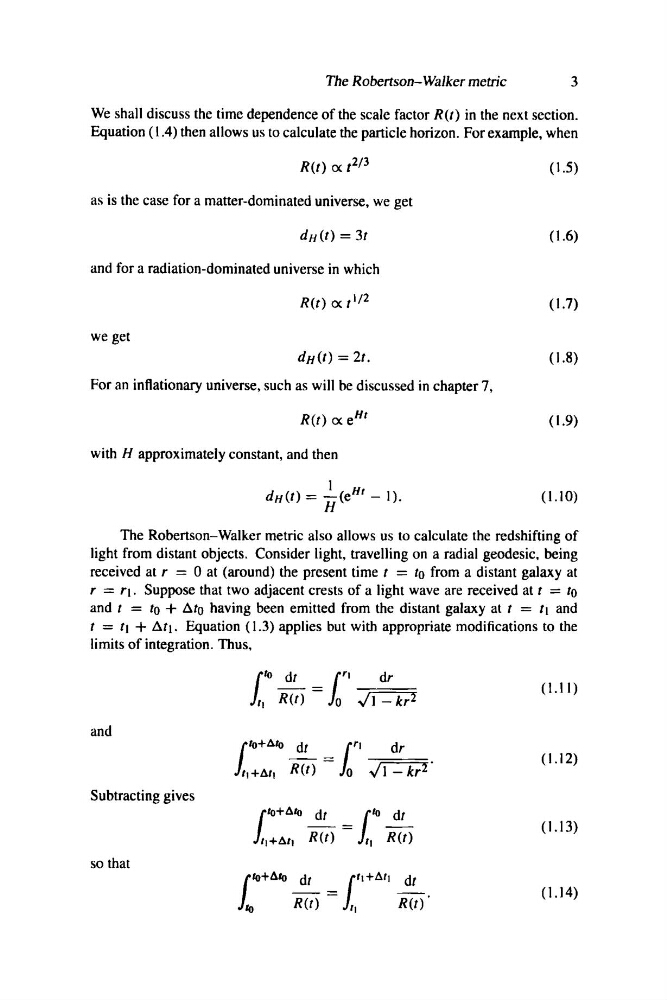
The Robertson-Walker metric also aHows us to calculate the redshifting of
light from distant objects. Consider light, travelling on a radial geodesic, being
received at r = 0 at (around) the present time t = to from a distant galaxy at
r = r\. Suppose that two adjacent crests of a light wave are received at t = to
and t = to + ~to having been emitted from the distant galaxy at t = 1\ and
t = 1\ + M\. Equation (1.3) applies but with appropriate modifications to the
limits of integration. Thus,
1
' 0
dt
('I
dr
(1.11 )
I.
R(t) = Jo JI - kr 2
and
1
'0+ 6 10 dt
('I
dr
( 1.12)
1.+61. R(t) = Jo .JI - kr 2
Subtracting gives
1
'0+ 6 10 dt
1 '0 dt
( 1.13)
1.+61. R(t)
1
= I. R(t)
so that
1
10+610 ~ = ' .+ 6' • ~.
( 1.14)
10
R(t)
I.
R(t)
3
We shaH discuss the time dependence of the scale factor R(t) in the next section.
Equation ( 1.4) then allows us to calculate the particle horizon. For example, when
R(t) ex t 2 / 3
(1.5)
as is the case for a matter-dominated universe, we get
dH(t) = 3t
(1.6)
and for a radiation-dominated universe in which
R(t) ex t l / 2
(1.7)
we get
dH(t) = 21.
(1.8)
For an inflationary universe, such as will be discussed in chapter 7,
R(t) ex e HI
( 1.9)
with H approximately constant, and then
I
dH(t) = H (e HI - I).
( I.lO)
The Robertson-Walker metric also aHows us to calculate the redshifting of
light from distant objects. Consider light, travelling on a radial geodesic, being
received at r = 0 at (around) the present time t = to from a distant galaxy at
r = r\. Suppose that two adjacent crests of a light wave are received at t = to
and t = to + ~to having been emitted from the distant galaxy at t = 1\ and
t = 1\ + M\. Equation (1.3) applies but with appropriate modifications to the
limits of integration. Thus,
1
' 0
dt
('I
dr
(1.11 )
I.
R(t) = Jo JI - kr 2
and
1
'0+ 6 10 dt
('I
dr
( 1.12)
1.+61. R(t) = Jo .JI - kr 2
Subtracting gives
1
'0+ 6 10 dt
1 '0 dt
( 1.13)
1.+61. R(t)
1
= I. R(t)
so that
1
10+610 ~ = ' .+ 6' • ~.
( 1.14)
10
R(t)
I.
R(t)