

Affleck-Dine baryogenesis
141
come in to play. First, the positive mass-squared tenn dominates the inflationary
contribution, so that q, begins to oscillate undamped about q, = 0, with initial
condition rp = with number density
P~
2
n~ = -
= m~lrpl
(4.262)
m~
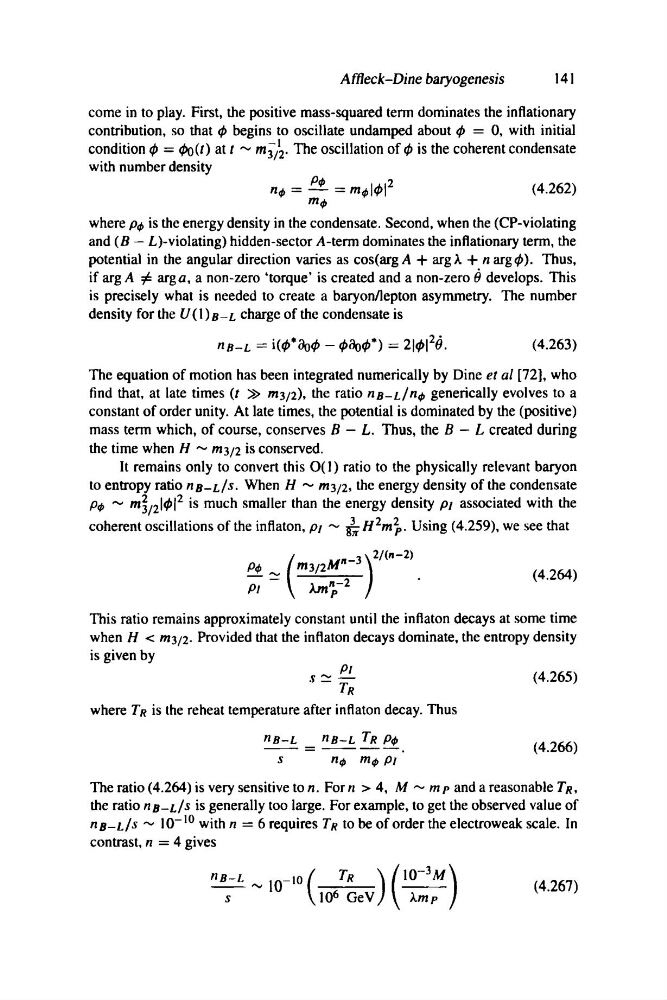
where P~ is the energy density in the condensate. Second, when the (CP-violating
and (B - L)-violating) hidden-sector A-tenn dominates the inflationary tenn, the
potential in the angular direction varies as cos(arg A + arg A + n arg rp). Thus,
if arg A '# arg a, a non-zero 'torque' is created and a non-zero {} develops. This
is precisely what is needed to create a baryonllepton asymmetry. The number
density for the U(I)B-L charge of the condensate is
nB-L = i(rp*Oorp - rpOoq,*) = 2IrpI2{}.
(4.263)
The equation of motion has been integrated numerically by Dine et at [72J, who
find that, at late times (t » m3/2), the ratio nB-L!n~ generically evolves to a
constant of order unity. At late times, the potential is dominated by the (positive)
mass tenn which, of course, conserves B - L. Thus, the B - L created during
the time when H ,...., m3/2 is conserved.
It remains only to convert this O( I) ratio to the physically relevant baryon
to entropy ratio nB-LIs. When H ,...., m3/2, the energy density of the condensate
P~ ,...., m~/2IrpI2 is much smaller than the energy density PI associated with the
coherent oscillations of the inflaton, PI ,...., tH2m~. Using (4.259), we see that
3)2/Cn-2)
P~ ~ ( m3/2 Mn
(4.264)
PI
Am n - 2
p
This ratio remains approximately constant until the inflaton decays at some time
when H < m3/2. Provided that the inflaton decays dominate, the entropy density
is given by
PI
s~(4.265)
TR
where TR is the reheat temperature after inflaton decay. Thus
nB-L nB-L TR P~
- - = - - - -
(4.266)
s
n~
m~ PI
The ratio (4.264) is very sensitive to n. For n > 4, M ,...., mp and a reasonable TR,
the ratio nB-Lis is generally too large. For example, to get the observed value of
nB-LIs""" 10- 10 with n = 6 requires TR to be of order the electroweak scale. In
contrast, n = 4 gives
nB-L ,...., 10-10 ( TR ) (1O3
M)
(4.267)
s
1()6 GeV
Amp
141
come in to play. First, the positive mass-squared tenn dominates the inflationary
contribution, so that q, begins to oscillate undamped about q, = 0, with initial
condition rp = with number density
P~
2
n~ = -
= m~lrpl
(4.262)
m~
where P~ is the energy density in the condensate. Second, when the (CP-violating
and (B - L)-violating) hidden-sector A-tenn dominates the inflationary tenn, the
potential in the angular direction varies as cos(arg A + arg A + n arg rp). Thus,
if arg A '# arg a, a non-zero 'torque' is created and a non-zero {} develops. This
is precisely what is needed to create a baryonllepton asymmetry. The number
density for the U(I)B-L charge of the condensate is
nB-L = i(rp*Oorp - rpOoq,*) = 2IrpI2{}.
(4.263)
The equation of motion has been integrated numerically by Dine et at [72J, who
find that, at late times (t » m3/2), the ratio nB-L!n~ generically evolves to a
constant of order unity. At late times, the potential is dominated by the (positive)
mass tenn which, of course, conserves B - L. Thus, the B - L created during
the time when H ,...., m3/2 is conserved.
It remains only to convert this O( I) ratio to the physically relevant baryon
to entropy ratio nB-LIs. When H ,...., m3/2, the energy density of the condensate
P~ ,...., m~/2IrpI2 is much smaller than the energy density PI associated with the
coherent oscillations of the inflaton, PI ,...., tH2m~. Using (4.259), we see that
3)2/Cn-2)
P~ ~ ( m3/2 Mn
(4.264)
PI
Am n - 2
p
This ratio remains approximately constant until the inflaton decays at some time
when H < m3/2. Provided that the inflaton decays dominate, the entropy density
is given by
PI
s~(4.265)
TR
where TR is the reheat temperature after inflaton decay. Thus
nB-L nB-L TR P~
- - = - - - -
(4.266)
s
n~
m~ PI
The ratio (4.264) is very sensitive to n. For n > 4, M ,...., mp and a reasonable TR,
the ratio nB-Lis is generally too large. For example, to get the observed value of
nB-LIs""" 10- 10 with n = 6 requires TR to be of order the electroweak scale. In
contrast, n = 4 gives
nB-L ,...., 10-10 ( TR ) (1O3
M)
(4.267)
s
1()6 GeV
Amp