

138
Baryogenesis
example. Even so, there remains the possibility of dimension-five, and higher,
non-renormalizable operators, whose effects are suppressed by at least one
power of a (hopefully) superbeavy scale M, e.g. the Planck mass mp. The
alternative approach to baryogenesis, proposed by Affleck-Dine utilizes both of
these features.
First, recall that in a supersymmetric theory there are scalar fields with
non-zero baryon or lepton number. Before supersymmetry breaking, there are
generally many (D- and F-) flat directions. These are directions (in field
configuration space) along which the potential is a constant (i.e. 'flat'). These
include directions that allow gauge invariant combinations of squark and/or
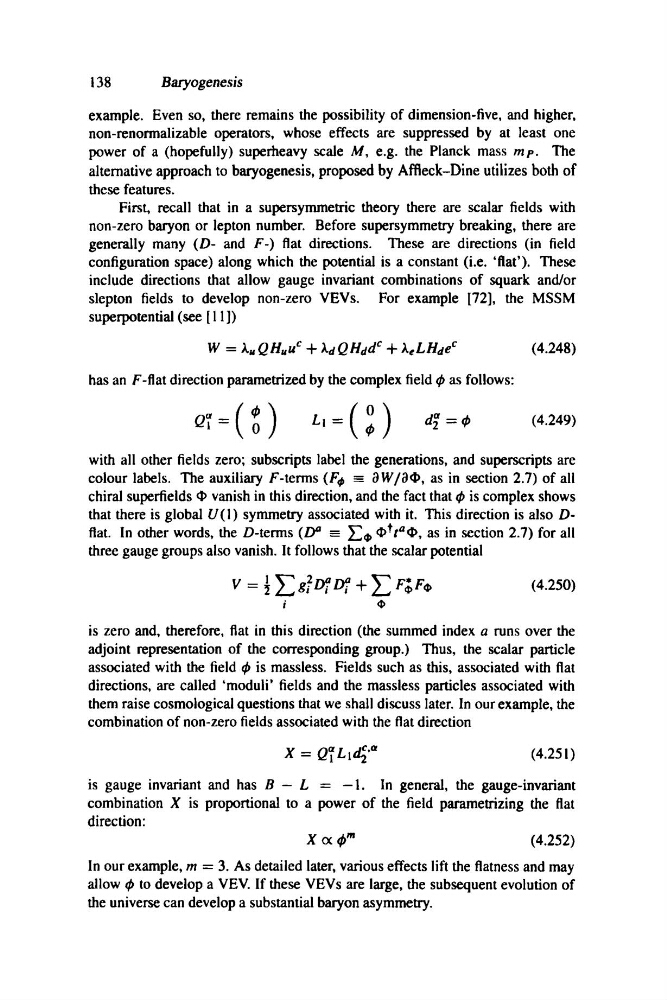
slepton fields to develop non-zero VEVs. For example [72], the MSSM
superpotential (see [11])
W=~Q~~+~Q~'+~L~~
(4.248)
has an F -flat direction parametrized by the complex field q, as follows:
Qi=(~) L\ = ( ~ ) di = q,
(4.249)
with all other fields zero; subscripts label the generations, and superscripts are
colour labels. The auxiliary F-terms (F4I ;;: aw/a, as in section 2.7) of all
chiral superfields vanish in this direction, and the fact that q, is complex shows
that there is global U ( 1) symmetry associated with it. This direction is also Dflat. In other words, the D-terms (D" ;;: L~ttQ, as in section 2.7) for all
three gauge groups also vanish. It follows that the scalar potential
(4.250)
v =! LgfDfvr + L F';F~
~
is zero and, therefore, flat in this direction (the summed index a runs over the
adjoint representation of the corresponding group.) Thus, the scalar particle
associated with the field t/J is massless. Fields such as this, associated with flat
directions, are called 'moduli' fields and the massless particles associated with
them raise cosmological questions that we shall discuss later. In our example, the
combination of non-zero fields associated with the flat direction
x = QiLI~·/I
(4.251)
is gauge invariant and has B - L = -1. In general, the gauge-invariant
combination X is proportional to a power of the field parametrizing the flat
direction:
X ex q,m
(4.252)
In our example, m = 3. As detailed later, various effects lift the flatness and may
allow q, to develop a VEV. If these VEVs are large, the subsequent evolution of
the universe can develop a substantial baryon asymmetry.
Baryogenesis
example. Even so, there remains the possibility of dimension-five, and higher,
non-renormalizable operators, whose effects are suppressed by at least one
power of a (hopefully) superbeavy scale M, e.g. the Planck mass mp. The
alternative approach to baryogenesis, proposed by Affleck-Dine utilizes both of
these features.
First, recall that in a supersymmetric theory there are scalar fields with
non-zero baryon or lepton number. Before supersymmetry breaking, there are
generally many (D- and F-) flat directions. These are directions (in field
configuration space) along which the potential is a constant (i.e. 'flat'). These
include directions that allow gauge invariant combinations of squark and/or
slepton fields to develop non-zero VEVs. For example [72], the MSSM
superpotential (see [11])
W=~Q~~+~Q~'+~L~~
(4.248)
has an F -flat direction parametrized by the complex field q, as follows:
Qi=(~) L\ = ( ~ ) di = q,
(4.249)
with all other fields zero; subscripts label the generations, and superscripts are
colour labels. The auxiliary F-terms (F4I ;;: aw/a
chiral superfields vanish in this direction, and the fact that q, is complex shows
that there is global U ( 1) symmetry associated with it. This direction is also Dflat. In other words, the D-terms (D" ;;: L~
three gauge groups also vanish. It follows that the scalar potential
(4.250)
v =! LgfDfvr + L F';F~
~
is zero and, therefore, flat in this direction (the summed index a runs over the
adjoint representation of the corresponding group.) Thus, the scalar particle
associated with the field t/J is massless. Fields such as this, associated with flat
directions, are called 'moduli' fields and the massless particles associated with
them raise cosmological questions that we shall discuss later. In our example, the
combination of non-zero fields associated with the flat direction
x = QiLI~·/I
(4.251)
is gauge invariant and has B - L = -1. In general, the gauge-invariant
combination X is proportional to a power of the field parametrizing the flat
direction:
X ex q,m
(4.252)
In our example, m = 3. As detailed later, various effects lift the flatness and may
allow q, to develop a VEV. If these VEVs are large, the subsequent evolution of
the universe can develop a substantial baryon asymmetry.