

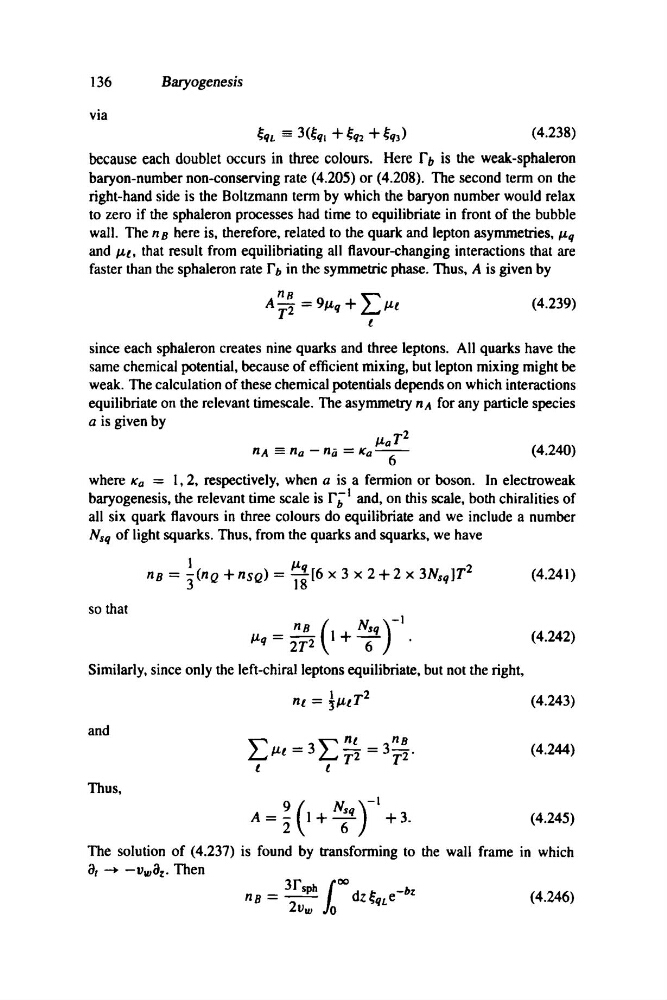
136
Baryogenesis
via
~qL == 3(~ql +~92 +~qJ)
(4.238)
because each doublet occurs in three colours. Here rb is the weak-sphaleron
baryon-number non-conserving rate (4.205) or (4.208). The second term on the
right-hand side is the Boltzmann term by which the baryon number would relax
to zero if the sphaleron processes had time to equilibriate in front of the bubble
wall. The n B here is. therefore. related to the quark and lepton asymmetries. ILq
and ILL. that result from equilibriating all ftavour-changing interactions that are
faster than the sphaleron rate rb in the symmetric phase. Thus. A is given by
nB
~
A T2 = 9ILq + ~ ILt
(4.239)
l
since each sphaleron creates nine quarks and three leptons. All quarks have the
same chemical potential. because of efficient mixing, but lepton mixing might be
weak. The calculation of these chemical potentials depends on which interactions
equilibriate on the relevant tiroescale. The asymmetry n,4 for any particle species
a is given by
lLa T2
n,4 == na - njj = lCa-6(4.240)
where lCa = I. 2. respectively, when a is a fermion or hoson. In eIectroweak
baryogenesis. the relevant time scale is r; 1 and. on this scale. both chiralities of
all six quark flavours in three colours do equilibriate and we include a number
Nsq of light squarks. Thus. from the quarks and squarks. we have
)
~
2
nB = '3(nQ +nsQ) = 18[6 x 3 x 2+2 x 3Nsq JT
(4.241)
so that
-1
nB (
IV. sq )
ILq=- 1 + -
(4.242)
2T2
6
Similarly. since only the left-chiralleptons equilibriate. but not the right,
nl = lILlT2
(4.243)
and
~
~ ILL =
~ nt
nB
3 ~
(4.244)
T2 = 3 T2 .
l
l
Thus.
9 (
N
A = 2 1 + ~q )-1 +3.
(4.245)
The solution of (4.237) is found by transforming to the wall frame in which
at - -VII/az. Then
- 3r sp 10
00
-bz
h
dZ~qLe
(4.246)
nB - 2vw 0
Baryogenesis
via
~qL == 3(~ql +~92 +~qJ)
(4.238)
because each doublet occurs in three colours. Here rb is the weak-sphaleron
baryon-number non-conserving rate (4.205) or (4.208). The second term on the
right-hand side is the Boltzmann term by which the baryon number would relax
to zero if the sphaleron processes had time to equilibriate in front of the bubble
wall. The n B here is. therefore. related to the quark and lepton asymmetries. ILq
and ILL. that result from equilibriating all ftavour-changing interactions that are
faster than the sphaleron rate rb in the symmetric phase. Thus. A is given by
nB
~
A T2 = 9ILq + ~ ILt
(4.239)
l
since each sphaleron creates nine quarks and three leptons. All quarks have the
same chemical potential. because of efficient mixing, but lepton mixing might be
weak. The calculation of these chemical potentials depends on which interactions
equilibriate on the relevant tiroescale. The asymmetry n,4 for any particle species
a is given by
lLa T2
n,4 == na - njj = lCa-6(4.240)
where lCa = I. 2. respectively, when a is a fermion or hoson. In eIectroweak
baryogenesis. the relevant time scale is r; 1 and. on this scale. both chiralities of
all six quark flavours in three colours do equilibriate and we include a number
Nsq of light squarks. Thus. from the quarks and squarks. we have
)
~
2
nB = '3(nQ +nsQ) = 18[6 x 3 x 2+2 x 3Nsq JT
(4.241)
so that
-1
nB (
IV. sq )
ILq=- 1 + -
(4.242)
2T2
6
Similarly. since only the left-chiralleptons equilibriate. but not the right,
nl = lILlT2
(4.243)
and
~
~ ILL =
~ nt
nB
3 ~
(4.244)
T2 = 3 T2 .
l
l
Thus.
9 (
N
A = 2 1 + ~q )-1 +3.
(4.245)
The solution of (4.237) is found by transforming to the wall frame in which
at - -VII/az. Then
- 3r sp 10
00
-bz
h
dZ~qLe
(4.246)
nB - 2vw 0