

128
Baryogenesis
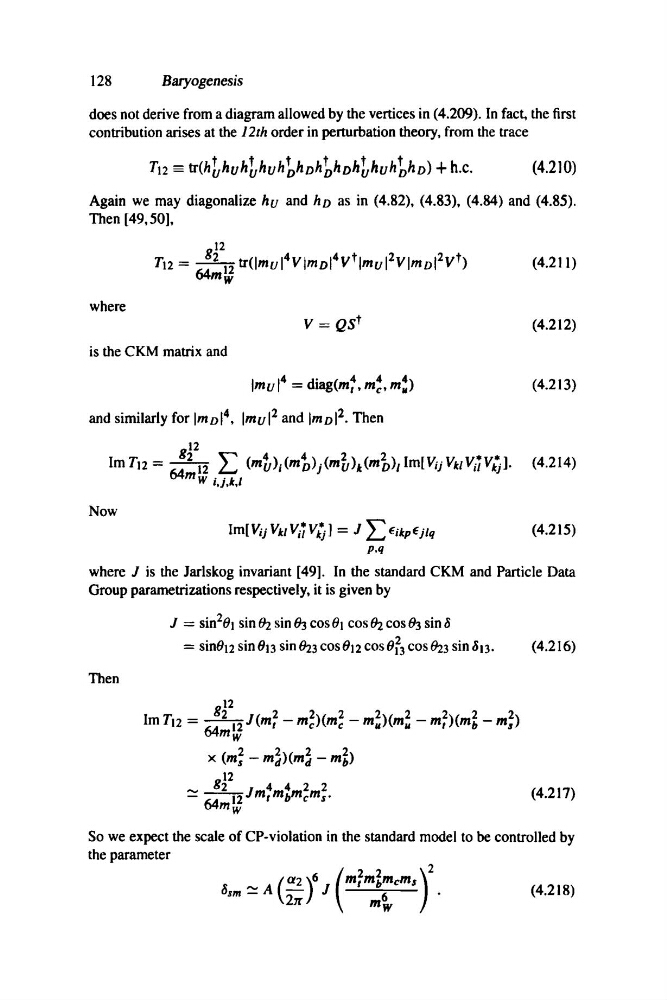
does not derive from a diagram allowed by the vertices in (4.209). In fact, the first
contribution arises at the 12th order in perturbation theory, from the trace
T12 = tr(h~huh~huh1hoh 1hoh~huh1ho) + h.c.
(4.210)
Again we may diagonaiize hu and ho as in (4.82), (4.83), (4.84) and (4.85).
Then [49,50],
g12
T12 = ~tr(lmuI4VlmoI4VtlmuI2VlmoI2Vt)
(4.211)
64mw
where
v = QS t
(4.212)
is the CKM matrix and
Imu 14 = diag(m:, m!, m!)
(4.213)
and similarly for Imol4, Imul2 and Imol2. Then
12
ImTI2= g2 12 L (mt)i(m~)j(m~)k(m~),Im[VijVIeIVi;Vlj]. (4.214)
64mw 't), ' 'lel ,
Now
Im[Vij Vlel Vi; Vlj] = J L E;1cpE jlq
(4.215)
p,q
where J is the Jarlskog invariant [49]. In the standard CKM and Particle Data
Group parametrizations respectively, it is given by
J = sin 2 9) sin 9:2 sin 9] cos 8) cos 9:2 cos 9] sin 15
= sin9)2 sin 813 sin 9:23 cos 9)2 cos 91 3 cos 9:23 sin 813. (4.216)
Then
12
Im T\2 = g2 12 J(m; - m~)(m~ - m~)(m~ - m;)(m~ - m;)
64mw
x (m; - m~)(m~ - m~)
12
'"
- --.-2
g2
4 4 2 2
Jm,mbmcms·
(4.217)
64mw
So we expect the scale of CP-violation in the standard
r
model to be controlled by
the parameter
a,m ~ A (;;)6 J (m1't'",
(4.218)
Baryogenesis
does not derive from a diagram allowed by the vertices in (4.209). In fact, the first
contribution arises at the 12th order in perturbation theory, from the trace
T12 = tr(h~huh~huh1hoh 1hoh~huh1ho) + h.c.
(4.210)
Again we may diagonaiize hu and ho as in (4.82), (4.83), (4.84) and (4.85).
Then [49,50],
g12
T12 = ~tr(lmuI4VlmoI4VtlmuI2VlmoI2Vt)
(4.211)
64mw
where
v = QS t
(4.212)
is the CKM matrix and
Imu 14 = diag(m:, m!, m!)
(4.213)
and similarly for Imol4, Imul2 and Imol2. Then
12
ImTI2= g2 12 L (mt)i(m~)j(m~)k(m~),Im[VijVIeIVi;Vlj]. (4.214)
64mw 't), ' 'lel ,
Now
Im[Vij Vlel Vi; Vlj] = J L E;1cpE jlq
(4.215)
p,q
where J is the Jarlskog invariant [49]. In the standard CKM and Particle Data
Group parametrizations respectively, it is given by
J = sin 2 9) sin 9:2 sin 9] cos 8) cos 9:2 cos 9] sin 15
= sin9)2 sin 813 sin 9:23 cos 9)2 cos 91 3 cos 9:23 sin 813. (4.216)
Then
12
Im T\2 = g2 12 J(m; - m~)(m~ - m~)(m~ - m;)(m~ - m;)
64mw
x (m; - m~)(m~ - m~)
12
'"
- --.-2
g2
4 4 2 2
Jm,mbmcms·
(4.217)
64mw
So we expect the scale of CP-violation in the standard
r
model to be controlled by
the parameter
a,m ~ A (;;)6 J (m1't'",
(4.218)