

Sphaleron-induced baryogenesis
125
number non-conserving transition, such as (4.160), might be observed. Such
energies will soon be available at the LHC. However, it is not just the potential
barrier which has to be sunnounted. The energy scale (4.188) suggests that about
30 weak gauge bosons must be created and assembled into the highly coherent
sphaleron configuration, so that the process is highly suppressed by phase-space
considerations unless the energy is considerably in excess of the sphaleron mass.
The other possibility, and the one which is of primary concern to us, is that,
at temperatures kBT '" Esph, thennal effects might give baryon number nonconservation at an appreciable rate. To calculate the thennal transition rate we
must remember that the effective potential becomes temperature dependent [44]
and, in consequence, so does the the Higgs field expectation value v(T) and,
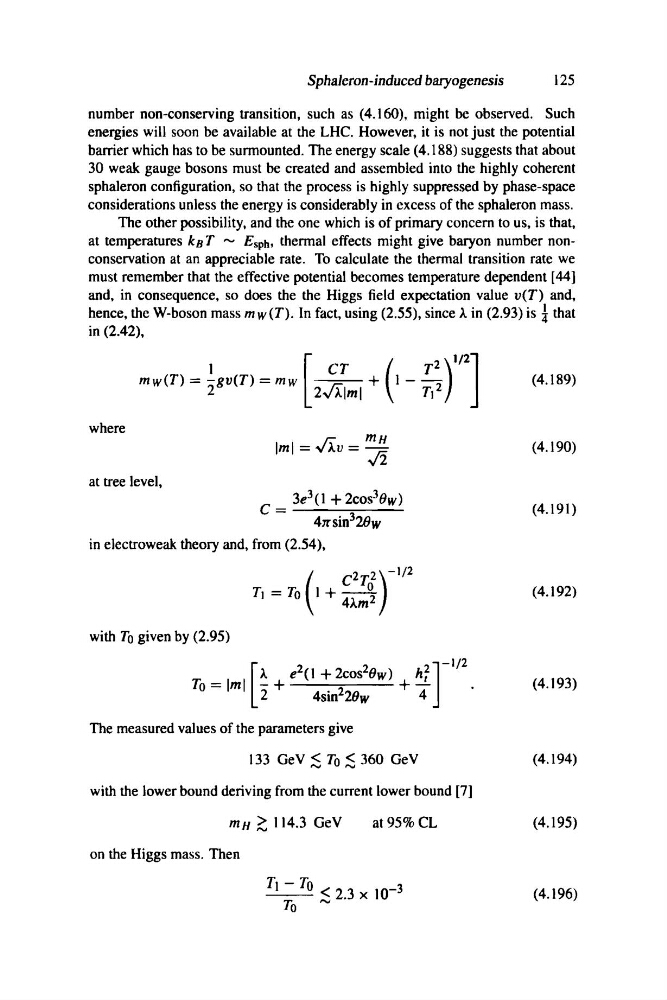
hence, the W-boson mass mw(T). In fact, using (2.55), since).. in (2.93) is! that
in (2.42),
I
CT + 1-~ 2 )1/2]
=
[
(
mw(T)
(4.189)
= "igv(T)
mw 2v'ilml
T12
where
=
=
mH
..ti
Iml ,Jiv
(4.190)
at tree level,
C = 3e 3 (l + 2cos 3 8w)
(4.191)
41rsin 3W w
in electroweak theory and, from (2.54),
C2T.2)-1/2
TJ
(
= To 1 +--%
(4.192)
4)..m
with To given by (2.95)
To = Iml [~ + e 2 (l + 2cos28w) h~]-J/2
2
4sin 2 28w
+"4
(4.193)
The measured values of the parameters give
133 GeV ;S To ;S 360 GeV
(4.194)
with the lower bound deriving from the current lower bound [7]
mH ~ 114.3 GeV
at 95% CL
(4.195)
on the Higgs mass. Then
Tl - TO < 2.3 x 10⁻³
(4.196)
To ""
125
number non-conserving transition, such as (4.160), might be observed. Such
energies will soon be available at the LHC. However, it is not just the potential
barrier which has to be sunnounted. The energy scale (4.188) suggests that about
30 weak gauge bosons must be created and assembled into the highly coherent
sphaleron configuration, so that the process is highly suppressed by phase-space
considerations unless the energy is considerably in excess of the sphaleron mass.
The other possibility, and the one which is of primary concern to us, is that,
at temperatures kBT '" Esph, thennal effects might give baryon number nonconservation at an appreciable rate. To calculate the thennal transition rate we
must remember that the effective potential becomes temperature dependent [44]
and, in consequence, so does the the Higgs field expectation value v(T) and,
hence, the W-boson mass mw(T). In fact, using (2.55), since).. in (2.93) is! that
in (2.42),
I
CT + 1-~ 2 )1/2]
=
[
(
mw(T)
(4.189)
= "igv(T)
mw 2v'ilml
T12
where
=
=
mH
..ti
Iml ,Jiv
(4.190)
at tree level,
C = 3e 3 (l + 2cos 3 8w)
(4.191)
41rsin 3W w
in electroweak theory and, from (2.54),
C2T.2)-1/2
TJ
(
= To 1 +--%
(4.192)
4)..m
with To given by (2.95)
To = Iml [~ + e 2 (l + 2cos28w) h~]-J/2
2
4sin 2 28w
+"4
(4.193)
The measured values of the parameters give
133 GeV ;S To ;S 360 GeV
(4.194)
with the lower bound deriving from the current lower bound [7]
mH ~ 114.3 GeV
at 95% CL
(4.195)
on the Higgs mass. Then
Tl - TO < 2.3 x 10⁻³
(4.196)
To ""