

122
Baryogenesis
For positive t'. the motion is just the reverse of the motion for negative t' , so that
b = ! 100 dt' LE = !SE.
(4.169)
-00
Thus. the quantum-mechanical transition rate r at which the particle tunnels
through the potential barrier is exponentially suppressed as [39.40J
r ex e- SE •
(4.170)
In a quantum field theory. to find the transition rate between adjacent vacua
we need a field configuration which interpolates between them in Euclidean
spacetime. as in section 2.9. We can get a feel for what is involved using an
observation made by Belavin et 01 [41J and 't Hooft [42J. For a Euclidean
spacetime.
J d"x (W;" - W;,,)2 ~ O.
(4.171)
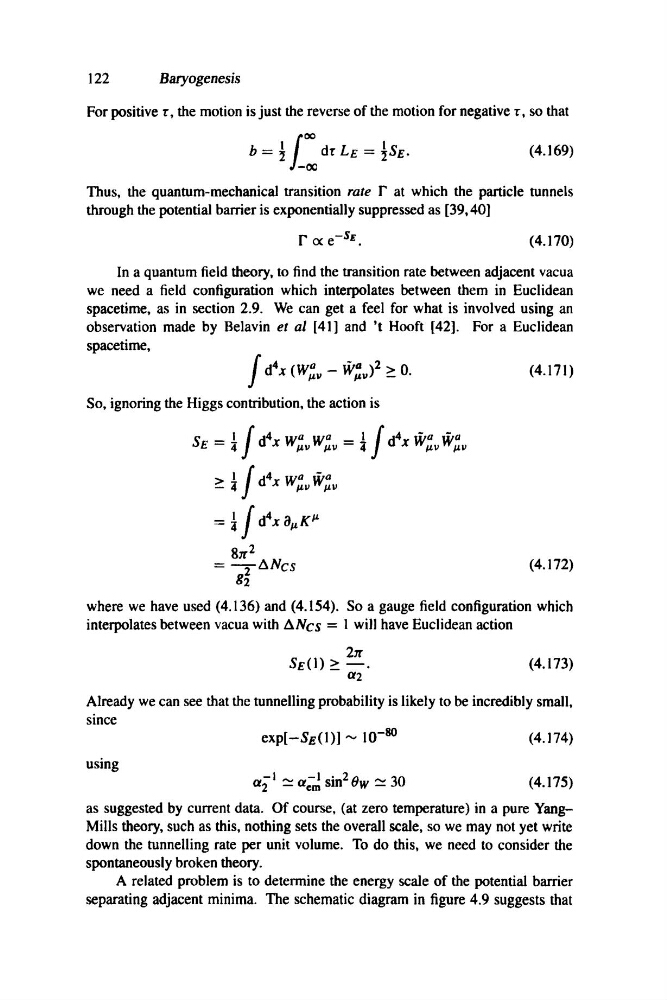
So. ignoring the Higgs contribution. the action is
W a W a
S
I Jd 4
I Jd 4 W- a W- a
E = 4
X
/.I." /.I." = 4
X
/.I." /.1.11
I Jd 4 W a W-a
~ 4
X
/.1.11 /.1.11
=! J d 4 xa/.l.K/.I.
81r 2
= - 2 I1Ncs
(4.172)
g2
where we have used (4.136) and (4.154). So a gauge field configuration which
interpolates between vacua with I1Ncs = I will have EucIidean action
2rr
SE(1) ~-.
(4.173)
a2
Already we can see that the tunnelling probability is likely to be incredibly small.
since
exp[-SE(1)J'" 10- 80
(4.174)
using
ail ~ a~ sin 2 9w ~ 30
(4.175)
as suggested by current data. Of course, (at zero temperature) in a pure YangMills theory. such as this. nothing sets the overall scale. so we may not yet write
down the tunnelling rate per unit volume. To do this, we need to consider the
spontaneously broken theory.
A related problem is to determine the energy scale of the potential barrier
separating adjacent minima. The schematic diagram in figure 4.9 suggests that
Baryogenesis
For positive t'. the motion is just the reverse of the motion for negative t' , so that
b = ! 100 dt' LE = !SE.
(4.169)
-00
Thus. the quantum-mechanical transition rate r at which the particle tunnels
through the potential barrier is exponentially suppressed as [39.40J
r ex e- SE •
(4.170)
In a quantum field theory. to find the transition rate between adjacent vacua
we need a field configuration which interpolates between them in Euclidean
spacetime. as in section 2.9. We can get a feel for what is involved using an
observation made by Belavin et 01 [41J and 't Hooft [42J. For a Euclidean
spacetime.
J d"x (W;" - W;,,)2 ~ O.
(4.171)
So. ignoring the Higgs contribution. the action is
W a W a
S
I Jd 4
I Jd 4 W- a W- a
E = 4
X
/.I." /.I." = 4
X
/.I." /.1.11
I Jd 4 W a W-a
~ 4
X
/.1.11 /.1.11
=! J d 4 xa/.l.K/.I.
81r 2
= - 2 I1Ncs
(4.172)
g2
where we have used (4.136) and (4.154). So a gauge field configuration which
interpolates between vacua with I1Ncs = I will have EucIidean action
2rr
SE(1) ~-.
(4.173)
a2
Already we can see that the tunnelling probability is likely to be incredibly small.
since
exp[-SE(1)J'" 10- 80
(4.174)
using
ail ~ a~ sin 2 9w ~ 30
(4.175)
as suggested by current data. Of course, (at zero temperature) in a pure YangMills theory. such as this. nothing sets the overall scale. so we may not yet write
down the tunnelling rate per unit volume. To do this, we need to consider the
spontaneously broken theory.
A related problem is to determine the energy scale of the potential barrier
separating adjacent minima. The schematic diagram in figure 4.9 suggests that