

120
Baryogenesis
E
It!
It I
• t
:7..-t::====
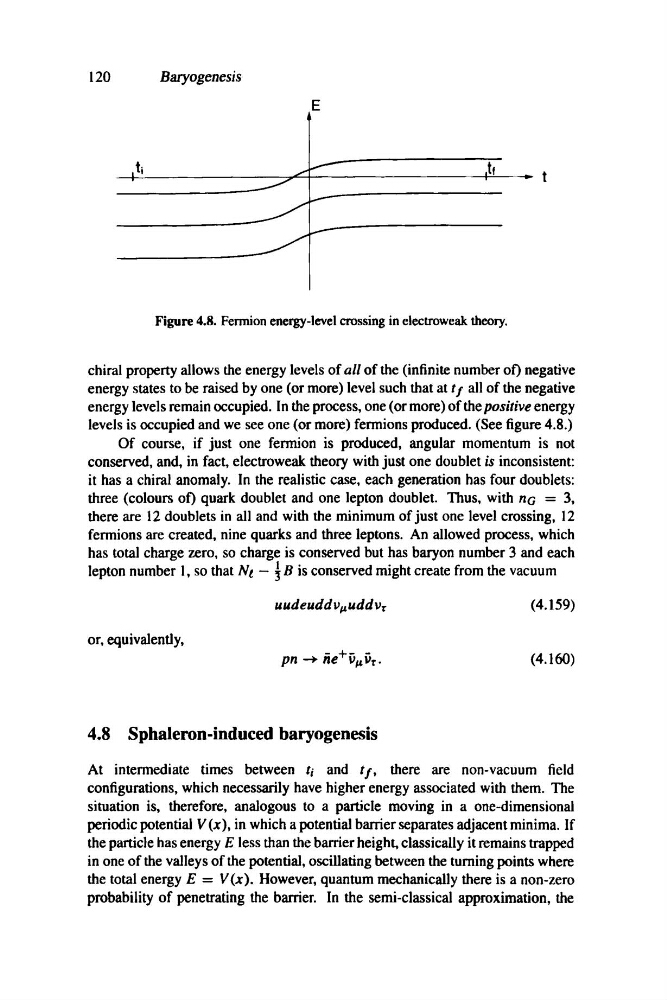
Figure 4.8. Fermion energy-level crossing in electroweak theory.
chiral property allows the energy levels of all of the (infinite number of) negative
energy states to be raised by one (or more) level such that at t, all of the negative
energy levels remain occupied. In the process, one (or more) of the positive energy
levels is occupied and we see one (or more) fermions produced. (See figure 4.8.)
Of course. if just one fermion is produced, angular momentum is not
conserved. and, in fact, electroweak theory with just one doublet is inconsistent:
it has a chiral anomaly. In the realistic case. each generation has four doublets:
three (colours of) quark doublet and one lepton doublet. Thus, with nG = 3,
there are 12 doublets in all and with the minimum of just one level crossing, 12
fermions are created, nine quarks and three leptons. An allowed process. which
has total charge zero, so charge is conserved but has baryon number 3 and each
lepton number I, so that Nt. - ! B is conserved might create from the vacuum
uudeuddv/luddvr
(4.159)
or, equivalently,
- +-
pn -+ ne V"V'l"
(4.160)
4.8 Spbaleron-induced baryogenesis
At intermediate times between t; and t" there are non-vacuum field
configurations, which necessarily have higher energy associated with them. The
situation is. therefore. analogous to a particle moving in a one-dimensional
periodic potential V (x). in which a potential barrier separates adjacent minima. If
the particle has energy E less than the barrier height, classically it remains trapped
in one of the valleys of the potential. oscillating between the turning points where
the total energy E = V(x). However. quantum mechanically there is a non-zero
probability of penetrating the barrier. In the semi-classical approximation, the
Baryogenesis
E
It!
It I
• t
:7..-t::====
Figure 4.8. Fermion energy-level crossing in electroweak theory.
chiral property allows the energy levels of all of the (infinite number of) negative
energy states to be raised by one (or more) level such that at t, all of the negative
energy levels remain occupied. In the process, one (or more) of the positive energy
levels is occupied and we see one (or more) fermions produced. (See figure 4.8.)
Of course. if just one fermion is produced, angular momentum is not
conserved. and, in fact, electroweak theory with just one doublet is inconsistent:
it has a chiral anomaly. In the realistic case. each generation has four doublets:
three (colours of) quark doublet and one lepton doublet. Thus, with nG = 3,
there are 12 doublets in all and with the minimum of just one level crossing, 12
fermions are created, nine quarks and three leptons. An allowed process. which
has total charge zero, so charge is conserved but has baryon number 3 and each
lepton number I, so that Nt. - ! B is conserved might create from the vacuum
uudeuddv/luddvr
(4.159)
or, equivalently,
- +-
pn -+ ne V"V'l"
(4.160)
4.8 Spbaleron-induced baryogenesis
At intermediate times between t; and t" there are non-vacuum field
configurations, which necessarily have higher energy associated with them. The
situation is. therefore. analogous to a particle moving in a one-dimensional
periodic potential V (x). in which a potential barrier separates adjacent minima. If
the particle has energy E less than the barrier height, classically it remains trapped
in one of the valleys of the potential. oscillating between the turning points where
the total energy E = V(x). However. quantum mechanically there is a non-zero
probability of penetrating the barrier. In the semi-classical approximation, the