

116
Baryogenesis
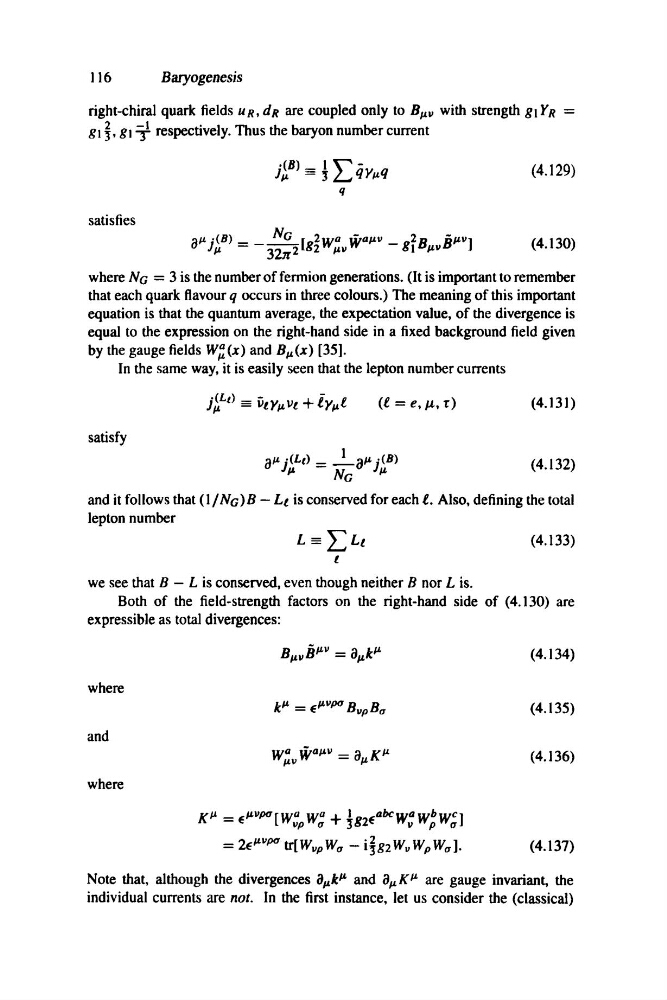
right-chiral quark fields UR. dR are coupled only to Bp.lI with strength gtYR =
gl i. gl =f respectively. Thus the baryon number current
i!B) == l L qYp.q
(4.129)
q
satisfies
ap.}·{B) = _ Na [g2Wa Wap.lI _ g2B SP.lI]
p.
321r
(4.130)
2 2 p.1)
1 P.lI
where Na = 3 is the number of fennion generations. (It is important to remember
that each quark flavour q occurs in three colours.) The meaning of this important
equation is that the quantum average, the expectation value, of the divergence is
equal to the expression on the right-hand side in a fixed background field given
by the gauge fields W:(x) and Bp.(x) [35].
In the same way, it is easily seen that the lepton number currents
j~Ll) == VtYp. Vt + lyp.l (l = e. /L. t')
(4.131)
satisfy
aP. iLL> = _1_ap. iB)
(4.132)
p.
Na
p.
and it follows that (1/ NG)B - Lt is conserved for each l. Also. defining the total
lepton number
L==LLt
(4.133)
t
we see that B - L is conserved. even though neither B nor Lis.
Both of the field-strength factors on the right-hand side of (4.130) are
expressible as total divergences:
Bp.lISP.1) = ap.kp.
(4.134)
where
kP. = ~P.lI/XI Blip Ba
(4.135)
and
W a Wap.1) = a KP.
P.lI
(4.136)
IL
where
KIL - EILlI/XI[w a W a + Ig2~abc~WbWc]
-
lip a
J
lIpU
= 2EP.lI/XI tr[WlIp Wu - i~g2 WI) Wp Wa ].
(4.137)
Note that. although the divergences ap.kIL and ap.Kp. are gauge invariant, the
individual currents are not. In the first instance. let us consider the (classical)
Baryogenesis
right-chiral quark fields UR. dR are coupled only to Bp.lI with strength gtYR =
gl i. gl =f respectively. Thus the baryon number current
i!B) == l L qYp.q
(4.129)
q
satisfies
ap.}·{B) = _ Na [g2Wa Wap.lI _ g2B SP.lI]
p.
321r
(4.130)
2 2 p.1)
1 P.lI
where Na = 3 is the number of fennion generations. (It is important to remember
that each quark flavour q occurs in three colours.) The meaning of this important
equation is that the quantum average, the expectation value, of the divergence is
equal to the expression on the right-hand side in a fixed background field given
by the gauge fields W:(x) and Bp.(x) [35].
In the same way, it is easily seen that the lepton number currents
j~Ll) == VtYp. Vt + lyp.l (l = e. /L. t')
(4.131)
satisfy
aP. iLL> = _1_ap. iB)
(4.132)
p.
Na
p.
and it follows that (1/ NG)B - Lt is conserved for each l. Also. defining the total
lepton number
L==LLt
(4.133)
t
we see that B - L is conserved. even though neither B nor Lis.
Both of the field-strength factors on the right-hand side of (4.130) are
expressible as total divergences:
Bp.lISP.1) = ap.kp.
(4.134)
where
kP. = ~P.lI/XI Blip Ba
(4.135)
and
W a Wap.1) = a KP.
P.lI
(4.136)
IL
where
KIL - EILlI/XI[w a W a + Ig2~abc~WbWc]
-
lip a
J
lIpU
= 2EP.lI/XI tr[WlIp Wu - i~g2 WI) Wp Wa ].
(4.137)
Note that. although the divergences ap.kIL and ap.Kp. are gauge invariant, the
individual currents are not. In the first instance. let us consider the (classical)