

108
Baryogenesis
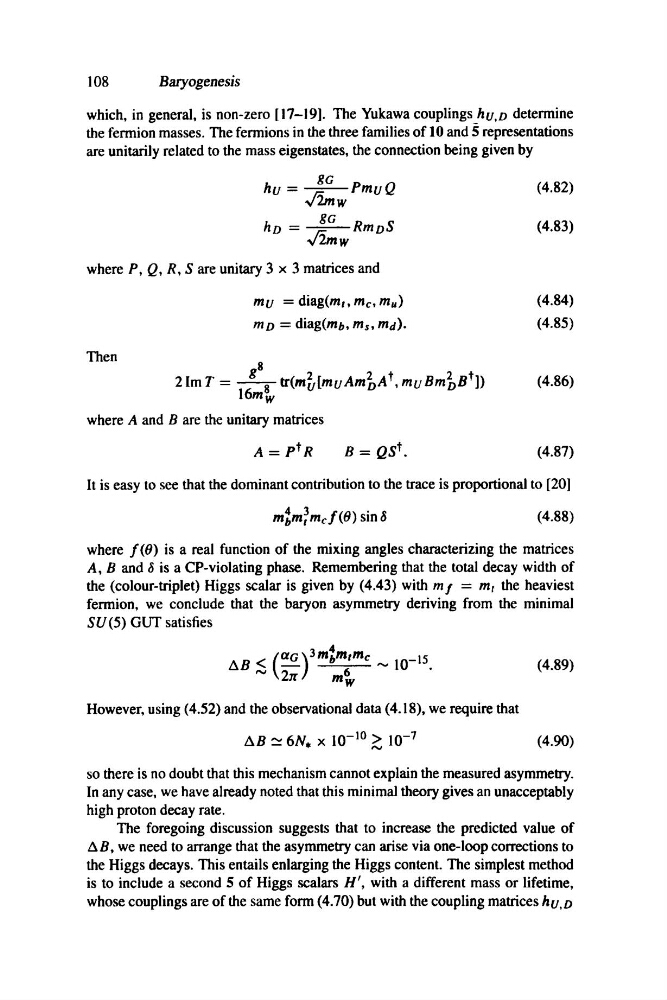
which, in general, is non-zero [17-19]. The Yukawa couplings hU.D detennine
the fennion masses. The fennions in the three families of 10 and 5 representations
are unitarily related to the mass eigenstates, the connection being given by
~PmuQ
(4.82)
hu = .J2mw
~RmDS
(4.83)
hD = ../2mw
where P, Q, R, S are unitary 3 x 3 matrices and
mu = diag(m" mc, mu)
(4.84)
mD = diag(mb, ms, md).
(4.85)
Then
gS
2Im T = --s- tr(m~(muAm~At, muBm~Bt])
(4.86)
16mw
where A and B are the unitary matrices
A = ptR
B = QS t .
(4.87)
It is easy to see that the dominant contribution to the trace is proportional to [20]
m:m:mc!(9) sin 8
(4.88)
where /(9) is a real function of the mixing angles characterizing the matrices
A, B and 8 is a CP-violating phase. Remembering that the total decay width of
the (colour-triplet) Higgs scalar is given by (4.43) with m f = m, the heaviest
fennion, we conclude that the baryon asymmetry deriving from the minimal
SU(5) GUT satisfies
llB < (a G )3 m : m ,m c
'" 2
,... 10- 15
(4.89)
1r
m6
•
w
However, using (4.52) and the observational data (4.18), we require that
llB ~ 6N. x 10- 10 > 10- 7
(4.90)
'"
so there is no doubt that this mechanism cannot explain the measured asymmetry.
In any case, we have already noted that this minimal theory gives an unacceptably
high proton decay rate.
The foregoing discussion suggests that to increase the predicted value of
llB, we need to arrange that the asymmetry can arise via one-loop corrections to
the Higgs decays. This entails enlarging the Higgs content. The simplest method
is to include a second 5 of Higgs scalars H', with a different mass or lifetime,
whose couplings are of the same fonn (4.70) but with the coupling matrices hU.D
Baryogenesis
which, in general, is non-zero [17-19]. The Yukawa couplings hU.D detennine
the fennion masses. The fennions in the three families of 10 and 5 representations
are unitarily related to the mass eigenstates, the connection being given by
~PmuQ
(4.82)
hu = .J2mw
~RmDS
(4.83)
hD = ../2mw
where P, Q, R, S are unitary 3 x 3 matrices and
mu = diag(m" mc, mu)
(4.84)
mD = diag(mb, ms, md).
(4.85)
Then
gS
2Im T = --s- tr(m~(muAm~At, muBm~Bt])
(4.86)
16mw
where A and B are the unitary matrices
A = ptR
B = QS t .
(4.87)
It is easy to see that the dominant contribution to the trace is proportional to [20]
m:m:mc!(9) sin 8
(4.88)
where /(9) is a real function of the mixing angles characterizing the matrices
A, B and 8 is a CP-violating phase. Remembering that the total decay width of
the (colour-triplet) Higgs scalar is given by (4.43) with m f = m, the heaviest
fennion, we conclude that the baryon asymmetry deriving from the minimal
SU(5) GUT satisfies
llB < (a G )3 m : m ,m c
'" 2
,... 10- 15
(4.89)
1r
m6
•
w
However, using (4.52) and the observational data (4.18), we require that
llB ~ 6N. x 10- 10 > 10- 7
(4.90)
'"
so there is no doubt that this mechanism cannot explain the measured asymmetry.
In any case, we have already noted that this minimal theory gives an unacceptably
high proton decay rate.
The foregoing discussion suggests that to increase the predicted value of
llB, we need to arrange that the asymmetry can arise via one-loop corrections to
the Higgs decays. This entails enlarging the Higgs content. The simplest method
is to include a second 5 of Higgs scalars H', with a different mass or lifetime,
whose couplings are of the same fonn (4.70) but with the coupling matrices hU.D