

106
Baryogenesis
u
H3 - - - -
I
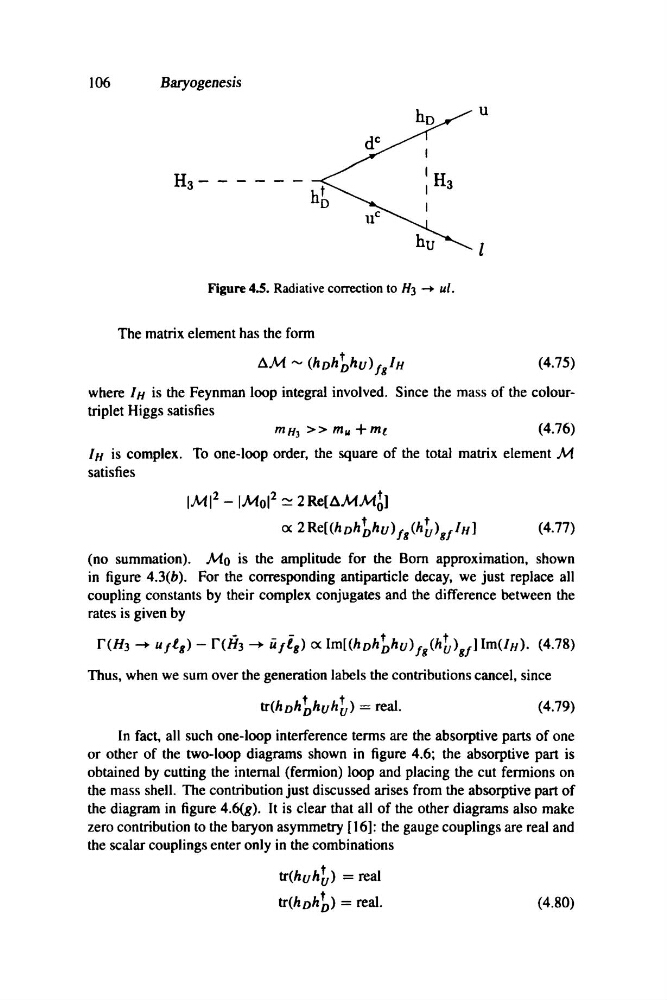
Figure 4.5. Radiative correction to H3 -+ uf.
The matrix element has the form
dM ...., (hDhbhu) f /H
(4.75)
where I H is the Feynman loop integral involved. Since the mass of the colourtriplet Higgs satisfies
mH3 » mu + mt
(4.76)
IH is complex. To one-loop order, the square of the total matrix element M
satisfies
IM 12 - IMol2 ~ 2 Re[dMM~]
QC 2 Re[(hDhbhu) fg(h~)gfIH]
(4.77)
(no summation). Mo is the amplitude for the Born approximation, shown
in figure 4.3(b). For the corresponding antiparticle decay, we just replace all
coupling constants by their complex conjugates and the difference between the
rates is given by
r(H3 -+ Uflg) - r(li3 -+ ufig) QC Im[(hDhbhu) f8(h~)gf] Im(lH). (4.78)
Thus, when we sum over the generation labels the contributions cancel, since
tr(hDhbhUh~) = real.
(4.79)
In fact, all such one-loop interference terms are the absorptive parts of one
or other of the two-loop diagrams shown in figure 4.6; the absorptive part is
obtained by cutting the internal (fermion) loop and placing the cut fermions on
the mass shell. The contribution just discussed arises from the absorptive part of
the diagram in figure 4.6(g). It is clear that all of the other diagrams also make
zero contribution to the baryon asymmetry [16]: the gauge couplings are real and
the scalar couplings enter only in the combinations
tr(huh~) = real
tr(hDhb) = real.
(4.80)
Baryogenesis
u
H3 - - - -
I
Figure 4.5. Radiative correction to H3 -+ uf.
The matrix element has the form
dM ...., (hDhbhu) f /H
(4.75)
where I H is the Feynman loop integral involved. Since the mass of the colourtriplet Higgs satisfies
mH3 » mu + mt
(4.76)
IH is complex. To one-loop order, the square of the total matrix element M
satisfies
IM 12 - IMol2 ~ 2 Re[dMM~]
QC 2 Re[(hDhbhu) fg(h~)gfIH]
(4.77)
(no summation). Mo is the amplitude for the Born approximation, shown
in figure 4.3(b). For the corresponding antiparticle decay, we just replace all
coupling constants by their complex conjugates and the difference between the
rates is given by
r(H3 -+ Uflg) - r(li3 -+ ufig) QC Im[(hDhbhu) f8(h~)gf] Im(lH). (4.78)
Thus, when we sum over the generation labels the contributions cancel, since
tr(hDhbhUh~) = real.
(4.79)
In fact, all such one-loop interference terms are the absorptive parts of one
or other of the two-loop diagrams shown in figure 4.6; the absorptive part is
obtained by cutting the internal (fermion) loop and placing the cut fermions on
the mass shell. The contribution just discussed arises from the absorptive part of
the diagram in figure 4.6(g). It is clear that all of the other diagrams also make
zero contribution to the baryon asymmetry [16]: the gauge couplings are real and
the scalar couplings enter only in the combinations
tr(huh~) = real
tr(hDhb) = real.
(4.80)