

98
Baryogenesis
gauge coupling [10.11]. Then the condition (4.38) can be easily satisfied. since,
in this case. we require only that
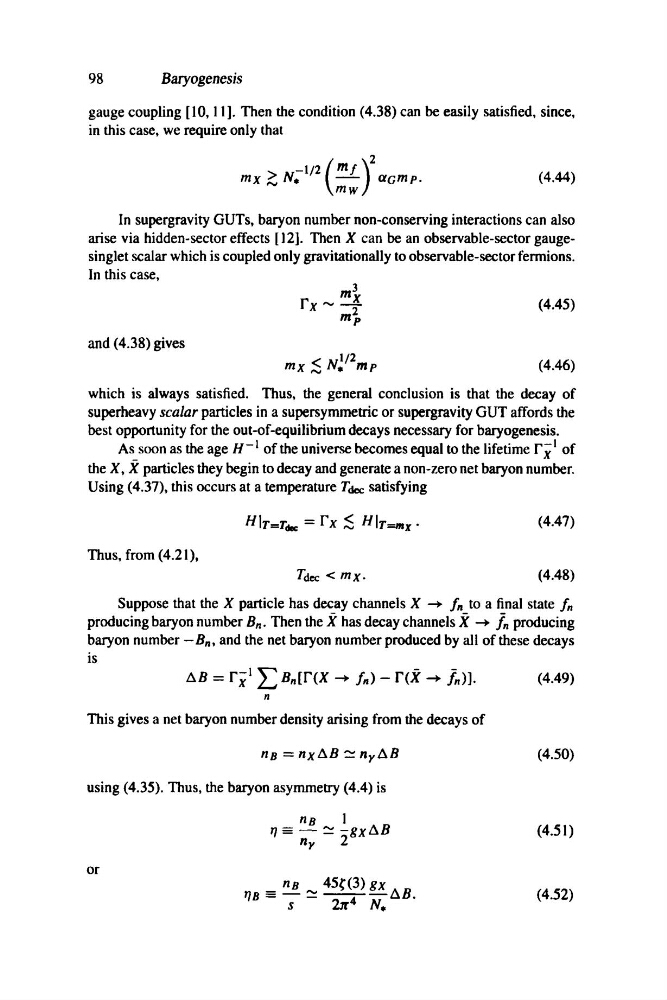
mx ~ N;I/2 (mf)2
(4.44)
mW
uGmp.
In supergravity GUTs. baryon number non-conserving interactions can also
arise via hidden-sector effects [12]. Then X can be an observable-sector gaugesinglet scalar which is coupled only gravitationally to observable-sector fermions.
In this case.
m 3
rx--K
(4.45)
m 2 p
and (4.38) gives
1/2
mx;S N. mp
(4.46)
which is always satisfied. Thus. the general conclusion is that the decay of
superheavy scalar particles in a supersymmetric or supergravity GUT affords the
best opportunity for the out-of-equilibrium decays necessary for baryogenesis.
As soon as the age H-1 of the universe becomes equal to the lifetime rx 1 of
the X. X particles they begin to decay and generate a non-zero net baryon number.
Using (4.37), this occurs at a temperature Tdcc satisfying
HIT=Tdec = rx ;S HIT=mx'
(4.47)
Thus. from (4.21),
Tdec < mx·
(4.48)
Suppose that the X particle has decay channels X ~ In to a final state In
producing baryon number Bn. Then the X has decay channels X ~ in producing
baryon number -Bn. and the net baryon number produced by all of these decays
is
!loB = rx 1 L Bn[f(X ~ In) - r(X ~ in)].
(4.49)
n
This gives a net baryon number density arising from the decays of
nB = nx!loB ~ ny!loB
(4.50)
using (4.35). Thus. the baryon asymmetry (4.4) is
" == nB '" I
(4.51)
ny - "2 gx !loB
or
nB '" 45~(3) gX !loB.
(4.52)
'1B == --;- - 23r4 N.
Baryogenesis
gauge coupling [10.11]. Then the condition (4.38) can be easily satisfied. since,
in this case. we require only that
mx ~ N;I/2 (mf)2
(4.44)
mW
uGmp.
In supergravity GUTs. baryon number non-conserving interactions can also
arise via hidden-sector effects [12]. Then X can be an observable-sector gaugesinglet scalar which is coupled only gravitationally to observable-sector fermions.
In this case.
m 3
rx--K
(4.45)
m 2 p
and (4.38) gives
1/2
mx;S N. mp
(4.46)
which is always satisfied. Thus. the general conclusion is that the decay of
superheavy scalar particles in a supersymmetric or supergravity GUT affords the
best opportunity for the out-of-equilibrium decays necessary for baryogenesis.
As soon as the age H-1 of the universe becomes equal to the lifetime rx 1 of
the X. X particles they begin to decay and generate a non-zero net baryon number.
Using (4.37), this occurs at a temperature Tdcc satisfying
HIT=Tdec = rx ;S HIT=mx'
(4.47)
Thus. from (4.21),
Tdec < mx·
(4.48)
Suppose that the X particle has decay channels X ~ In to a final state In
producing baryon number Bn. Then the X has decay channels X ~ in producing
baryon number -Bn. and the net baryon number produced by all of these decays
is
!loB = rx 1 L Bn[f(X ~ In) - r(X ~ in)].
(4.49)
n
This gives a net baryon number density arising from the decays of
nB = nx!loB ~ ny!loB
(4.50)
using (4.35). Thus. the baryon asymmetry (4.4) is
" == nB '" I
(4.51)
ny - "2 gx !loB
or
nB '" 45~(3) gX !loB.
(4.52)
'1B == --;- - 23r4 N.