

96
Baryogenesis
Then the asymmetry vanishes, since
11 ex RX - Ri = O.
(4.33)
Only a departure from thermal equilibrium will permit an asymmetry. Such
a departure can arise, for example, during a phase transition in which gauge
symmetry breaking occurs. It can also arise due to the expansion of the universe
during the decay of a heavy particle.
4.3 Out-oC-equilibrium decay of heavy particles
Given enough time any particle, no matter how weakly it interacts, will reach
thermal equilibrium. However, in an expanding universe, it becomes increasingly
difficult for any given species X of particle to remain in thermal eqUilibrium.
This is because the expansion dilutes the densities of all particles with which
X interacts and thereby inhibits the rate of the interactions needed to maintain
equilibrium; and also because the rate of decay rx of the X particles eventually
falls below the expansion rate H of the universe and the decays are unable to
reduce the numbers of X particles to the levels required to stay in equilibrium.
Suppose X is a superheavy boson, having non-zero baryon number, which
decays to lighter fermions f in a baryon-number non-conserving process. Gauge
vector bosons and Higgs scalar particles with these properties arise naturally
in grand unified theories (GUTs) which unify the strong and electroweak
interactions [lO,II]. At high temperatures T » mx, we assume that all particles
are in equilibrium, and that the net baryon number B is zero. The number
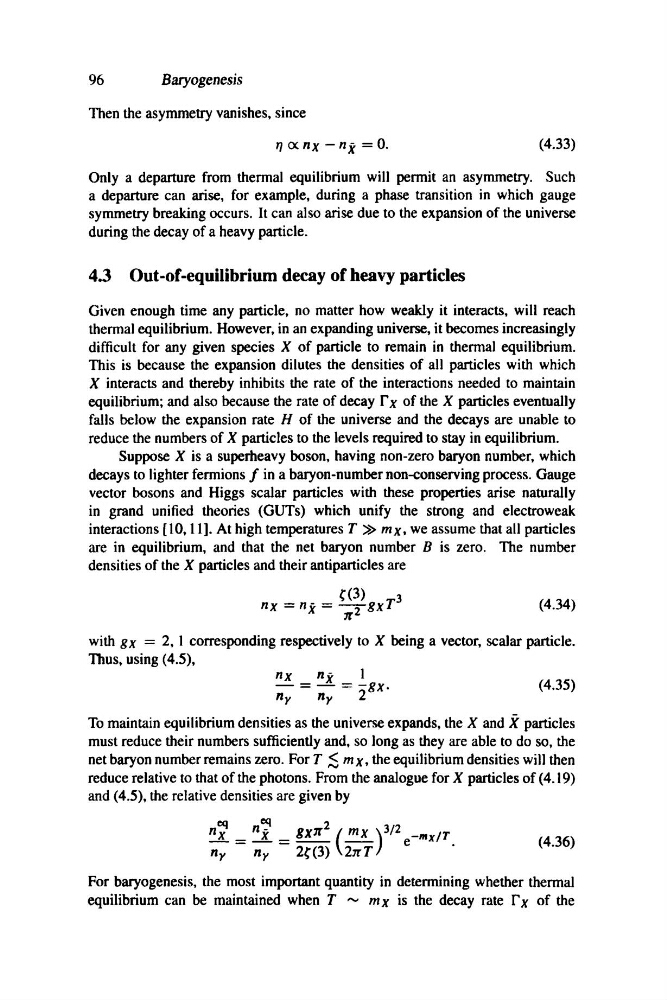
densities of the X particles and their antiparticles are
~(3)
3
RX = Ri = -2-gxT
(4.34)
1r
with gx = 2, I corresponding respectively to X being a vector, scalar particle.
Thus, using (4.5),
RX _ Ri
1
(4.35)
Ry - Ry = i gx .
To maintain equilibrium densities as the universe expands, the X and i particles
must reduce their numbers sufficiently and, so long as they are able to do so, the
net baryon number remains zero. For T ;S m x, the equilibrium densities will then
reduce relative to that of the photons. From the analogue for X particles of (4.19)
and (4.5), the relative densities are given by
eq
eq
2
RX = ni = gX 1r (mx )3/2 e-mxIT .
(4.36)
ny
ny
2~(3) 21rT
For baryogenesis, the most important quantity in determining whether thermal
equilibrium can be maintained when T '" mx is the decay rate rx of the
Baryogenesis
Then the asymmetry vanishes, since
11 ex RX - Ri = O.
(4.33)
Only a departure from thermal equilibrium will permit an asymmetry. Such
a departure can arise, for example, during a phase transition in which gauge
symmetry breaking occurs. It can also arise due to the expansion of the universe
during the decay of a heavy particle.
4.3 Out-oC-equilibrium decay of heavy particles
Given enough time any particle, no matter how weakly it interacts, will reach
thermal equilibrium. However, in an expanding universe, it becomes increasingly
difficult for any given species X of particle to remain in thermal eqUilibrium.
This is because the expansion dilutes the densities of all particles with which
X interacts and thereby inhibits the rate of the interactions needed to maintain
equilibrium; and also because the rate of decay rx of the X particles eventually
falls below the expansion rate H of the universe and the decays are unable to
reduce the numbers of X particles to the levels required to stay in equilibrium.
Suppose X is a superheavy boson, having non-zero baryon number, which
decays to lighter fermions f in a baryon-number non-conserving process. Gauge
vector bosons and Higgs scalar particles with these properties arise naturally
in grand unified theories (GUTs) which unify the strong and electroweak
interactions [lO,II]. At high temperatures T » mx, we assume that all particles
are in equilibrium, and that the net baryon number B is zero. The number
densities of the X particles and their antiparticles are
~(3)
3
RX = Ri = -2-gxT
(4.34)
1r
with gx = 2, I corresponding respectively to X being a vector, scalar particle.
Thus, using (4.5),
RX _ Ri
1
(4.35)
Ry - Ry = i gx .
To maintain equilibrium densities as the universe expands, the X and i particles
must reduce their numbers sufficiently and, so long as they are able to do so, the
net baryon number remains zero. For T ;S m x, the equilibrium densities will then
reduce relative to that of the photons. From the analogue for X particles of (4.19)
and (4.5), the relative densities are given by
eq
eq
2
RX = ni = gX 1r (mx )3/2 e-mxIT .
(4.36)
ny
ny
2~(3) 21rT
For baryogenesis, the most important quantity in determining whether thermal
equilibrium can be maintained when T '" mx is the decay rate rx of the