

Introduction
93
where
27r 2
s- - 45 g.s,TT 3
(4.14)
with
( T;)3 7
(T;)3
= L T +"8 L T
(4.15)
g.S,T
gi
gi
bosons
ferrmons
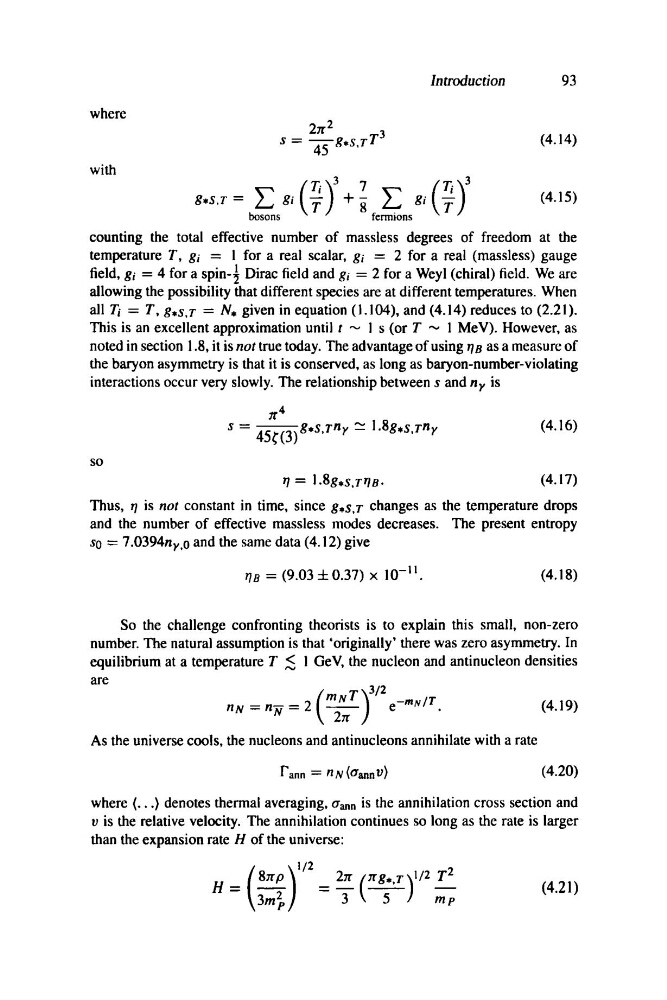
counting the total effective number of massless degrees of freedom at the
temperature T, gi = I for a real scalar, gi = 2 for a real (mass less) gauge
field, gi = 4 for a spin-! Dirac field and gi = 2 for a Weyl (chiral) field. We are
allowing
T;
the possibility that different species are at different temperatures. When
all
= T, g.S,T = N. given in equation (1.104), and (4.14) reduces to (2.21).
This is an excellent approximation until t '" 1 s (or T '" 1 MeV). However, as
noted in section 1.8, it is not true today. The advantage of using '1 B as a measure of
the baryon asymmetry is that it is conserved, as long as baryon-number-violating
interactions occur very slowly. The relationship between s and ny is
7r 4
s = 45~(3)g.S.Tny ~ 1.8g.s,Tny
(4.16)
so
'1 = 1.8g.S,T'1B.
(4.17)
Thus, '1 is not constant in time, since g.S,T changes as the temperature drops
and the number of effective massless modes decreases. The present entropy
so = 7 .0394ny ,0 and the same data (4.12) give
'18 = (9.03 ± 0.37) x 10- 11 .
(4.18)
So the challenge confronting theorists is to explain this small, non-zero
number. The natural assumption is that 'originally' there was zero asymmetry. In
equilibrium at a temperature T ~ 1 GeV, the nucleon and antinucleon densities
are
nN = nN = 2 (mNT)3/2 27r
e- mN / T •
(4.19)
As the universe cools, the nucleons and antinucleons annihilate with a rate
r ann = RN (aannV)
(4.20)
where ( ... ) denotes thermal averaging, aann is the annihilation cross section and
v is the relative velocity. The annihilation continues so long as the rate is larger
than the expansion rate H of the universe:
1/2
H = ( 87r~) = 27r (7r g .,T )1/2 T2
(4.21)
3mp
3
5
mp
93
where
27r 2
s- - 45 g.s,TT 3
(4.14)
with
( T;)3 7
(T;)3
= L T +"8 L T
(4.15)
g.S,T
gi
gi
bosons
ferrmons
counting the total effective number of massless degrees of freedom at the
temperature T, gi = I for a real scalar, gi = 2 for a real (mass less) gauge
field, gi = 4 for a spin-! Dirac field and gi = 2 for a Weyl (chiral) field. We are
allowing
T;
the possibility that different species are at different temperatures. When
all
= T, g.S,T = N. given in equation (1.104), and (4.14) reduces to (2.21).
This is an excellent approximation until t '" 1 s (or T '" 1 MeV). However, as
noted in section 1.8, it is not true today. The advantage of using '1 B as a measure of
the baryon asymmetry is that it is conserved, as long as baryon-number-violating
interactions occur very slowly. The relationship between s and ny is
7r 4
s = 45~(3)g.S.Tny ~ 1.8g.s,Tny
(4.16)
so
'1 = 1.8g.S,T'1B.
(4.17)
Thus, '1 is not constant in time, since g.S,T changes as the temperature drops
and the number of effective massless modes decreases. The present entropy
so = 7 .0394ny ,0 and the same data (4.12) give
'18 = (9.03 ± 0.37) x 10- 11 .
(4.18)
So the challenge confronting theorists is to explain this small, non-zero
number. The natural assumption is that 'originally' there was zero asymmetry. In
equilibrium at a temperature T ~ 1 GeV, the nucleon and antinucleon densities
are
nN = nN = 2 (mNT)3/2 27r
e- mN / T •
(4.19)
As the universe cools, the nucleons and antinucleons annihilate with a rate
r ann = RN (aannV)
(4.20)
where ( ... ) denotes thermal averaging, aann is the annihilation cross section and
v is the relative velocity. The annihilation continues so long as the rate is larger
than the expansion rate H of the universe:
1/2
H = ( 87r~) = 27r (7r g .,T )1/2 T2
(4.21)
3mp
3
5
mp