

475
Q.2. The electroweak theory
the t 3 = +1/2 quarks denoted by f, where f = u, c, t; and for the t 3 = −1/2
′
′
CKM-mixed quarks denoted by f
′ where f = d
′ , s , b
′ .
Note that for simplicity we do not include neutrino flavour mixing.
Q.2.1 External particles
Leptons and quarks
For each fermion or antifermion line entering the graph include the spinor
u(p, s)
or
v(p, s)
(Q.8)
and for spin1 particles leaving the graph the spinor
2
′
′
u ¯(p , s
′ )
or
v ¯(p , s
′ ).
(Q.9)
Vector bosons
For each vector boson line entering the graph include the factor
∈ μ (k, λ)
(Q.10)
and for vector bosons leaving the graph the factor
∈
∗
μ (k
′ , λ
′ ).
(Q.11)
Q.2.2 Propagators
Leptons and quarks
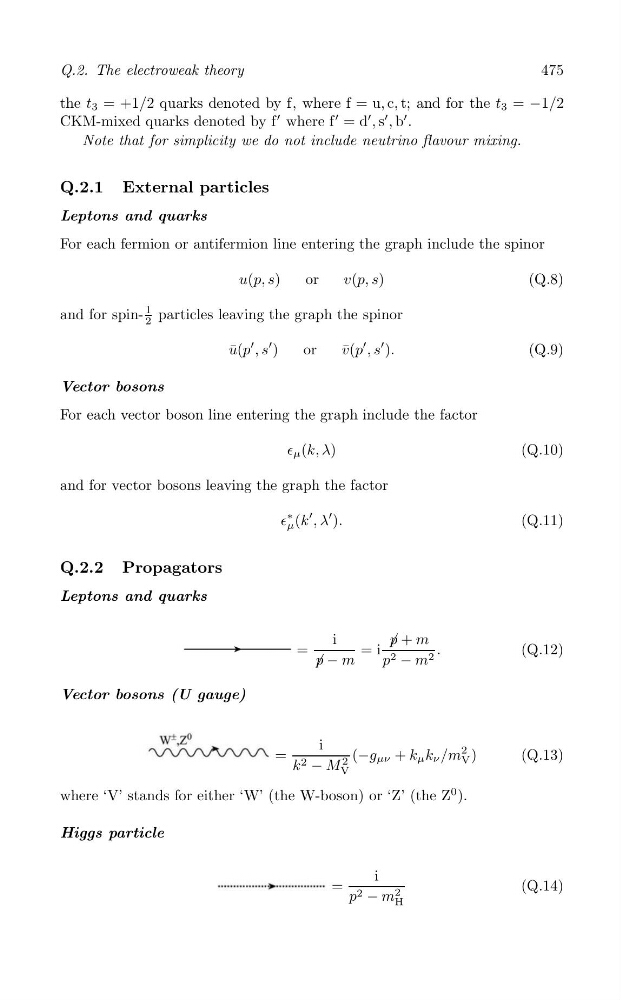
i
/ p + m
=
= i
.
(Q.12)
/ p − m
p 2 − m 2
Vector bosons (U gauge)
=
i
(−g μν + k μ k ν /m
2
(Q.13)
V )
k 2 − M 2
V
where ‘V’ stands for either ‘W’ (the W-boson) or ‘Z’ (the Z
0 ).
Higgs particle
i
=
(Q.14)
2
p 2 − m H