

79
3.4. The negative-energy solutions
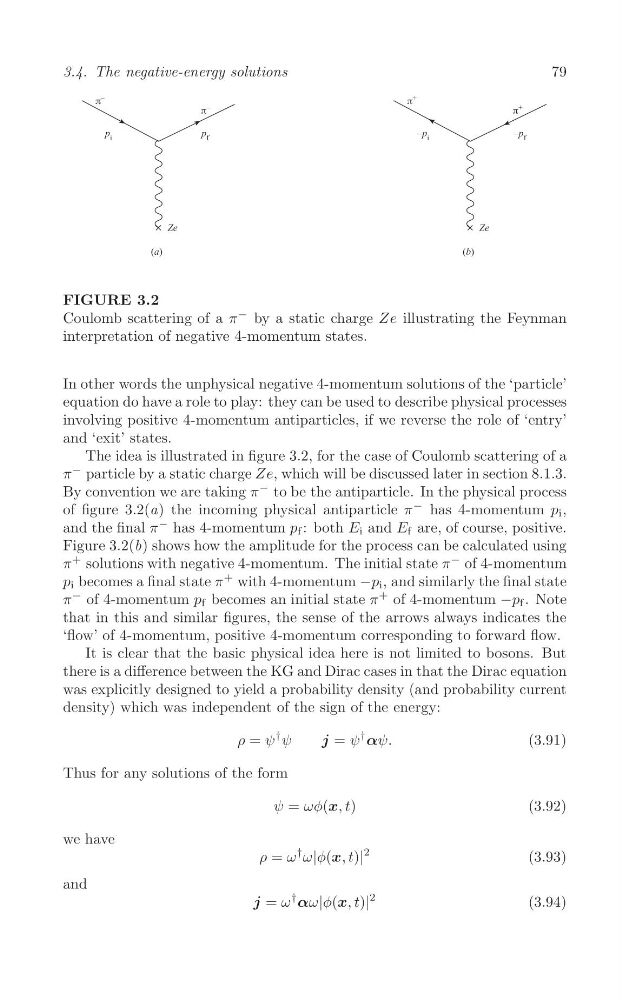
FIGURE 3.2
Coulomb scattering of a π
− by a static charge Ze illustrating the Feynman
interpretation of negative 4-momentum states.
In other words the unphysical negative 4-momentum solutions of the ‘particle’
equation do have a role to play: they can be used to describe physical processes
involving positive 4-momentum antiparticles, if we reverse the role of ‘entry’
and ‘exit’ states.
The idea is illustrated in figure 3.2, for the case of Coulomb scattering of a
π
− particle by a static charge Ze, which will be discussed later in section 8.1.3.
By convention we are taking π
− to be the antiparticle. In the physical process
of figure 3.2(a) the incoming physical antiparticle π
− has 4-momentum p i ,
and the final π
− has 4-momentum p f : both E i and E f are, of course, positive.
Figure 3.2(b) shows how the amplitude for the process can be calculated using
π
+ solutions with negative 4-momentum. The initial state π
− of 4-momentum
p i becomes a final state π
+ with 4-momentum −p i , and similarly the final state
π
− of 4-momentum p f becomes an initial state π
+ of 4-momentum −p f . Note
that in this and similar figures, the sense of the arrows always indicates the
‘flow’ of 4-momentum, positive 4-momentum corresponding to forward flow.
It is clear that the basic physical idea here is not limited to bosons. But
there is a difference between the KG and Dirac cases in that the Dirac equation
was explicitly designed to yield a probability density (and probability current
density) which was independent of the sign of the energy:
ρ = ψ
† ψ
j = ψ
†
αψ.
(3.91)
Thus for any solutions of the form
ψ = ωφ(x, t)
(3.92)
we have
ρ = ω
† ω|φ(x, t)|
2
(3.93)
and
j = ω
†
αω|φ(x, t)|
2
(3.94)
3.4. The negative-energy solutions
FIGURE 3.2
Coulomb scattering of a π
− by a static charge Ze illustrating the Feynman
interpretation of negative 4-momentum states.
In other words the unphysical negative 4-momentum solutions of the ‘particle’
equation do have a role to play: they can be used to describe physical processes
involving positive 4-momentum antiparticles, if we reverse the role of ‘entry’
and ‘exit’ states.
The idea is illustrated in figure 3.2, for the case of Coulomb scattering of a
π
− particle by a static charge Ze, which will be discussed later in section 8.1.3.
By convention we are taking π
− to be the antiparticle. In the physical process
of figure 3.2(a) the incoming physical antiparticle π
− has 4-momentum p i ,
and the final π
− has 4-momentum p f : both E i and E f are, of course, positive.
Figure 3.2(b) shows how the amplitude for the process can be calculated using
π
+ solutions with negative 4-momentum. The initial state π
− of 4-momentum
p i becomes a final state π
+ with 4-momentum −p i , and similarly the final state
π
− of 4-momentum p f becomes an initial state π
+ of 4-momentum −p f . Note
that in this and similar figures, the sense of the arrows always indicates the
‘flow’ of 4-momentum, positive 4-momentum corresponding to forward flow.
It is clear that the basic physical idea here is not limited to bosons. But
there is a difference between the KG and Dirac cases in that the Dirac equation
was explicitly designed to yield a probability density (and probability current
density) which was independent of the sign of the energy:
ρ = ψ
† ψ
j = ψ
†
αψ.
(3.91)
Thus for any solutions of the form
ψ = ωφ(x, t)
(3.92)
we have
ρ = ω
† ω|φ(x, t)|
2
(3.93)
and
j = ω
†
αω|φ(x, t)|
2
(3.94)