

451
M.7. The relation between SU(2) and SO(3)
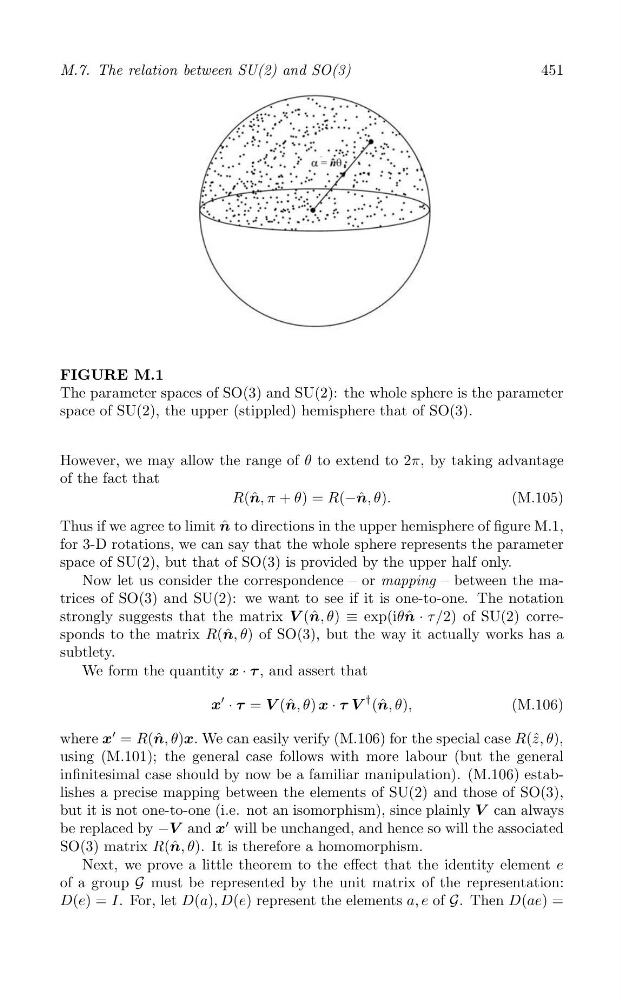
FIGURE M.1
The parameter spaces of SO(3) and SU(2): the whole sphere is the parameter
space of SU(2), the upper (stippled) hemisphere that of SO(3).
However, we may allow the range of θ to extend to 2π, by taking advantage
of the fact that
R(n ˆ , π + θ) = R(−n ˆ , θ).
(M.105)
Thus if we agree to limit n ˆ to directions in the upper hemisphere of figure M.1,
for 3-D rotations, we can say that the whole sphere represents the parameter
space of SU(2), but that of SO(3) is provided by the upper half only.
Now let us consider the correspondence – or mapping – between the matrices of SO(3) and SU(2): we want to see if it is one-to-one. The notation
strongly suggests that the matrix V (n ˆ , θ) ≡ exp(iθn ˆ · τ/2) of SU(2) corresponds to the matrix R(n ˆ , θ) of SO(3), but the way it actually works has a
subtlety.
We form the quantity x · τ , and assert that
′
x · τ = V (n ˆ , θ) x · τ V
† (n ˆ , θ),
(M.106)
′
where x = R(n ˆ , θ)x. We can easily verify (M.106) for the special case R(ˆ z, θ),
using (M.101); the general case follows with more labour (but the general
infinitesimal case should by now be a familiar manipulation). (M.106) establishes a precise mapping between the elements of SU(2) and those of SO(3),
but it is not one-to-one (i.e. not an isomorphism), since plainly V can always
′
be replaced by −V and x will be unchanged, and hence so will the associated
SO(3) matrix R(n ˆ , θ). It is therefore a homomorphism.
Next, we prove a little theorem to the effect that the identity element e
of a group G must be represented by the unit matrix of the representation:
D(e) = I. For, let D(a), D(e) represent the elements a, e of G. Then D(ae) =
M.7. The relation between SU(2) and SO(3)
FIGURE M.1
The parameter spaces of SO(3) and SU(2): the whole sphere is the parameter
space of SU(2), the upper (stippled) hemisphere that of SO(3).
However, we may allow the range of θ to extend to 2π, by taking advantage
of the fact that
R(n ˆ , π + θ) = R(−n ˆ , θ).
(M.105)
Thus if we agree to limit n ˆ to directions in the upper hemisphere of figure M.1,
for 3-D rotations, we can say that the whole sphere represents the parameter
space of SU(2), but that of SO(3) is provided by the upper half only.
Now let us consider the correspondence – or mapping – between the matrices of SO(3) and SU(2): we want to see if it is one-to-one. The notation
strongly suggests that the matrix V (n ˆ , θ) ≡ exp(iθn ˆ · τ/2) of SU(2) corresponds to the matrix R(n ˆ , θ) of SO(3), but the way it actually works has a
subtlety.
We form the quantity x · τ , and assert that
′
x · τ = V (n ˆ , θ) x · τ V
† (n ˆ , θ),
(M.106)
′
where x = R(n ˆ , θ)x. We can easily verify (M.106) for the special case R(ˆ z, θ),
using (M.101); the general case follows with more labour (but the general
infinitesimal case should by now be a familiar manipulation). (M.106) establishes a precise mapping between the elements of SU(2) and those of SO(3),
but it is not one-to-one (i.e. not an isomorphism), since plainly V can always
′
be replaced by −V and x will be unchanged, and hence so will the associated
SO(3) matrix R(n ˆ , θ). It is therefore a homomorphism.
Next, we prove a little theorem to the effect that the identity element e
of a group G must be represented by the unit matrix of the representation:
D(e) = I. For, let D(a), D(e) represent the elements a, e of G. Then D(ae) =