

76
3. Relativistic Quantum Mechanics
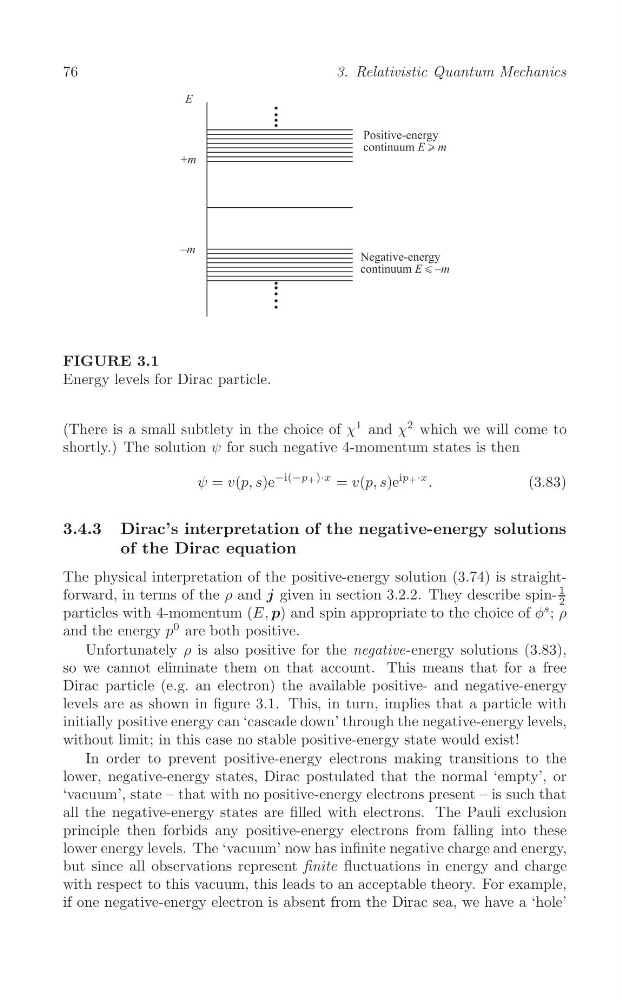
FIGURE 3.1
Energy levels for Dirac particle.
(There is a small subtlety in the choice of χ
1 and χ
2 which we will come to
shortly.) The solution ψ for such negative 4-momentum states is then
ψ = v(p, s)e
−i(−p+)·x = v(p, s)e
ip+ ·x .
(3.83)
3.4.3 Dirac’s interpretation of the negative-energy solutions
of the Dirac equation
The physical interpretation of the positive-energy solution (3.74) is straightforward, in terms of the ρ and j given in section 3.2.2. They describe spin1
2
particles with 4-momentum (E, p) and spin appropriate to the choice of φ
s ; ρ
and the energy p
0 are both positive.
Unfortunately ρ is also positive for the negative-energy solutions (3.83),
so we cannot eliminate them on that account. This means that for a free
Dirac particle (e.g. an electron) the available positive- and negative-energy
levels are as shown in figure 3.1. This, in turn, implies that a particle with
initially positive energy can ‘cascade down’ through the negative-energy levels,
without limit; in this case no stable positive-energy state would exist!
In order to prevent positive-energy electrons making transitions to the
lower, negative-energy states, Dirac postulated that the normal ‘empty’, or
‘vacuum’, state – that with no positive-energy electrons present – is such that
all the negative-energy states are filled with electrons. The Pauli exclusion
principle then forbids any positive-energy electrons from falling into these
lower energy levels. The ‘vacuum’ now has infinite negative charge and energy,
but since all observations represent finite fluctuations in energy and charge
with respect to this vacuum, this leads to an acceptable theory. For example,
if one negative-energy electron is absent from the Dirac sea, we have a ‘hole’
3. Relativistic Quantum Mechanics
FIGURE 3.1
Energy levels for Dirac particle.
(There is a small subtlety in the choice of χ
1 and χ
2 which we will come to
shortly.) The solution ψ for such negative 4-momentum states is then
ψ = v(p, s)e
−i(−p+)·x = v(p, s)e
ip+ ·x .
(3.83)
3.4.3 Dirac’s interpretation of the negative-energy solutions
of the Dirac equation
The physical interpretation of the positive-energy solution (3.74) is straightforward, in terms of the ρ and j given in section 3.2.2. They describe spin1
2
particles with 4-momentum (E, p) and spin appropriate to the choice of φ
s ; ρ
and the energy p
0 are both positive.
Unfortunately ρ is also positive for the negative-energy solutions (3.83),
so we cannot eliminate them on that account. This means that for a free
Dirac particle (e.g. an electron) the available positive- and negative-energy
levels are as shown in figure 3.1. This, in turn, implies that a particle with
initially positive energy can ‘cascade down’ through the negative-energy levels,
without limit; in this case no stable positive-energy state would exist!
In order to prevent positive-energy electrons making transitions to the
lower, negative-energy states, Dirac postulated that the normal ‘empty’, or
‘vacuum’, state – that with no positive-energy electrons present – is such that
all the negative-energy states are filled with electrons. The Pauli exclusion
principle then forbids any positive-energy electrons from falling into these
lower energy levels. The ‘vacuum’ now has infinite negative charge and energy,
but since all observations represent finite fluctuations in energy and charge
with respect to this vacuum, this leads to an acceptable theory. For example,
if one negative-energy electron is absent from the Dirac sea, we have a ‘hole’