

Problems
433
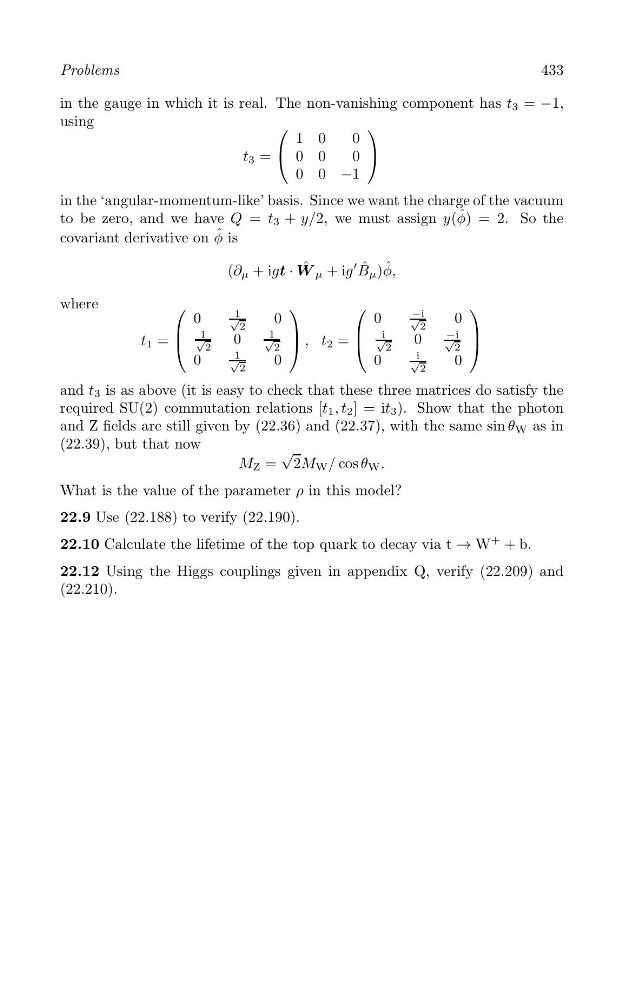
in the gauge in which it is real. The non-vanishing component has t 3 = −1,
using
(
)
1 0
0
t 3 = ( 0 0
0 )
0 0 −1
in the ‘angular-momentum-like’ basis. Since we want the charge of the vacuum
ˆ
to be zero, and we have Q = t 3 + y/2, we must assign y(φ) = 2. So the
ˆ
covariant derivative on φ is
(∂ μ + igt · ˆ
W μ + ig
′ ˆ ˆ
B μ )φ,
where
(
)
(
)
0
√ 1
0
0
−i
|
2
√
0
2
( √ 1
0
1 |
|
|
t 1 =
√ )
i
i
, t 2 =
2
( √
0
−
2
2
√
2 )
0
√ 1
0
0
√ i
0
2
2
and t 3 is as above (it is easy to check that these three matrices do satisfy the
required SU(2) commutation relations [t 1 , t 2 ] = it 3 ). Show that the photon
and Z fields are still given by (22.36) and (22.37), with the same sin θ W as in
(22.39), but that now
M Z =
√
2M W / cos θ W .
What is the value of the parameter ρ in this model?
22.9 Use (22.188) to verify (22.190).
22.10 Calculate the lifetime of the top quark to decay via t → W
+ + b.
22.12 Using the Higgs couplings given in appendix Q, verify (22.209) and
(22.210).