

404
22. The GSW Gauge Theory of Electroweak Interactions
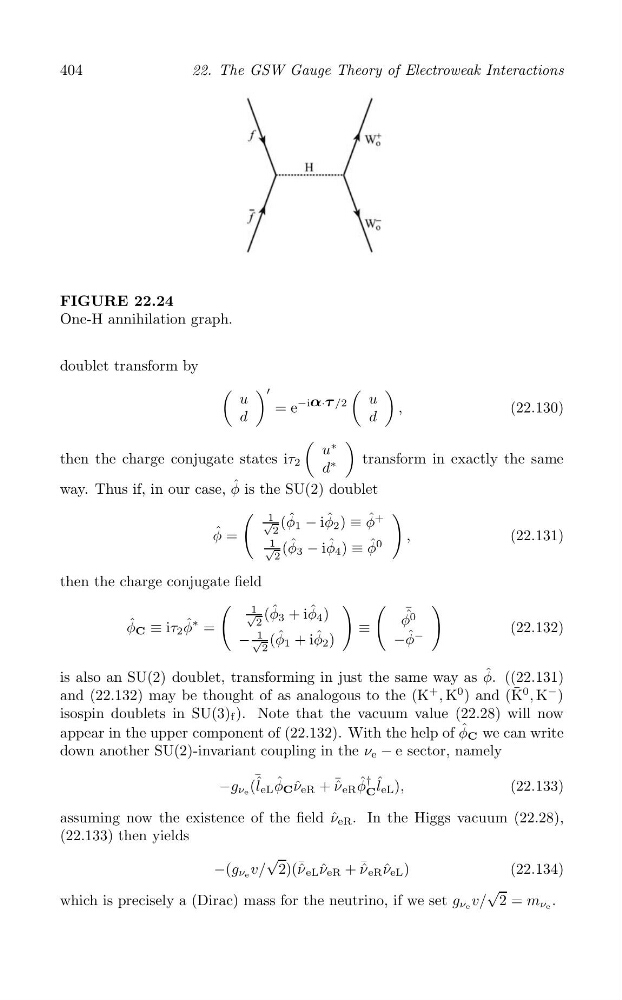
FIGURE 22.24
One-H annihilation graph.
doublet transform by
(
)
(
)
u
′
iα τ /2 u
= e
− ·
,
(22.130)
d
d
(
)
u
∗
then the charge conjugate states iτ 2
transform in exactly the same
d
∗
ˆ
way. Thus if, in our case, φ is the SU(2) doublet
(
)
1 ˆ
ˆ
ˆ
√ (φ
+
1
ˆ
− iφ 2 ) ≡ φ
φ =
2
,
(22.131)
√ 1 ˆ − ˆ ≡ ˆ
(φ
iφ
0
3
4 ) φ
2
then the charge conjugate field
(
) (
)
ˆ
√ 1
ˆ
(φ + iφ 4 )
¯
3
ˆ
φ 0
ˆ
φ C ≡
ˆ
iτ
2
2 φ
∗ =
(22.132)
− √ 1 ˆ
ˆ
ˆ
(φ 1 + iφ 2 )
≡
2
−φ
−
ˆ
is also an SU(2) doublet, transforming in just the same way as φ. ((22.131)
¯
and (22.132) may be thought of as analogous to the (K
+ , K
0 ) and (K
0 , K
− )
isospin doublets in SU(3) f ). Note that the vacuum value (22.28) will now
ˆ
appear in the upper component of (22.132). With the help of φ C we can write
down another SU(2)-invariant coupling in the ν e − e sector, namely
¯
−
ˆ ˆ
¯ ˆ
g νe (l eL φ C ν ˆ eR + ν ˆ eR φ
†
C
ˆ l eL ),
(22.133)
assuming now the existence of the field ν ˆ eR . In the Higgs vacuum (22.28),
(22.133) then yields
−
¯
¯
(g νe v/
√
2)(ν ˆ eL ν ˆ eR + ν ˆ eR ν ˆ eL )
(22.134)
which is precisely a (Dirac) mass for the neutrino, if we set g νe v/
√
2 = m νe .