

395
22.4. The discovery of the W
± and Z
0 at the CERN p¯ p collider
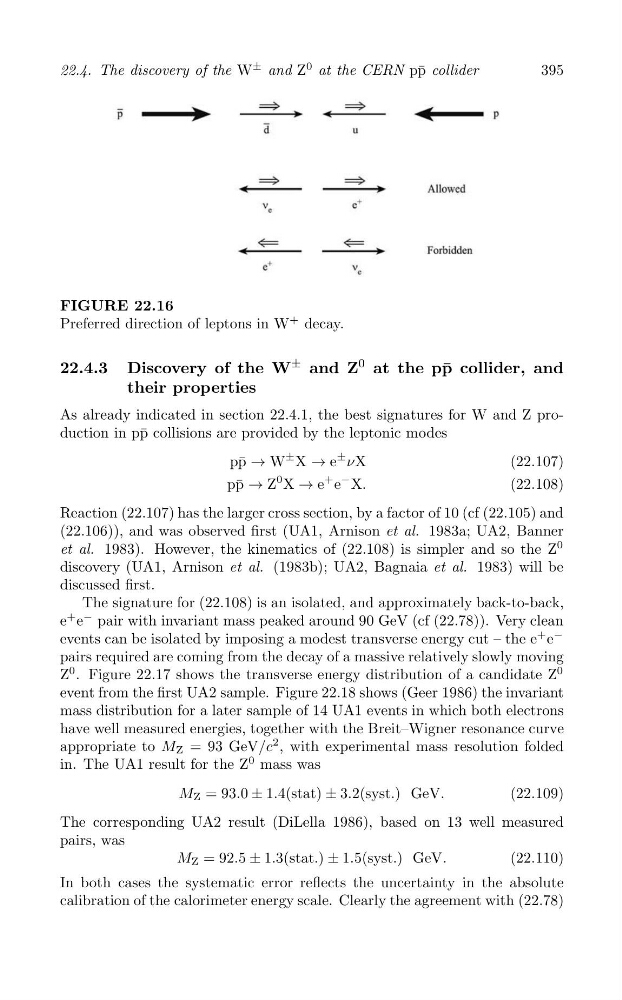
FIGURE 22.16
Preferred direction of leptons in W
+ decay.
22.4.3 Discovery of the W ± and Z 0 at the p¯ p collider, and
their properties
As already indicated in section 22.4.1, the best signatures for W and Z production in p¯ p collisions are provided by the leptonic modes
p¯ p → W
± X → e
± νX
(22.107)
+
p¯ p → Z
0 X → e e
− X.
(22.108)
Reaction (22.107) has the larger cross section, by a factor of 10 (cf (22.105) and
(22.106)), and was observed first (UA1, Arnison et al. 1983a; UA2, Banner
et al. 1983). However, the kinematics of (22.108) is simpler and so the Z
0
discovery (UA1, Arnison et al. (1983b); UA2, Bagnaia et al. 1983) will be
discussed first.
The signature for (22.108) is an isolated, and approximately back-to-back,
+
e e
− pair with invariant mass peaked around 90 GeV (cf (22.78)). Very clean
events can be isolated by imposing a modest transverse energy cut – the e
+ e
−
pairs required are coming from the decay of a massive relatively slowly moving
Z
0 . Figure 22.17 shows the transverse energy distribution of a candidate Z
0
event from the first UA2 sample. Figure 22.18 shows (Geer 1986) the invariant
mass distribution for a later sample of 14 UA1 events in which both electrons
have well measured energies, together with the Breit–Wigner resonance curve
appropriate to M Z = 93 GeV/c
2 , with experimental mass resolution folded
in. The UA1 result for the Z
0 mass was
M Z = 93.0 ± 1.4(stat) ± 3.2(syst.) GeV.
(22.109)
The corresponding UA2 result (DiLella 1986), based on 13 well measured
pairs, was
M Z = 92.5 ± 1.3(stat.) ± 1.5(syst.) GeV.
(22.110)
In both cases the systematic error reflects the uncertainty in the absolute
calibration of the calorimeter energy scale. Clearly the agreement with (22.78)