

70
3. Relativistic Quantum Mechanics
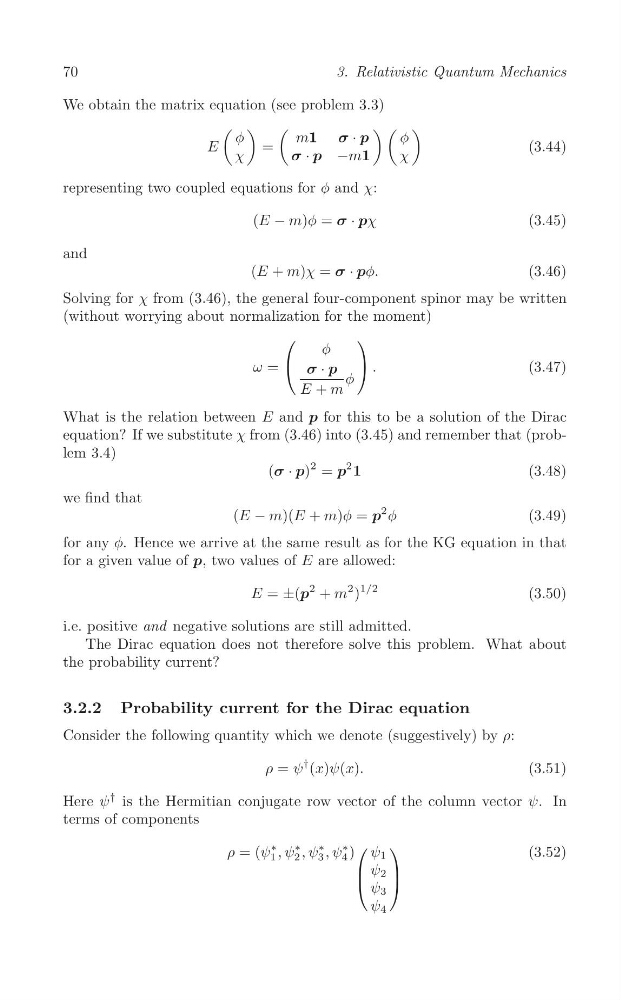
We obtain the matrix equation (see problem 3.3)
( ) (
) ( )
φ
m1 σ · p
φ
E
=
(3.44)
χ
σ · p −m1
χ
representing two coupled equations for φ and χ:
(E − m)φ = σ · pχ
(3.45)
and
(E + m)χ = σ · pφ.
(3.46)
Solving for χ from (3.46), the general four-component spinor may be written
(without worrying about normalization for the moment)
(
)
φ
ω =
σ · p
.
(3.47)
(
)
φ
E + m
What is the relation between E and p for this to be a solution of the Dirac
equation? If we substitute χ from (3.46) into (3.45) and remember that (problem 3.4)
(σ · p)
2 = p
2 1
(3.48)
we find that
(E − m)(E + m)φ = p
2 φ
(3.49)
for any φ. Hence we arrive at the same result as for the KG equation in that
for a given value of p, two values of E are allowed:
2
2 )
1/2
E = ±(p + m
(3.50)
i.e. positive and negative solutions are still admitted.
The Dirac equation does not therefore solve this problem. What about
the probability current?
3.2.2 Probability current for the Dirac equation
Consider the following quantity which we denote (suggestively) by ρ:
ρ = ψ
† (x)ψ(x).
(3.51)
Here ψ
† is the Hermitian conjugate row vector of the column vector ψ. In
terms of components
ρ = (ψ 1
∗ , ψ 2
∗ , ψ 3
∗ , ψ 4
∗ )
( ψ 1
)
(3.52)
| ψ 2 |
( )
ψ 3
ψ 4
3. Relativistic Quantum Mechanics
We obtain the matrix equation (see problem 3.3)
( ) (
) ( )
φ
m1 σ · p
φ
E
=
(3.44)
χ
σ · p −m1
χ
representing two coupled equations for φ and χ:
(E − m)φ = σ · pχ
(3.45)
and
(E + m)χ = σ · pφ.
(3.46)
Solving for χ from (3.46), the general four-component spinor may be written
(without worrying about normalization for the moment)
(
)
φ
ω =
σ · p
.
(3.47)
(
)
φ
E + m
What is the relation between E and p for this to be a solution of the Dirac
equation? If we substitute χ from (3.46) into (3.45) and remember that (problem 3.4)
(σ · p)
2 = p
2 1
(3.48)
we find that
(E − m)(E + m)φ = p
2 φ
(3.49)
for any φ. Hence we arrive at the same result as for the KG equation in that
for a given value of p, two values of E are allowed:
2
2 )
1/2
E = ±(p + m
(3.50)
i.e. positive and negative solutions are still admitted.
The Dirac equation does not therefore solve this problem. What about
the probability current?
3.2.2 Probability current for the Dirac equation
Consider the following quantity which we denote (suggestively) by ρ:
ρ = ψ
† (x)ψ(x).
(3.51)
Here ψ
† is the Hermitian conjugate row vector of the column vector ψ. In
terms of components
ρ = (ψ 1
∗ , ψ 2
∗ , ψ 3
∗ , ψ 4
∗ )
( ψ 1
)
(3.52)
| ψ 2 |
( )
ψ 3
ψ 4