

22.2. The SU(2) × U(1) electroweak gauge theory
379
where e ˆ L =
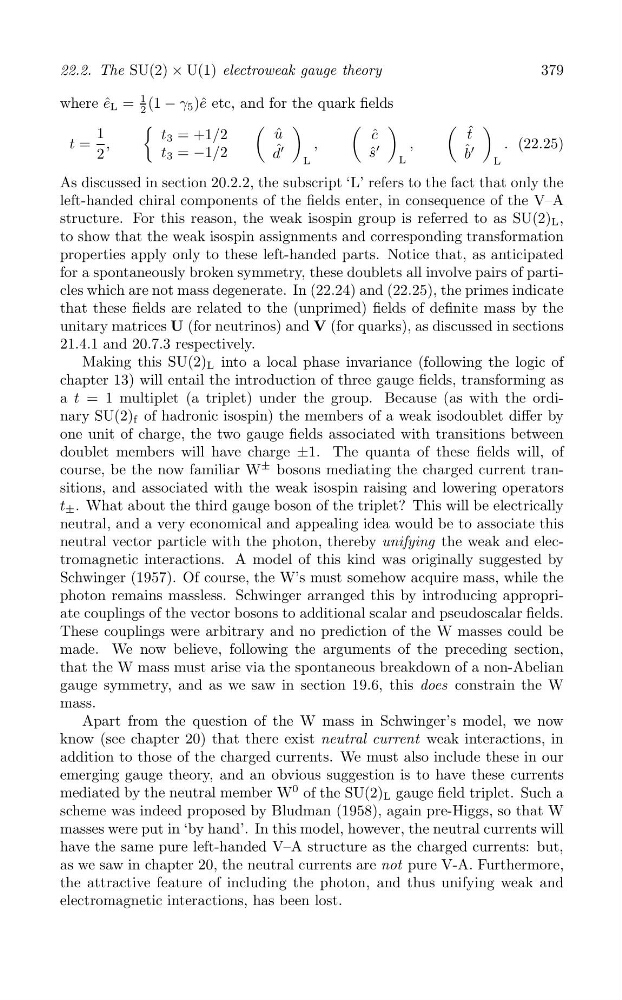
1 (1 − γ 5 )ˆ e etc, and for the quark fields
2
(
(
)
(
)
(
)
1
t
t
t = ,
3 = +1/2
u ˆ
c ˆ
ˆ
,
,
. (22.25)
t 3 = − /2
ˆ
2
1
d
′
s ˆ
′
ˆ
L
b
L
′
L
As discussed in section 20.2.2, the subscript ‘L’ refers to the fact that only the
left-handed chiral components of the fields enter, in consequence of the V–A
structure. For this reason, the weak isospin group is referred to as SU(2) L ,
to show that the weak isospin assignments and corresponding transformation
properties apply only to these left-handed parts. Notice that, as anticipated
for a spontaneously broken symmetry, these doublets all involve pairs of particles which are not mass degenerate. In (22.24) and (22.25), the primes indicate
that these fields are related to the (unprimed) fields of definite mass by the
unitary matrices U (for neutrinos) and V (for quarks), as discussed in sections
21.4.1 and 20.7.3 respectively.
Making this SU(2) L into a local phase invariance (following the logic of
chapter 13) will entail the introduction of three gauge fields, transforming as
a t = 1 multiplet (a triplet) under the group. Because (as with the ordinary SU(2) f of hadronic isospin) the members of a weak isodoublet differ by
one unit of charge, the two gauge fields associated with transitions between
doublet members will have charge ±1. The quanta of these fields will, of
course, be the now familiar W
± bosons mediating the charged current transitions, and associated with the weak isospin raising and lowering operators
t . What about the third gauge boson of the triplet? This will be electrically
±
neutral, and a very economical and appealing idea would be to associate this
neutral vector particle with the photon, thereby unifying the weak and electromagnetic interactions. A model of this kind was originally suggested by
Schwinger (1957). Of course, the W’s must somehow acquire mass, while the
photon remains massless. Schwinger arranged this by introducing appropriate couplings of the vector bosons to additional scalar and pseudoscalar fields.
These couplings were arbitrary and no prediction of the W masses could be
made. We now believe, following the arguments of the preceding section,
that the W mass must arise via the spontaneous breakdown of a non-Abelian
gauge symmetry, and as we saw in section 19.6, this does constrain the W
mass.
Apart from the question of the W mass in Schwinger’s model, we now
know (see chapter 20) that there exist neutral current weak interactions, in
addition to those of the charged currents. We must also include these in our
emerging gauge theory, and an obvious suggestion is to have these currents
mediated by the neutral member W
0 of the SU(2) L gauge field triplet. Such a
scheme was indeed proposed by Bludman (1958), again pre-Higgs, so that W
masses were put in ‘by hand’. In this model, however, the neutral currents will
have the same pure left-handed V–A structure as the charged currents: but,
as we saw in chapter 20, the neutral currents are not pure V-A. Furthermore,
the attractive feature of including the photon, and thus unifying weak and
electromagnetic interactions, has been lost.