

368
22. The GSW Gauge Theory of Electroweak Interactions
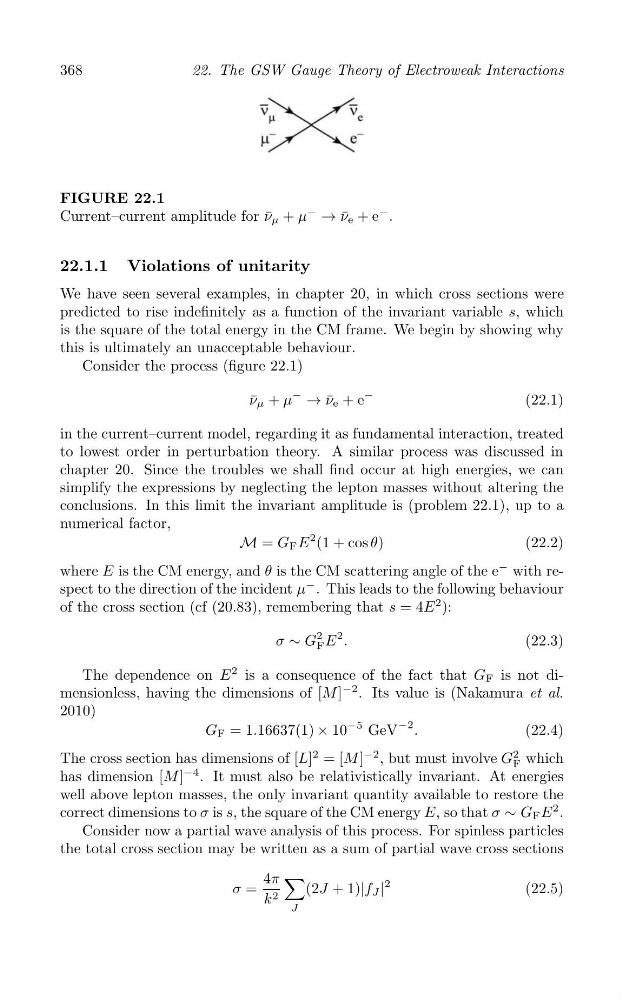
FIGURE 22.1
Current–current amplitude for ¯
ν μ + μ
−
→ ν ¯ e + e
− .
22.1.1 Violations of unitarity
We have seen several examples, in chapter 20, in which cross sections were
predicted to rise indefinitely as a function of the invariant variable s, which
is the square of the total energy in the CM frame. We begin by showing why
this is ultimately an unacceptable behaviour.
Consider the process (figure 22.1)
−
ν ¯ μ + μ
−
→ ν ¯ e + e
(22.1)
in the current–current model, regarding it as fundamental interaction, treated
to lowest order in perturbation theory. A similar process was discussed in
chapter 20. Since the troubles we shall find occur at high energies, we can
simplify the expressions by neglecting the lepton masses without altering the
conclusions. In this limit the invariant amplitude is (problem 22.1), up to a
numerical factor,
M = G F E
2 (1 + cos θ)
(22.2)
where E is the CM energy, and θ is the CM scattering angle of the e
− with respect to the direction of the incident μ
− . This leads to the following behaviour
of the cross section (cf (20.83), remembering that s = 4E
2 ):
σ ∼ G
2
F E
2 .
(22.3)
The dependence on E
2 is a consequence of the fact that G F is not dimensionless, having the dimensions of [M ]
−2 . Its value is (Nakamura et al.
2010)
G F = 1.16637(1) × 10
−5 GeV
−2 .
(22.4)
The cross section has dimensions of [L]
2 = [M ]
−2 , but must involve G
2 which
F
has dimension [M ]
−4 . It must also be relativistically invariant. At energies
well above lepton masses, the only invariant quantity available to restore the
correct dimensions to σ is s, the square of the CM energy E, so that σ ∼ G F E
2 .
Consider now a partial wave analysis of this process. For spinless particles
the total cross section may be written as a sum of partial wave cross sections
∑
4π
σ =
(2J + 1)|f J |
2
(22.5)
k 2
J