

359
21.4. Neutrino mixing and oscillations
We begin with the CHOOZ experiment, which was the first experiment to
limit the value of θ e3 (Apollonio et al. 1999, 2003). CHOOZ is the name of
a nuclear power station situated near the French village of the same name.
The experiment was designed to detect reactor ¯
ν e s via the inverse β-decay
+
reaction ¯
ν e + p → e + n. The signature was a delayed coincidence between
the prompt e
+ signal, and the signal from the neutron capture. The detector was located in an underground laboratory about 1 km from the neutrino
source. It consisted of a central 5-ton target filled with 0.09 % Gd-doped
liquid scintillator; Gd-doping was chosen to maximize the capture of the neutrons. The neutrino energy E was a few MeV, and L was 1 km. For these
values 2λ 21 (E) is greater than about 10 km, while 2λ 31 (E) is about 0.3 km.
The neglect of sin
2 L/2λ 21 (E) is justified, and formula (21.127) can be used
for the ¯
ν e survival probability. The experiment found no evidence for ¯
ν e disappearance, and reported the 90% CL upper limit of sin
2 2θ e3 < 0.19, for
2
|Δm 31 | = 2 × 10
−3 eV
2 . We shall for the moment set θ e3 to zero, and return
to discuss its value at the end of the chapter.
2
The mass squared range Δm > 2×10
−3 eV
2 can be explored by acceleratorbased long-baseline experiments, with typically E ∼ 1 GeV and L ∼ several hundred kilometres. The K2K (KEK-to-Kamioka) experiment was the
first accelerator-based experiment with a neutrino path length extending hundreds of kilometres. A horn-focused wide-band ν μ beam with mean energy
1.3 GeV and path length 250 km was produced by 12 GeV protons from
the KEK-PS and directed to the Super-Kamiokande detector. In this case,
L/2λ 21 (E) ∼ 10
−2 , which may be neglected. Then formulae (21.128) and
(21.129) may be used, in the approximation U e3 ≈ 0. The K2K data showed
2
(Ahn et al. 2006) that sin
2 2θ μ3 ≈ 1(θ μ3 ≈ π/4), and that |Δm 31 | had a value
consistent with (21.125).
The first evidence for the appearance of ν e in a ν μ beam was obtained by
the T2K collaboration (Abe et al. 2011). The ν μ beam is produced using
the high intensity proton accelerator at J-PARC, located in Tokai, Japan.
The beam was directed 2.5
◦ off-axis to the Super-Kamiokande detector at
Kamioka, 295 km away. This configuration produces a narrow-band ν μ beam,
2
tuned at the first oscillation maximum E ν = |Δm |L/2π ≈ 0.6 MeV, so
31
as to reduce background from higher energy neutrino interactions. In the
vacuum, the probability of the appearance of a ν e in a ν μ beam is given (in
our customary effective 2-state mixing approximation) by (21.126) as
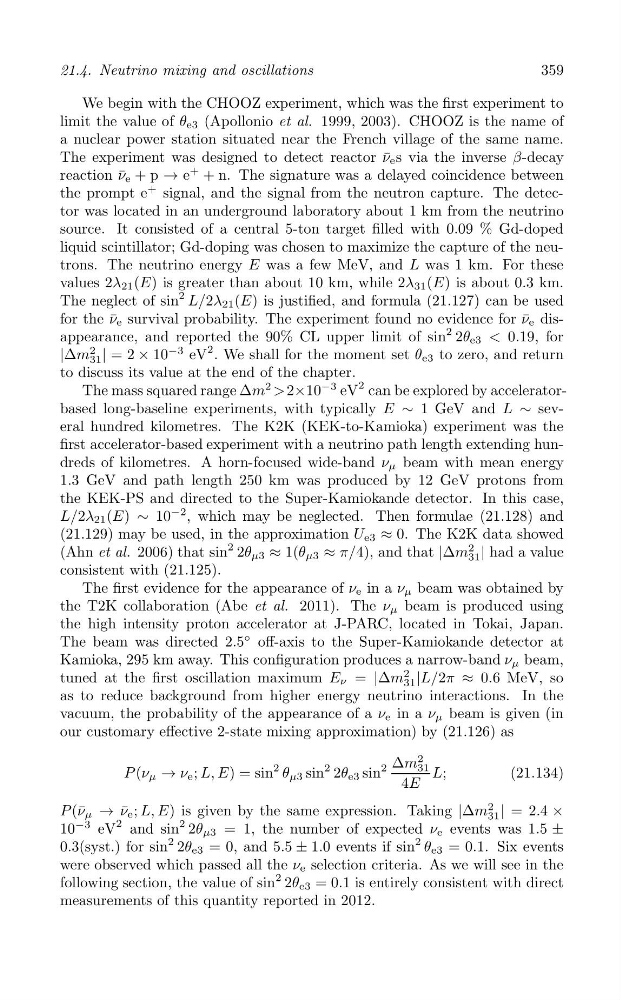
2
31
P (ν μ → ν e ; L, E) = sin
2 θ μ3 sin
2 2θ e3 sin
2 Δm L;
(21.134)
4E
2
P (¯ ν μ → ν ¯ e ; L, E) is given by the same expression. Taking |Δm 31 | = 2.4 ×
10
−3 eV
2 and sin
2 2θ μ3 = 1, the number of expected ν e events was 1.5 ±
0.3(syst.) for sin
2 2θ e3 = 0, and 5.5 ± 1.0 events if sin
2 θ e3 = 0.1. Six events
were observed which passed all the ν e selection criteria. As we will see in the
following section, the value of sin
2 2θ e3 = 0.1 is entirely consistent with direct
measurements of this quantity reported in 2012.