

350
21. CP Violation and Oscillation Phenomena
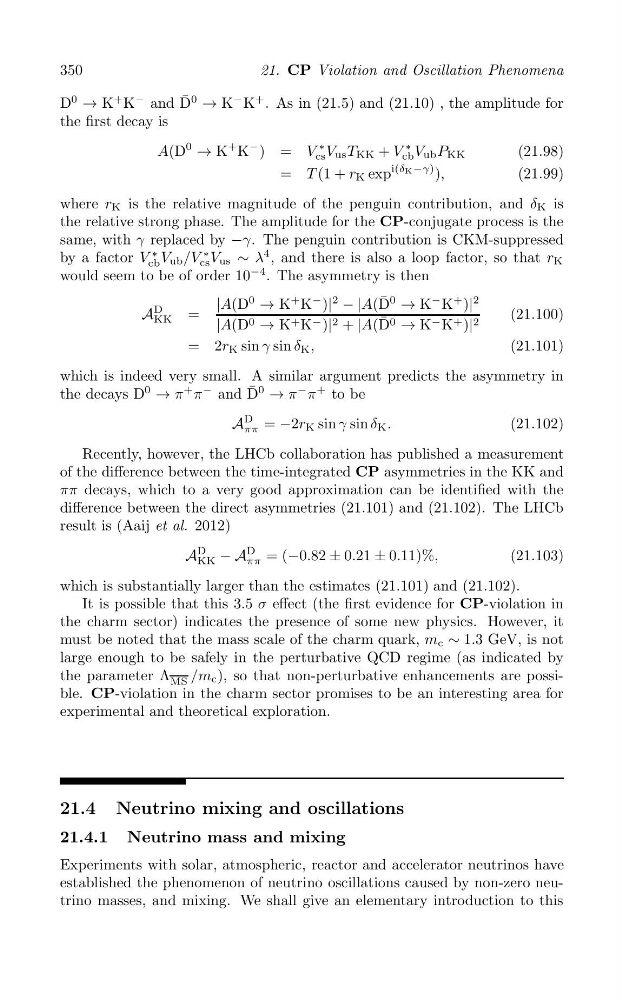
D
0
→ K
+ K
− and D ¯ 0 → K
− K
+ . As in (21.5) and (21.10) , the amplitude for
the first decay is
∗
∗
A(D
0
→ K
+ K
− ) = V V us T KK + V cb V ub P KK
(21.98)
cs
i(δK −γ) ),
= T (1 + r K exp
(21.99)
where r K is the relative magnitude of the penguin contribution, and δ K is
the relative strong phase. The amplitude for the CP-conjugate process is the
same, with γ replaced by −γ. The penguin contribution is CKM-suppressed
∗
∗
by a factor V V ub /V cs V us ∼ λ
4 , and there is also a loop factor, so that r K
cb
would seem to be of order 10
−4 . The asymmetry is then
2
|A(D
0
→ K
+ K
− )|
2
− |A(D ¯ 0 → K
− K
+ )|
D
A
=
(21.100)
KK
2
|A(D 0 → K + K − )| 2 + |A(D ¯ 0 → K − K + )|
= 2r K sin γ sin δ K ,
(21.101)
which is indeed very small. A similar argument predicts the asymmetry in
the decays D
0
→ π
+ π
− and D ¯ 0 → π
− π
+ to be
D
A = −2r K sin γ sin δ K .
(21.102)
ππ
Recently, however, the LHCb collaboration has published a measurement
of the difference between the time-integrated CP asymmetries in the KK and
ππ decays, which to a very good approximation can be identified with the
difference between the direct asymmetries (21.101) and (21.102). The LHCb
result is (Aaij et al. 2012)
D
D
A KK − A ππ = (−0.82 ± 0.21 ± 0.11)%,
(21.103)
which is substantially larger than the estimates (21.101) and (21.102).
It is possible that this 3.5 σ effect (the first evidence for CP-violation in
the charm sector) indicates the presence of some new physics. However, it
must be noted that the mass scale of the charm quark, m c ∼ 1.3 GeV, is not
large enough to be safely in the perturbative QCD regime (as indicated by
the parameter Λ /m c ), so that non-perturbative enhancements are possiMS
ble. CP-violation in the charm sector promises to be an interesting area for
experimental and theoretical exploration.
21.4 Neutrino mixing and oscillations
21.4.1 Neutrino mass and mixing
Experiments with solar, atmospheric, reactor and accelerator neutrinos have
established the phenomenon of neutrino oscillations caused by non-zero neutrino masses, and mixing. We shall give an elementary introduction to this