

21.2. CP violation in B meson oscillations
337
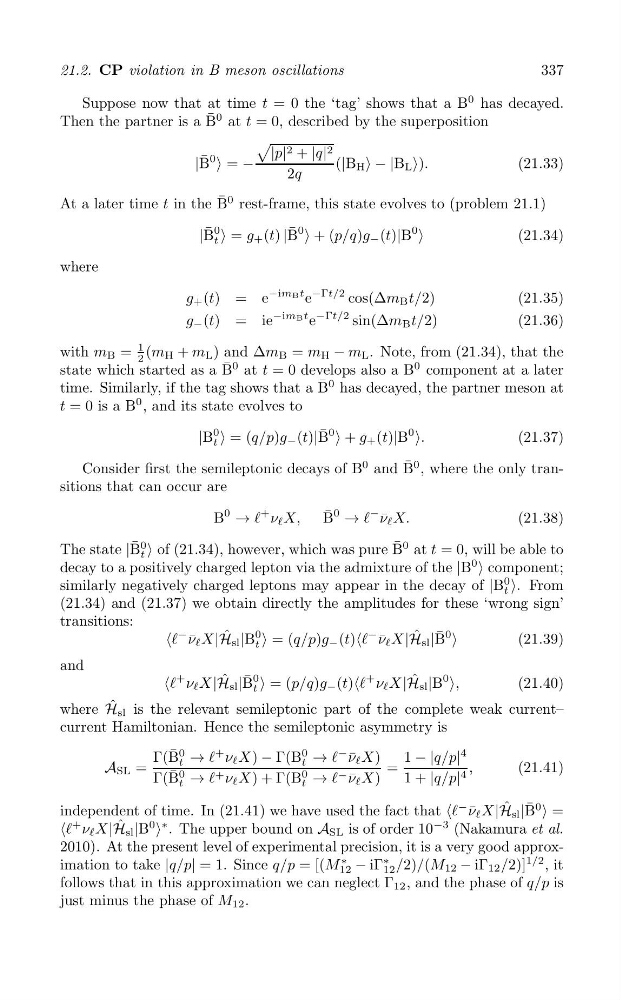
Suppose now that at time t = 0 the ‘tag’ shows that a B
0 has decayed.
¯
Then the partner is a B
0 at t = 0, described by the superposition
√
| ¯
B
0
› =
|p| 2 + |q| 2
−
( B
2q
| H › − |B L ›).
(21.33)
¯
At a later time t in the B
0 rest-frame, this state evolves to (problem 21.1)
| ¯
B
0
t ›
¯
= g + (t) |B
0
› + (p/q)g (t)
−
|B
0
›
(21.34)
where
g (t) = e
−imBt
Γ
+
e
− t/2 cos(Δm B t/2)
(21.35)
g (t) = ie
−imBt e
−Γt/2 sin(Δm
−
B t/2)
(21.36)
with m B =
1 (m H + m L ) and Δm B = m H − m L . Note, from (21.34), that the
2
¯
state which started as a B
0 at t = 0 develops also a B
0 component at a later
¯
time. Similarly, if the tag shows that a B
0 has decayed, the partner meson at
t = 0 is a B
0 , and its state evolves to
|
¯
B
0
t › = (q/p)g (t)
−
|B
0
› + g + (t)|B
0
›.
(21.37)
¯
Consider first the semileptonic decays of B
0 and B
0 , where the only transitions that can occur are
0
→
+
¯
B
e ν e X,
B
0
→ e
− ν ¯ e X.
(21.38)
The state | ¯
B
0
t ›
¯
of (21.34), however, which was pure B
0 at t = 0, will be able to
decay to a positively charged lepton via the admixture of the |B
0
› component;
similarly negatively charged leptons may appear in the decay of |B
0
t ›. From
(21.34) and (21.37) we obtain directly the amplitudes for these ‘wrong sign’
transitions:
‹e
− ν ¯ e X|H ˆ sl |B
0
t › = (q/p)g (t)‹e
−
H ˆ
ν ¯
−
e X| sl | ¯
B
0
›
(21.39)
and
‹e
+ ν e X|H ˆ sl | ¯
B
0
t ›
H ˆ
= (p/q)g (t)
−
‹e
+ ν e X|
0
sl |B ›,
(21.40)
ˆ
where H sl is the relevant semileptonic part of the complete weak current–
current Hamiltonian. Hence the semileptonic asymmetry is
¯
Γ(B
0
t → e
+ ν e X) − Γ(B
0
t → e
− ν ¯ e X)
1
q/p
SL =
|
4
=
¯
Γ(B 0
t → e + ν e X) + Γ(B 0
− |
A
,
(21.41)
t → e − ν ¯ X)
1 + |q/p| 4
e
ˆ ¯
independent of time. In (21.41) we have used the fact that ‹e
− ν ¯ e X|H sl |B
0
› =
‹e
+ ν e X|H ˆ sl |B
0
›
∗ . The upper bound on A SL is of order 10
−3 (Nakamura et al.
2010). At the present level of experimental precision, it is a very good approximation to take |q/p| = 1. Since q/p = [(M
∗
− iΓ
∗ /2)/(M − iΓ /2)]
1/2
12
12
12
12
, it
follows that in this approximation we can neglect Γ 12 , and the phase of q/p is
just minus the phase of M 12 .