

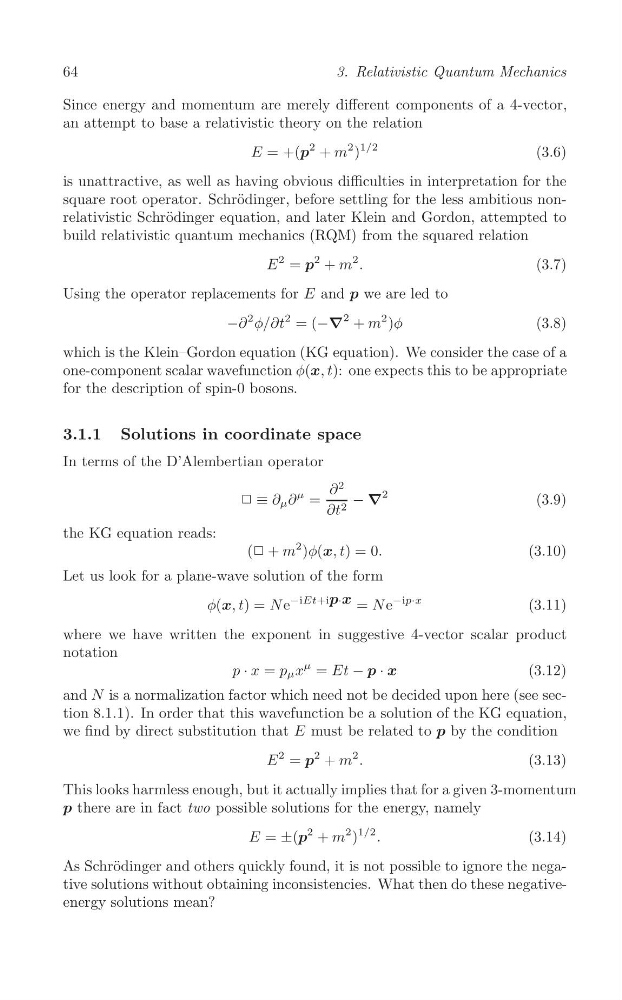
64
3. Relativistic Quantum Mechanics
Since energy and momentum are merely different components of a 4-vector,
an attempt to base a relativistic theory on the relation
2
2 )
1/2
E = +(p + m
(3.6)
is unattractive, as well as having obvious difficulties in interpretation for the
square root operator. Schr¨ odinger, before settling for the less ambitious nonrelativistic Schr¨ odinger equation, and later Klein and Gordon, attempted to
build relativistic quantum mechanics (RQM) from the squared relation
2
2
E
2 = p + m .
(3.7)
Using the operator replacements for E and p we are led to
−∂
2 φ/∂t
2 = (−∇
2 + m
2 )φ
(3.8)
which is the Klein–Gordon equation (KG equation). We consider the case of a
one-component scalar wavefunction φ(x, t): one expects this to be appropriate
for the description of spin-0 bosons.
3.1.1 Solutions in coordinate space
In terms of the D’Alembertian operator
∂
2
❗ ≡ ∂ μ ∂
μ =
− ∇
2
(3.9)
∂t 2
the KG equation reads:
(❗ + m
2 )φ(x, t) = 0.
(3.10)
Let us look for a plane-wave solution of the form
−iEt+ip·x
−ip·x
φ(x, t) = N e
= N e
(3.11)
where we have written the exponent in suggestive 4-vector scalar product
notation
μ
p · x = p μ x = Et − p · x
(3.12)
and N is a normalization factor which need not be decided upon here (see section 8.1.1). In order that this wavefunction be a solution of the KG equation,
we find by direct substitution that E must be related to p by the condition
2
2
E
2 = p + m .
(3.13)
This looks harmless enough, but it actually implies that for a given 3-momentum
p there are in fact two possible solutions for the energy, namely
2
2 )
1/2
E = ±(p + m
.
(3.14)
As Schr¨ odinger and others quickly found, it is not possible to ignore the negative solutions without obtaining inconsistencies. What then do these negativeenergy solutions mean?
3. Relativistic Quantum Mechanics
Since energy and momentum are merely different components of a 4-vector,
an attempt to base a relativistic theory on the relation
2
2 )
1/2
E = +(p + m
(3.6)
is unattractive, as well as having obvious difficulties in interpretation for the
square root operator. Schr¨ odinger, before settling for the less ambitious nonrelativistic Schr¨ odinger equation, and later Klein and Gordon, attempted to
build relativistic quantum mechanics (RQM) from the squared relation
2
2
E
2 = p + m .
(3.7)
Using the operator replacements for E and p we are led to
−∂
2 φ/∂t
2 = (−∇
2 + m
2 )φ
(3.8)
which is the Klein–Gordon equation (KG equation). We consider the case of a
one-component scalar wavefunction φ(x, t): one expects this to be appropriate
for the description of spin-0 bosons.
3.1.1 Solutions in coordinate space
In terms of the D’Alembertian operator
∂
2
❗ ≡ ∂ μ ∂
μ =
− ∇
2
(3.9)
∂t 2
the KG equation reads:
(❗ + m
2 )φ(x, t) = 0.
(3.10)
Let us look for a plane-wave solution of the form
−iEt+ip·x
−ip·x
φ(x, t) = N e
= N e
(3.11)
where we have written the exponent in suggestive 4-vector scalar product
notation
μ
p · x = p μ x = Et − p · x
(3.12)
and N is a normalization factor which need not be decided upon here (see section 8.1.1). In order that this wavefunction be a solution of the KG equation,
we find by direct substitution that E must be related to p by the condition
2
2
E
2 = p + m .
(3.13)
This looks harmless enough, but it actually implies that for a given 3-momentum
p there are in fact two possible solutions for the energy, namely
2
2 )
1/2
E = ±(p + m
.
(3.14)
As Schr¨ odinger and others quickly found, it is not possible to ignore the negative solutions without obtaining inconsistencies. What then do these negativeenergy solutions mean?