

20.7. Quark weak currents
319
strangeness-changing transitions, as we saw after (20.106). But this could
just as well be achieved if the matrix was unitary. Now a general 2 × 2 matrix
has 8 real parameters; unitarity gives 2 real conditions from the diagonal elements of V CGIM V CGI
†
M = I, and one complex condition from the off-diagonal
elements, leaving four real parameters. If all the elements are taken to be
real from the beginning, the matrix becomes orthogonal, as in (20.164), and
ˆ
depends on only one real parameter, the ‘rotation’ in the 2-dimensional d − s ˆ
space. So in the general, unitary case, the matrix will have one real angle
parameter, and three phase parameters. But we have four quark fields whose
phases we can adjust. In fact, since only phase differences enter, we really only
have three free phases at our disposal, but that is just enough to transform
away the three phases in the unitary version of V CGIM , leaving it in the real
orthogonal form (20.164). Kobayashi and Maskawa therefore concluded that
the 2-generation GIM-type theory could not accommodate CP-violation.
In a step which may seem natural now but was very bold in 1972, they
decided to see if there was room for CP-violation in a 3-generation model.
(Remember that there was no sign of any third generation particles at that
time.) The matrix transforming from the mass basis to the weak basis is
now a 3 × 3 unitary matrix V, with 18 real parameters. There are three real
diagonal conditions from unitarity, and three complex off-diagonal conditions,
leaving 9 real parameters. If the elements of V are taken to be real, one has an
orthogonal (rotation) matrix, which can be parametrized by three real Euler
angles. That leaves 6 phase parameters in the general unitary V. We also
have 6 quark fields, with 5 phase differences which can be adjusted. Thus
just one irreducible phase degree of freedom can remain in V, after quark
rephasing. Consequently, the three-generation model naturally accommodates
CP-violation in the quark sector: this was the great discovery of Kobayashi
and Maskawa (1973). It was another four years before the existence of the b
quark was established, and more than twenty before the t quark was produced.
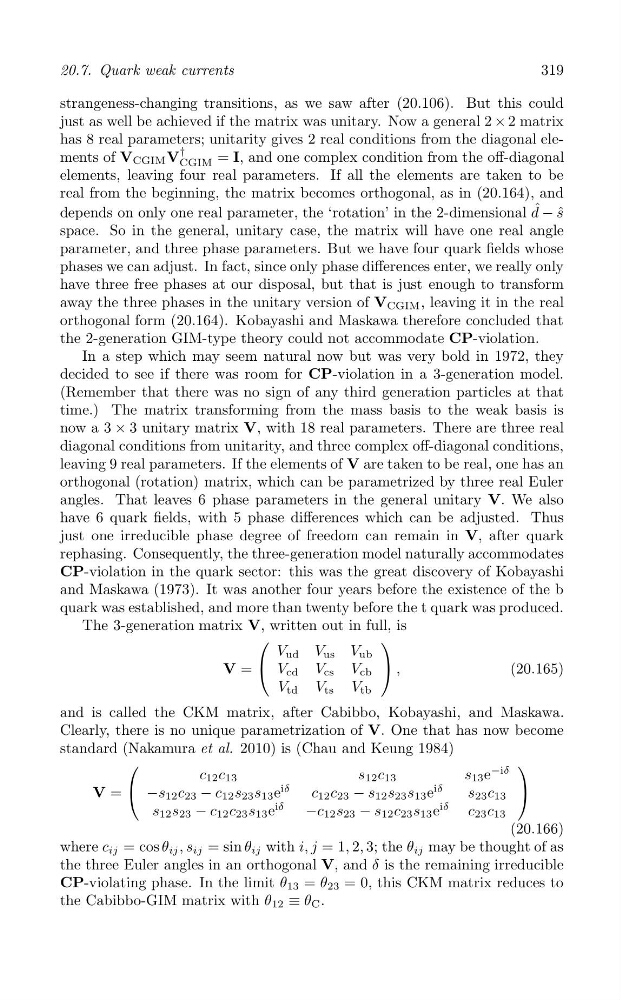
The 3-generation matrix V, written out in full, is
(
)
V ud V us V ub
V = ( V cd V cs V cb ) ,
(20.165)
V td V ts V tb
and is called the CKM matrix, after Cabibbo, Kobayashi, and Maskawa.
Clearly, there is no unique parametrization of V. One that has now become
standard (Nakamura et al. 2010) is (Chau and Keung 1984)
(
)
c 12 c
iδ
13
s 12 c 13
s 13 e
−
V = ( −s c − c s s e
iδ
c
iδ
12 23
12 23 13
12 c 23 − s 12 s 23 s 13 e
s 23 c 13 )
s s 23 − c c 23 s 13 e
iδ
12
12
−c 12 s −
δ
23
s
i
12 c 23 s 13 e
c 23 c 13
(20.166)
where c ij = cos θ ij , s ij = sin θ ij with i, j = 1, 2, 3; the θ ij may be thought of as
the three Euler angles in an orthogonal V, and δ is the remaining irreducible
CP-violating phase. In the limit θ 13 = θ 23 = 0, this CKM matrix reduces to
the Cabibbo-GIM matrix with θ 12 ≡ θ C .