

317
20.7. Quark weak currents
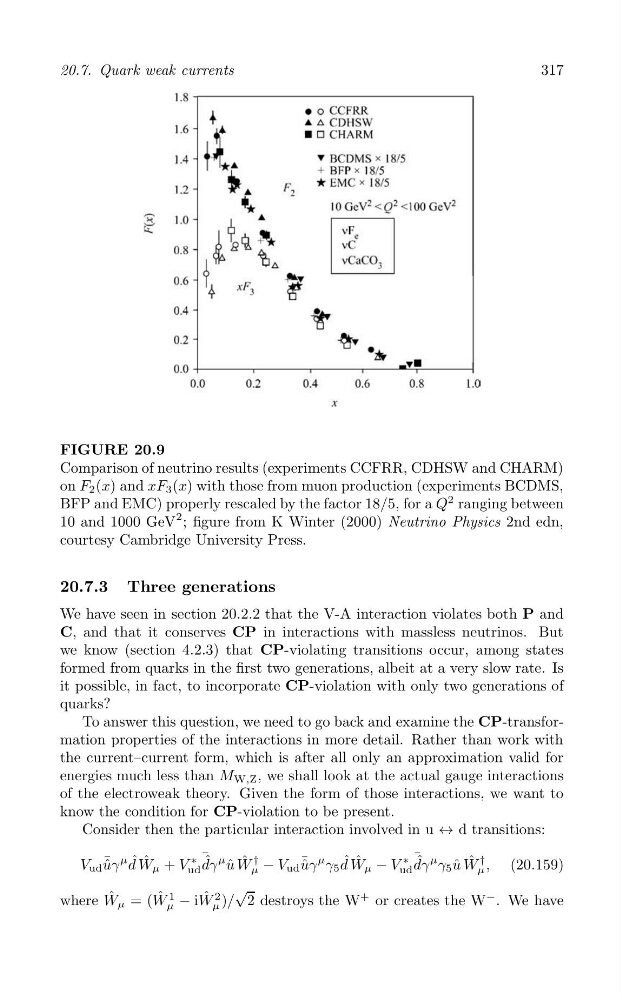
FIGURE 20.9
Comparison of neutrino results (experiments CCFRR, CDHSW and CHARM)
on F 2 (x) and xF 3 (x) with those from muon production (experiments BCDMS,
BFP and EMC) properly rescaled by the factor 18/5, for a Q
2 ranging between
10 and 1000 GeV
2 ; figure from K Winter (2000) Neutrino Physics 2nd edn,
courtesy Cambridge University Press.
20.7.3 Three generations
We have seen in section 20.2.2 that the V-A interaction violates both P and
C, and that it conserves CP in interactions with massless neutrinos. But
we know (section 4.2.3) that CP-violating transitions occur, among states
formed from quarks in the first two generations, albeit at a very slow rate. Is
it possible, in fact, to incorporate CP-violation with only two generations of
quarks?
To answer this question, we need to go back and examine the CP-transformation properties of the interactions in more detail. Rather than work with
the current–current form, which is after all only an approximation valid for
energies much less than M W,Z , we shall look at the actual gauge interactions
of the electroweak theory. Given the form of those interactions, we want to
know the condition for CP-violation to be present.
Consider then the particular interaction involved in u ↔ d transitions:
¯
¯
¯ d ˆ
∗ ˆ
W ˆ †
¯
d ˆ ˆ
∗ ˆ
W ˆ †
V ud ˆ
W μ + V ud dγ
μ ˆ μ − V ud ˆ
W μ − V ud dγ
μ γ 5 ˆ μ , (20.159)
uγ
μ ˆ
u
uγ
μ γ 5
u
√
where W ˆ μ = (W ˆ 1 − iW ˆ 2 )/ 2 destroys the W
+ or creates the W
− . We have
μ
μ